

40 Animal Coloring Pages: Easy Cartoons to Detailed Wildlife
Forty animal coloring pages, sorted by animal so you can find the one you want without scrolling past twenty others. Some are thick-outlined cartoons a three-year-old can fill in with fat crayons; others are fine-line wildlife drawings that will keep an adult busy for an evening with a set of pencils. Each one below has a note on what makes it worth printing — the shape that is fun to colour, the detail that needs a sharp pencil, the trap that frustrates small hands.
If you want more of one animal in particular, the site has dedicated sets for 27 dog coloring pages, 32 bunny coloring pages, penguins and birds.
Wider outdoor scenes work differently from single-animal sheets — these nature coloring pages put the same animals into forests, waterfalls and savanna backgrounds, sorted by how heavy the linework is.
How to Pick the Right Page
Difficulty here has almost nothing to do with the animal and everything to do with line thickness and the number of enclosed shapes. A page with twelve big shapes is a toddler page. A page with four hundred small ones is an adult page wearing an animal costume.
- Ages 2–4: bold outlines, one animal, plenty of white space — numbers 1, 2, 11 and 25.
- Ages 5–8: cartoon animals with a background to fill in, like the fence in number 4 or the grass in number 32. Most of this list.
- Ages 9 and up: real fur texture and drawn anatomy — numbers 5, 21, 28 and 40.
- Adults: the dense ones — the leopard (19), the patterned zebra (31), the camel blanket (27) and the realistic lion (17).
Dogs and Puppies
Dogs are the most-printed animal on the site, and these ten cover the whole range from four-shape toddler pages to a realistic retriever with individually drawn coat strands.
1. Puppy With a Heart-Shaped Tag

The simplest page here and the one to start a small child on. The lines are thick enough to contain a crayon held in a fist, the eyes are solid black shapes that need no shading, and the whole dog is about eight enclosed areas. Nothing to get wrong.
The floppy ear is the one place to teach a first lesson in colour: make it one shade darker than the head and the ear suddenly reads as folding forward.
2. Grinning Puppy in the Grass

Same bold-outline family as the last one, but with a patch over one eye and a second patch on the back — two invitations to use a contrasting colour without anyone having to invent where the markings go.
The open mouth with the tongue showing is the bit children rush. Slow them down: pink tongue, darker pink or red at the back of the mouth, and the grin stops looking flat.
3. Two Puppies, One in a Cap

Two animals on one sheet means two colour schemes, which is more decision-making than it sounds like for a five-year-old. The cap is the useful part — an object that is definitely not fur, so it can be any colour at all without looking wrong.
Point out that the two dogs overlap. Colouring the front dog first, then the back one slightly darker, is the easiest way to explain depth to a child without saying the word.
4. Two Puppies by the Garden Fence

A busier sheet: picket fence, flowering bushes, foliage overhead. The dogs themselves stay simple, so the background carries the work.
The fence is the page’s gift — a run of identical vertical boards is the easiest place in the world to practise keeping a colour even across repeated shapes. Do the fence last, when the hand has warmed up.
5. Shaggy Terrier With a Name Tag

The fur here is drawn as hundreds of short overlapping strokes rather than a smooth outline, which changes how you colour it. Pressing a flat colour over the whole dog kills the texture.
Instead, colour lightly in the direction the strokes run, then go back over the shadowed side — under the chin, beneath the belly — with a second pass. Two passes of the same pencil will do more than two different colours.
6. Puppy in a Winter Hat and Scarf

A knitted hat and a wound scarf give you fabric next to fur, and fabric is where a coloured pencil can show off. The scarf folds around the neck; shade the underside of each fold and the wool starts to look soft.
Good page for a Christmas card. The hat is the only element that needs a bright colour — keep the dog muted and the hat pops.
7. Two Puppies at the Kennel Door

The wooden kennel is built from long parallel planks, and the perspective is genuinely drawn — the side wall recedes. That makes it a good page for an older child who is bored of flat cartoons.
Wood grain is worth the effort: a mid-brown base, then a darker brown dragged along the plank lines in a few places only. Shading every plank the same makes it look like plastic.
8. Puppy Riding a Scooter

Clothes, shoes, a scooter and a road — four non-fur surfaces in one page, which is unusual here. Children who always reach for brown get a reason not to.
The wheels are perfect circles seen straight on. Ask for one colour on the tyre and a different one in the hub; it is the fastest way to make a drawn object look like a made object.
9. Puppy With a Ball of Yarn
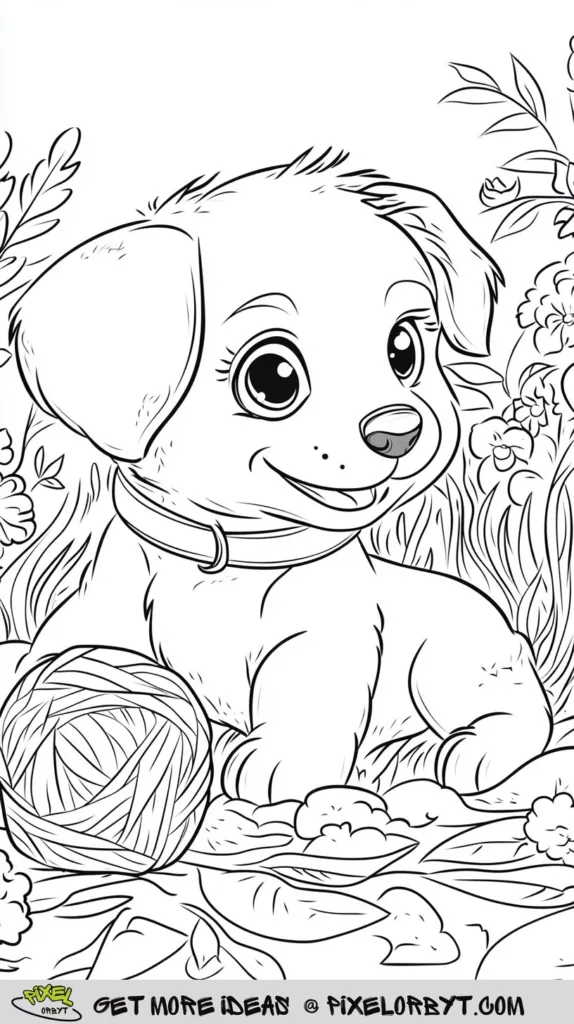
The yarn ball is wound with curved lines that all follow the sphere, and colouring along those curves instead of across them is the single clearest lesson in form on this whole page.
Do it once with straight back-and-forth strokes and once following the winding, side by side. The second one will look round and the first one will look like a flat circle.
10. Puppy Looking Up at a Grown Dog

The most restrained drawing in the set: no background at all, thin lines, two dogs and a suggestion of ground. It looks easy and is not.
With nothing to hide behind, every stroke shows. This is the one to hand to someone who wants to practise smooth, even shading — light layers, no hard edges, and let the paper stay white where the light hits the puppy’s back. If the coat itself is the interesting part, there are 56 dog sketching ideas with pencil references built for exactly that practice.
Cats and Kittens
Three house cats, deliberately different in style. If your household is more cat than dog, there are also 62 cat drawing ideas with sketching tips to draw from.
11. Smiling Cat With Closed Eyes

Chunky outlines, closed happy eyes, a scattering of falling leaves. The body is covered in small tick marks that suggest fur without demanding anything from the colourist.
Those tick marks are a decision point: leave them white and the cat looks tabby-striped, or colour straight over them and the cat looks solid. Both work. Try one of each.
12. Cat in Sunglasses and a Cap

The sunglasses are already filled solid black, which sets the contrast for the whole page — everything else can stay light and the cat will still read strongly.
The butterflies drifting past are small and fiddly, and they are the one place worth using a fine-tipped pen rather than a pencil. There is a whole set of butterfly coloring pages if the insects turn out to be the best part.
13. Two Kittens Climbing Into a Sneaker

A sneaker is a brilliant thing to put next to a cat: laces, eyelets, a rubber sole and a canvas upper are four textures, none of them fur.
Colour the shoe first and boldly. If the kittens go down first, the temptation is to keep the shoe pale and polite, and the joke of the page — two soft animals inside a hard object — goes flat.
Lions, Tigers and Wild Cats
Eight pages that run from a cartoon lion with a sun in the corner to a leopard rendered almost entirely in solid black rosettes. The gap in difficulty between the two ends of this section is the widest on the page.
14. Cartoon Lion Under the Sun

Standing full-body, friendly face, a sun and a couple of clouds — a starter lion. The mane is drawn as one big shape with a few dividing lines rather than hundreds of strands.
Encourage two golds: a lighter one on the body, a deeper one on the mane. The lion reads as a lion the moment those two values separate, and nothing else on the page matters as much.
15. Lion Cub With a Striped Mane

The cub’s mane is drawn as long parallel strands, which is a step up from the flat shape of the last page without being real fur yet.
Colour every second strand slightly darker. It takes two minutes, it is entirely mechanical, and it makes the mane look like it has depth.
16. Lion With Two Cubs

Three cats with three sizes of head, which makes this a quietly good page for teaching proportion: the cubs’ eyes are large relative to their skulls, the adult’s are small. That difference is what makes babies look like babies.
Keep the three animals close in colour and let the background do the contrast. Three differently coloured lions look like a mistake.
17. Realistic Lion in Tall Grass

This is the adult page of the section. The mane is hundreds of individual strands, the face carries whisker dots and fine muzzle lines, and the grass in front overlaps the body.
Work the mane in layers from the outside in, leaving the outer tips lightest. Overlapping grass blades should stay lighter than the lion behind them — that is what puts them in front. For pencil work in this register, see the realistic animal pencil drawing and sketching ideas.
18. Tiger Cub Sitting in the Leaves

The stripes are the whole page. They are drawn as open outlines, so you can either fill them solid black or colour them a deep brown-orange for a softer, younger-looking cub.
The trick is that the stripes bend around the body. Follow each stripe’s curve with the pencil rather than colouring straight across it, and the cub stops looking like a striped cardboard cut-out.
19. Leopard Portrait in Heavy Rosettes

The most graphically striking page here. Most of the leopard’s coat is already solid black, so your job is the small amount of paper left between the rosettes.
Resist filling those gaps with one flat yellow. A warm gold on the back, fading to cream down the chest, is what makes a big cat look rounded rather than printed.
20. Sitting Jaguar Cub

Same cat family, opposite approach: here the rosettes are drawn as open rings, so you colour inside them and the page stays light.
A rosette is not a dot — it is a broken ring with a darker centre. Colour the ring one shade and the middle a shade deeper, and the spots gain a dimension they never have when filled flat.
21. Lynx and Rabbit Side by Side

A wild cat and a rabbit sitting calmly together, both drawn realistically, both facing the same way. The ear tufts and cheek ruff on the lynx are the detail worth slowing down for.
Two animals with completely different coat lengths in one frame: short dense rabbit fur, long shaggy lynx fur. Vary the length of your pencil strokes to match and the difference will show without any change of colour.
Elephants, Hippos and Gentle Giants
Big animals with smooth skin instead of fur, which asks for a different approach: fewer strokes, more even pressure, and shadow that follows the bulk of the body.
22. Baby Elephant With Two Bunnies

Three animals, three sizes, one puddle. The elephant’s ears are the biggest clear shapes on the page and the easiest place to demonstrate that thin skin lets light through — keep the ear centres lighter than the head.
The bunnies are little more than rounded shapes with ears. Colour them last and keep them pale; they are supporting cast, and a bright bunny will steal the page from the elephant.
23. Baby Elephant at the Water’s Edge

Loose lines, plenty of open paper, water ripples at the feet. One of the gentlest pages in the collection.
The curled trunk is a cylinder bending toward you. Shade the underside of the curl and leave the top edge almost white; that single move is the difference between a trunk and a grey rope.
24. Elephant Calf in Dungarees

An elephant in dungarees gives you a whole garment to colour in something that is not grey, which children appreciate more than adults expect.
The foliage behind is dense and repetitive. Treat it as one mass with two greens rather than colouring every leaf individually, or the background will fight the elephant for attention.
25. Baby Elephant in the Jungle
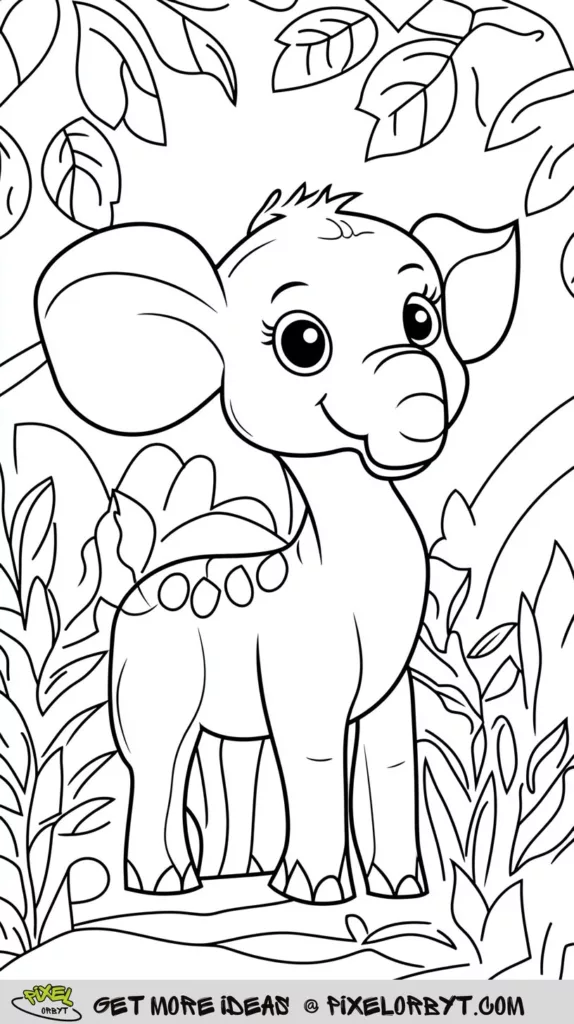
Clean outlines, a clear silhouette and leaves that frame rather than crowd. This is the most print-friendly elephant here for a group of children — everyone can finish it in a sitting.
The row of toenails on each foot is the only fine detail. Leave them white against a grey foot and the feet instantly look solid.
26. Smiling Baby Hippo

A hippo is a barrel with legs, which makes it ideal for learning smooth gradient shading — there is no fur texture to hide behind and no pattern to distract.
Darken the belly and the far side of the body, keep the top of the back light, and blend the middle. Smooth-skinned animals live or die on that gradient; the same problem shows up in the dolphin coloring pages.
27. Camel in a Decorated Saddle Blanket

The camel itself is simple. The saddle blanket is not — it is layered with borders, repeating motifs and a fringe of tassels, and it is easily the most intricate single object in this collection.
Pick three colours for the blanket and repeat them in a strict rotation across the borders. Improvising colour on a pattern this dense is how a page ends up muddy.
Horses, Zebras and Giraffes
Long legs, long necks and patterned coats. These are the pages where anatomy starts to matter, because a hoof drawn in the wrong place is obvious in a way a paw never is.
28. Horse in a Forest Clearing

Properly drawn horse anatomy — you can see the shoulder, the barrel and the hock as separate masses. Worth studying before colouring anything.
Shade along the muscle groups rather than across them: down the neck, around the shoulder, along the haunch. A horse coloured in flat brown loses everything the line artist put in.
29. Horse in Deep Woodland

Here the forest is the harder half. Trunks, bark texture, shrubs and ground cover fill three-quarters of the sheet.
Keep the woodland cool and slightly grey, and give the horse the only warm colour on the page. That one restraint will pull the animal forward out of the trees.
30. Mare and Foal in the Meadow

The foal’s legs are disproportionately long and its body short — that is accurate, and it is what makes a young horse look young.
A gentle, wide-open page. The hills behind are drawn as simple contour lines, so a pale wash of two greens is enough; save the detail for the two animals.
31. Zebra Against a Patterned Background

The background swirls are as busy as the zebra’s stripes, so the page is almost entirely line and almost no open space — a proper adult sheet.
Since the zebra is black and white by definition, put your colour in the background swirls and leave the animal monochrome. If patterned backgrounds appeal, the zentangle animal drawing ideas take the same idea further.
32. Zebra Foal Among the Grass

The cartoon counterpart to the last page: soft stripes, a spiky upright mane, butterflies drifting past.
Stripes on a young zebra get narrower down the legs. Follow the drawn spacing rather than making them even, and the legs will look like they taper.
33. Giraffe With a Small Companion

Huge eyes, soft rounded body, a smaller friend leaning in. Purely a comfort page, and a good one for a child who gets frustrated with detail.
The giraffe’s patches are drawn as large soft shapes, not the hard-edged tiles of a real giraffe. Two close browns, alternating, is all it needs.
34. Cartoon Giraffe in the Long Grass

Full body, all four legs visible, and the long neck running most of the height of the page — an easy win, because the tallest animal fills a portrait sheet naturally.
Work the patches from the top of the neck downward so your hand never rests on finished colour. It is the page most likely to get taped to a fridge, purely because of the shape.
Woodland and Farm Animals
The set closes in the forest and the field, with a mix of soft cartoon babies and a few sheets that ask for real fur work.
35. Three Cubs on a Fallen Log

Three cubs lined up behind a fallen log with leaves coming down around them — the most storybook page in the collection.
The falling leaves are scattered across open paper, which means they are the one element children can colour in any order without ruining anything. Good for a child who needs a warm-up before committing to the animals.
36. Fox Cub Among the Leaves

Dense layered foliage with the cub tucked into the middle of it. The temptation is to colour every leaf a different green; resist it.
Leaves in front of the fox should be darker than leaves behind. Get that one relationship right and the cub sits inside the bush instead of on top of it. Woodland fans will find the same trick in the deer coloring pages.
37. Kid Goat With Ridged Horns

The horns carry drawn ridges running across them, which is a proper texture detail on an otherwise clean page.
Colour the ridges as alternating bands of two closely related creams rather than one flat colour. The hooves are already dark, so let them stay the anchor at the bottom of the drawing.
38. Baby Goat in the Flowers

Dappled patches on the flank, small flowers at the feet, a tree arching overhead. Softer than the previous goat and better suited to younger children.
The flowers are the reward at the end — tiny, separate, and the only place on the page where a bright colour will not look out of place.
39. Panda Cub Sitting Up

Pandas are the easiest animal in the world to colour convincingly, because the pattern is fixed and everyone already knows it: black ears, eye patches, arms, legs.
That makes this a page about edges rather than colour. Getting a clean line where the black shoulder meets the white back is the only real challenge, and it is a good one.
40. Monkey Climbing a Branch

Fine fur strokes running in different directions across the body, a curled tail, and a genuine sense of grip in the hands and feet.
The face is drawn hairless and the body is not — keep the face smooth and untextured so that contrast survives. More primate references live in the 27 monkey pencil drawing ideas.
Getting More Out of These Pages
A few things that make a bigger difference than the choice of page:
- Print on 120gsm or heavier if markers are involved. Standard printer paper will bleed and the sheet underneath will be ruined.
- Work light to dark. You can always add another layer of pencil; you cannot take one away.
- Pick a light direction before you start and shade every animal on the same side.
- Leave some paper white. A highlight on a nose, an eye or the top of a back does more work than any colour you put down.
- Let children invent colours. A purple lion is not a mistake. Insisting on realism is how coloring stops being fun.
If the colouring turns into wanting to draw the animals from scratch, the natural next step is easy cute animal drawing ideas for kids, which is built around copying a reference rather than filling one in.
Frequently Asked Questions
Which of these pages suit a three-year-old?
Numbers 1 and 2 in the dog section, number 11 (the smiling cat), number 23 (the elephant at the water’s edge) and number 25 (the baby elephant in the jungle). All five have thick outlines, few enclosed shapes and large areas of open paper, which is what a fist-held crayon needs. Avoid the dense backgrounds — a child who cannot finish a page rarely wants a second one.
What is the best medium for these — pencils, markers or crayons?
Coloured pencils for anything with fur or fine pattern, because you can layer and vary pressure. Markers for the bold cartoon pages, where flat, saturated colour suits the thick outlines. Crayons for the youngest children. The camel blanket and the patterned zebra are pencil-only in practice; a marker tip is wider than most of those shapes.
How do I stop a coloured animal from looking flat?
Use two shades of the same colour instead of one. Put the darker shade along the underside of the body, beneath the chin, inside the ears and where one leg passes behind another. That is roughly ninety percent of what shading does, and it works on every page here regardless of style.
Can I print these for a classroom or a party?
Yes — print as many copies as you need for personal, classroom or party use. Handing out four or five different pages rather than one is worth doing: children compare finished sheets, and a table where everyone coloured the same lion gets competitive fast.
Where do I find more animal sets like this?
The site runs a dedicated set for most popular animals, including giraffes and octopus drawing references. For something adjacent, the 32 unicorn coloring pages take the horse anatomy in this post and turn it mythical, and animals sneak into the dessert line art too — several of the ice cream coloring pages feature a cat with a cone or a pair of beach-going dinosaurs.
Print a handful, spread them on the table and let whoever is colouring choose. The page someone picks for themselves gets finished; the one handed to them usually does not.


