

23 Free Cactus Coloring Pages to Print and Color
Twenty-three free cactus coloring pages, all drawn in pencil, all printable. Each one below comes with a note on what makes it interesting to colour — where the tricky shading sits, which page suits a five-year-old, and which will keep an adult busy for an hour.
Cacti are forgiving subjects. The forms are cylinders and spheres, so a wobbly hand still reads as a cactus, but the ribs and spines give you somewhere to put real detail. Right-click, save, print at A4.
Simple Saguaro Cactus Coloring Pages
Start here if you want something you can finish in one sitting. Big shapes, near-empty backgrounds, room to be bold.
1. Two-armed saguaro under clouds

The classic silhouette. The vertical ribs are the whole job: run your pencil along them rather than across, keep one rib on the sunlit side almost white, and the trunk turns round instead of flat. The three clouds are the only other shape on the page, so leave their tops bare paper and shade only their undersides.
2. Three-armed saguaro with a long cloud

The same plant with a third arm — a short stub tucked against the trunk — and one wide cloud across the top. A good page for testing two greens side by side: yellow-green on the lit half of each rib, blue-green in the grooves.
3. Spined saguaro study

Denser than the first two — fine spines are hatched over the whole body, so the edges look furred rather than clean. Colour underneath them in a mid green and let the spine marks show through, rather than colouring around each one.
4. Saguaro against a low sun

The one page here with a real light source. Push the plant down toward near-black and warm the disc behind it — orange at the rim, yellow in the middle. The grass clump at the base is already the darkest mass in the drawing; keep it that way. The sunset coloring pages use the same trick across a full sky.
Cartoon Cactus Coloring Pages for Kids
Three friendly faces with thick outlines and almost no interior detail. They print well small, so two fit on a page for a classroom — and they pair naturally with the easy drawing ideas for kids if you want them drawing as well as colouring.
5. Smiling cactus with outstretched arms

Dot eyes, a curved grin, arms held straight out to the sides. The body is one clean shape with faint vertical ribs already drawn in — a good first page for a child still learning to stay inside a line.
6. Grinning cactus with pad hands

Small cactus pads sprout at the end of each arm, like mittens. Give those a different green from the trunk and the character reads instantly.
7. Simple cactus character

The loosest drawing here — spines flick out in every direction and the face is three marks. Hand it to the youngest colourer in the room.
Potted Cacti and Pattern-Heavy Pages
Pots double the interest of a cactus page: a plant, a container and usually a mulch of stones — three different surfaces in one drawing, each wanting a different pencil stroke.
8. Two cacti on a wooden shelf

Terracotta pots with gravel on top, sitting on a plank shelf with visible grain. Colour the wood in long strokes following the grain and the shelf stops looking like a grey block.
9. Shelf pair with speckled pots

A four-stemmed column beside a squat barrel with long pale spines — a lesson in scale, and in how two plants share one light direction. The pots are stippled, so dab colour rather than sweep it, and leave some speckles untouched. For the glazes, borrow from these pottery painting ideas.
10. Ribbed cactus in a pebble-topped pot

The pebbles are the real work: each stone needs its own light side and cast shadow, or the mulch flattens into gravel soup. Vary the greys.
11. Barrel cactus in a carved pot

Long pale spines against a dark ribbed body. Leave the spines as bare paper and darken the gaps between ribs — the contrast does the work. A small prickly pear pad leans in from the right; keep it cooler and greyer so it stays behind the barrel.
12. Prickly pear in a patterned pot

Five overlapping flat pads above a pot carved in three bands of ornament. Pick two colours for the pattern and repeat them — three or more and the bands fight the plant for attention.
13. Paisley-patterned cactus

The most demanding page here, and the one with the clearest division of labour: the central body is packed edge to edge with paisley, dots and swirls, while the four surrounding arms stay plain and ribbed. Treat the middle as a puzzle and the arms as an ordinary cactus, and you get contrast for free. The zentangle coloring pages are built the same way.
Flowering Cactus Coloring Pages
Cactus blooms are the reward: waxy, wide open, and a shock of colour against all that green. Five pages that give pink, magenta and yellow somewhere to go.
14. Column cactus in full bloom

Blossoms crowd the top like a crown, with tight buds between them. Keep petals pale at the outer edge and drop the strongest colour into the throat of each flower, near the stamens.
15. Barrel cacti with open flowers

Three round bodies with ribs radiating from the top like melon segments. Follow those curves with your shading rather than colouring straight down — that curve is the only thing telling the viewer these are spheres and not discs.
16. Blooming prickly pear

A curving chain of pads, each segment overlapping the next, so a light shadow where one pad meets another instantly gives depth. Blooms in coral or lemon both work.
17. Barrel cluster with a daisy-like bloom

One large open flower sits front and centre with fine radiating petals, and a second smaller bloom opens behind it. Keep the back flower a step paler than the front one, or the two compete and the page loses its focal point. That petal work transfers straight across to the flower coloring pages.
18. Flowering cactus with trailing vine

A slim body with a wide blossom near the top and a vine of buds spilling down one side, crossing in front of the trunk in places. Keep the vine much lighter than the cactus so it stays readable where it overlaps.
Desert Scenes and Cactus Wildlife
The last five put the cactus in a setting — rocks, mountains, birds. They take longer, and they are the ones worth framing. For more of the wider view, try the landscape coloring pages and the nature coloring pages.
19. Desert garden with boulders

Columnar cacti behind a jumble of flat-faced rocks, an agave rosette and dry branches. Work back to front: cacti lightest, boulders mid, the undersides of the rocks darkest. If you enjoy this one, the landscape sketching ideas use the same back-to-front logic in pencil.
20. Slender saguaro with three birds

A very tall thin trunk with one bird on the crown and one on each arm. Leave them dark and almost flat — they read as silhouettes, and fussing over feathers kills the height.
21. Saguaro with five perched birds

Five birds this time — one on the crown, two clinging to the trunk, two sharing the right arm — and a warm background wash already printed into the drawing. Match it with a sand-coloured pencil at the base and the page holds together. More perched birds in the bird coloring pages.
22. Saguaro with distant mountains
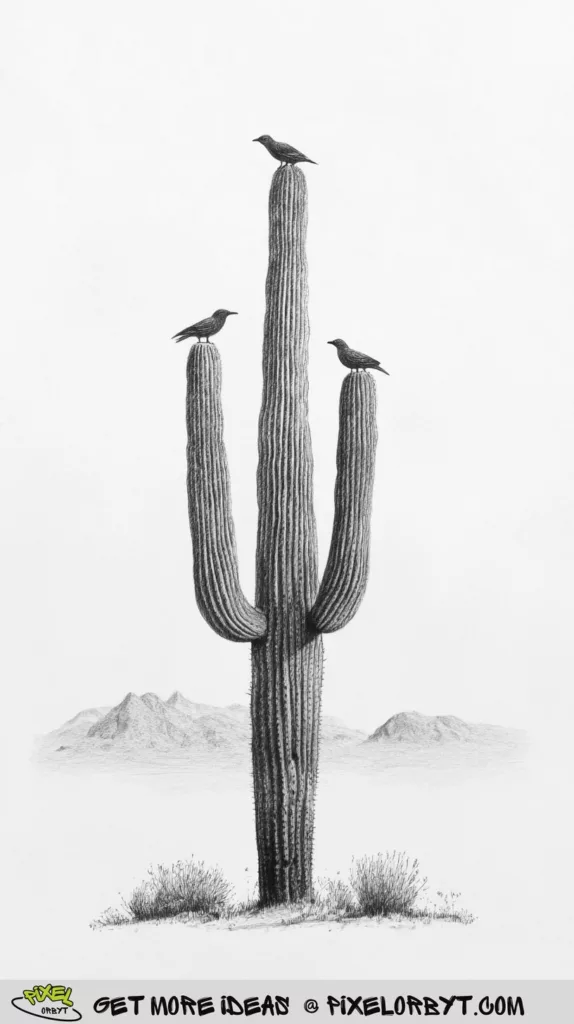
Low mountains sit far behind the cactus, drawn so faintly they almost disappear. Keep them pale blue-grey and barely there — distance is made with weak colour, not small size.
23. Wide desert landscape

The biggest scene here: two saguaro groups, a run of foreground boulders, agave spikes and layered ridges behind. Save it for a proper stretch of time.
Colouring Tips That Actually Change the Result
- Follow the ribs. Cactus ribs run top to bottom. Shade along them, never across, or the barrel goes flat.
- Leave a white stripe. One untouched rib down the lit side is the cheapest way to make a cylinder look round.
- Do not colour the spines. They are the lightest thing on the plant. Colour the body around them and leave the paper bare.
- Use two greens minimum. A warm yellow-green for the light, a cool blue-green for the grooves. One flat green reads as plastic.
- Print on 160gsm or heavier. Standard copier paper buckles under markers and will not take pencil layering.
Cactus Coloring Page FAQ
What colours make a cactus look realistic?
Sage green, olive and a touch of grey-blue, with the base browner and drier than the top. Real saguaros are dusty rather than bright. Save vivid green for the cartoon pages.
Which of these pages suit young children?
Numbers 5, 6 and 7 — the three cartoon cacti. Thick outlines, no interior detail, big enclosed areas. Numbers 1 and 2 also work for a child who can already stay inside a line.
Pencils or markers?
Coloured pencils, for these drawings. The pages already carry pencil shading and markers flood over that texture. If you want markers, use the cartoon pages, which have clean empty shapes.
Can I print these for a classroom or a care home?
Yes — print as many copies as you need for personal, classroom or group use. Just do not sell the sheets or repackage them as your own.
Print a couple, sharpen something green, and start with whichever one you kept looking back at. If the desert scenes hooked you more than the plants did, the nature sketch ideas are the next step.


