

30 Cartoon Characters With Big Noses to Draw and Copy
A big nose is the cheapest personality you can buy in a character drawing. One shape, drawn once, and the face is already grumpy, or hopeful, or scheming — before you have touched the eyes. That is why caricaturists reach for it first, and why every drawing below is built around the same trick: push the nose past what a real face allows, then let the rest of the head shrink to make room.

These 30 pencil studies are all drawn in the same loose graphite style, so you can copy them straight into a sketchbook without switching tools. Each one has a note on what makes the drawing work — the shape of the nose, where it sits against the eyeline, and the one thing that will go wrong if you rush it. Work through them in order or pick the faces that scare you. If a nose keeps defeating you on its own, spend an afternoon on these nose sketching ideas first and come back.
An oversized nose is only the beginning. For faces built around every other kind of exaggerated feature, the ugly cartoon character drawing ideas are a good companion set, and fat cartoon character drawings show how the same exaggeration logic works on a whole body rather than a head.
30 Cartoon Characters With Big Noses to Draw
Each study below names the specific shape being used and the thing that makes it work. Copy the ones that look hard.
1. The Sleepy Wanderer

The nose here is a long, gently curved wedge that runs almost the full height of the face, and the eyelids sit halfway down the eyeballs to match. Sleepiness is drawn with weight: everything hangs. Copy the beard as a downward spray of loose flicks rather than individual hairs, and keep the neck a thin line so the head reads as heavy on top of it.
2. The Sinister Grin

Every line on this face is a diagonal. The hooked nose points down-left, the grin runs up-right, and the quiff shoots up and back — opposing angles are what make a face read as scheming. Note that the two eyes are drawn at different sizes and heights. Symmetry kills villains; draw the squint first and let the other eye stay wide.
3. The Cheerful Big Nose

A round bulb nose sits right on top of the smile, and the cheeks push up into the lower eyelids. That contact point is the whole drawing — if you leave a gap between nose and mouth the face goes blank. Overlap them. The huge ears and the pin-thin neck are there to make the head feel oversized without you having to draw it bigger.
4. The Naive Innocent

Innocence comes from putting the eyes high and leaving a lot of empty face below them. The nose is a long wedge that widens to a soft ball at the tip, drawn with almost no shading so it stays light and friendly. The tiny sprout of hair on top is a classic trick: less hair means more head, and more head means younger.
5. The Grouchy Bird
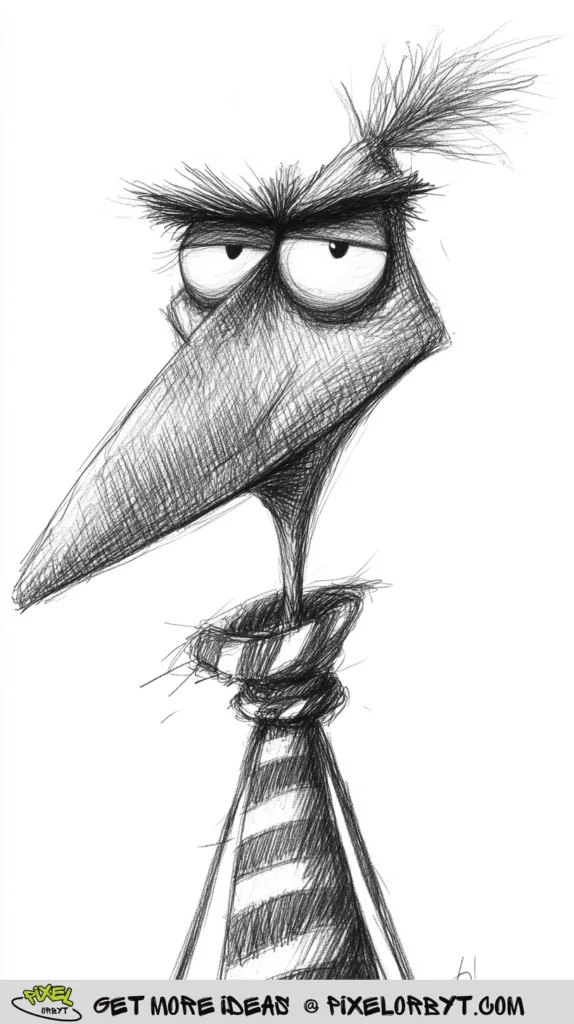
Proof the rule is not just for humans. The beak is a single long triangle taking up more than half the drawing, while the body underneath shrinks to a stick with a scarf on it. The sulk is entirely in two flat eyelid lines cutting the eyes in half. Try the same silhouette on other species using these bird sketching ideas as source material.
6. The Bespectacled Worrier

The glasses and the nose fight for the centre of the face, and the nose wins because it crosses the frame line. Drawing a nose in front of the lens rather than behind it instantly adds depth. The mouth is a short downward curve tucked close under the nose — that tightness is what makes him look permanently braced for bad news.
7. The Nerdy Dreamer

Sharp construction throughout: the jaw is two straight lines meeting at a point, and the nose is a clean triangle with one shaded plane. Because the face is so angular, the round lenses pop off it. His mouth is a flat line, which is the hardest expression to draw well — it has to be dead level or it turns into a smirk.
8. The Comedic Everyman

The nicest face in the set, and the most useful to study, because nothing is doing anything loud. The nose curves out and hooks slightly down at the tip; the chin recedes. That combination reads as agreeable. Keep the outline of the head as one unbroken smooth curve from forehead to jaw.
9. The Wild Inventor

The hair is scribbled at three times the volume of the skull, which is what sells eccentricity. Under it, the nose droops down and left with real weight in the shading. Notice the eyebrows sit high and slanted inward — worry — while the hair says chaos. Two contradicting signals on one face make characters interesting.
10. The Concerned Friend

The whole face is stretched vertically: long nose, long jaw, long neck. Stretching is a separate lever from enlarging, and it reads as nervous rather than funny. The ears are pinned wide at the same height as the eyes, giving you a horizontal to measure everything else against.
11. The Same Head, Drawn Twice

This is the previous character drawn again, and comparing the two is the most useful exercise on this page. Redrawing a face you have already invented is how you find out which lines are actually load-bearing — the nose length and the brow angle survive both takes, the hair does not. Do this with your own characters before you commit to a design.
12. The Pensive Cowboy

The hat brim is a long horizontal, the nose a long vertical, and the neck an even longer vertical — three simple shapes locked into a T. The moustache hangs off the underside of the nose like a second, softer nose. Shade the underside of the brim heavily so the eyes fall into shadow; that is where the weariness comes from.
13. The Mischievous Rabbit

The muzzle is a giant oval that takes over the lower half of the head, and the eyes are shoved up and squeezed together on top of it. Crossed arms on a spindly body finish the smugness. Animal characters follow the same rule as human ones: enlarge one feature, then shrink everything adjacent to it.
14. The Bearded Tinkerer

Tiny glasses against an enormous nose is the joke, and the size gap has to be extreme to land. The beard is drawn as texture, not shape — short overlapping strokes following the curve of the jaw. His eyes are drawn as simple dots inside big whites, which keeps a hairy face from getting muddy.
15. The Skeptical Artist

A knife-thin nose on a hollow face. The cheekbones are indicated with two short shadow strokes and nothing else, and the coat collar is drawn dark to push the pale head forward. Skepticism lives in the gap between the raised brow and the flat mouth, so keep the mouth small and give the brows room to move.
16. The Gleeful Jokester

Full-throttle laughter: the mouth is a huge open shape, the eyes squeeze into curved slits, and the hair blows back as though the laugh itself created wind. The nose lifts with the cheeks. When someone laughs hard the nose does not stay put — drawing it tilted upward is what separates a real laugh from a stuck-on smile.
17. The Cool Cowboy

The opposite of the pensive cowboy despite nearly identical parts. Here the hat tips forward, the smile lifts on one side only, and the eyelids drop lazily instead of tiredly. One-sided expressions read as confident; symmetrical ones read as open. Small change, completely different man.
18. The Cheerful Fellow

The largest nose-to-face ratio in the whole set. It occupies the middle third of the head and the eyes have been pushed up almost into the hairline to make room. That crowding is deliberate — when you enlarge a nose you must move the eyes, not just squeeze them. Pair this study with cartoon characters with big eyes to see how far you can push both features at once.
19. The Cheerful Rabbit
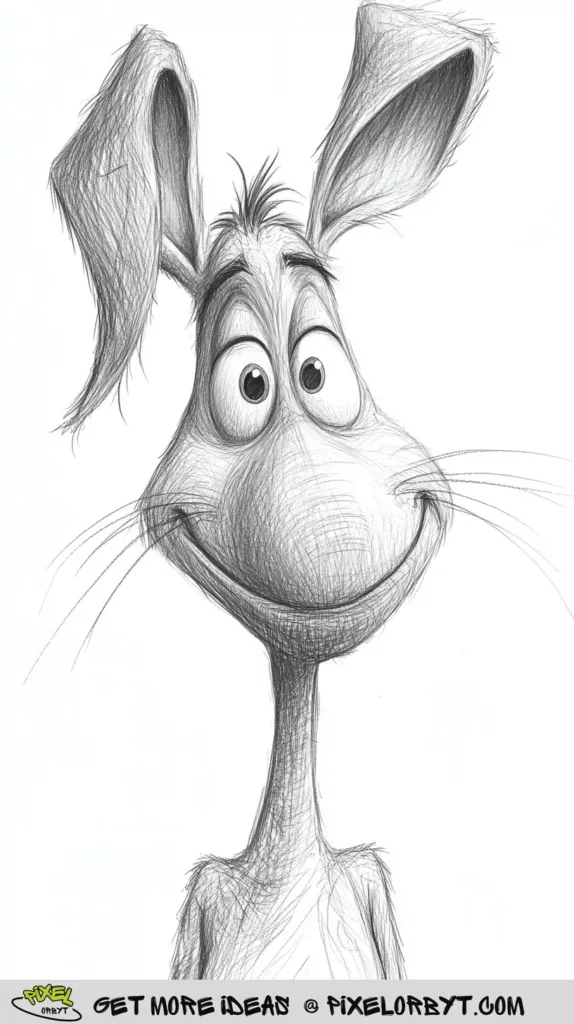
Gentler than the mischievous rabbit because the mouth is closed and the ears flop outward rather than standing up. The nose is a soft ball with a single highlight left white. Note how little detail is in the body — the character is entirely in the head, and the rest is a suggestion.
20. The Wise Old Man

Age is drawn as downward drift: the nose has descended, the brows have grown upward and outward, and the beard pulls the whole face toward the floor. Big round eyes underneath keep him kind rather than stern. For more studies of long silver hair and beards, the cartoon characters with white hair cover the same territory.
21. The Curly-Haired Skeptic

One raised eyebrow does all the acting here. The curls are drawn as a mass of small linked loops with dark gaps between them, not as individual spirals — get the outer silhouette first, then break it up. If curly hair is what you actually want to practise, these cartoon characters with curly hair go much deeper on that.
22. The Long-Necked Optimist

The neck is almost as long as the head, which shifts the character from funny to gangly and slightly awkward. The nose points down while the smile points up, and those crossed directions keep the face lively. A neck this thin also forces you to draw the head balanced, not just floating.
23. The Round-Nosed Optimist

The purest ball nose in the set — a near-perfect circle with the highlight left as blank paper and the shadow wrapped underneath. Round shapes read as harmless, so this face cannot look threatening no matter what you do with the brows. Useful when you need a friendly sidekick fast.
24. The Grinning Beanpole

A thin blade nose paired with a wide grin, which is a harder combination than it looks. Sharp noses want to belong to serious faces, so the mouth has to work overtime. The staring eyes with visible white all the way around push it toward manic. The suit underneath makes the joke better.
25. The Kindly Uncle

The warmest drawing here, and it is all in soft edges: no sharp corners anywhere on the face, and a closed smile that lifts into the cheeks. The freckles are dotted only across the nose bridge, which pulls attention to the nose without enlarging it further. Good practice for pushing character into a face gently — the same restraint most portrait drawing ideas ask for.
26. The Weary Bureaucrat

The heaviest nose in the collection. It hangs like a weight and drags the shading down with it, and the black glasses frames sit right on top, creating a horizontal bar across the face. Everything below the brow line is sagging. Draw the forehead tall and empty to make the crowded lower face feel worse.
27. The Toothy Charmer

The grin is drawn as a long rectangle of teeth stretching almost ear to ear, and the eyes hood over in response. When a smile gets this wide the eyes must close down, or the face looks unhinged. The nose curves in a single confident arc — try to draw it in one stroke rather than patching it.
28. The Wide-Eyed Neighbour

Setting the eyes unusually far apart on either side of the nose makes the nose feel wider even though it is not. Spacing is a free exaggeration; it costs no extra line work. The T-shirt and casual shoulders keep him ordinary, which is what makes the face funny.
29. The Long-Nosed Stranger

The best closing study on the page. The nose is a straight horizontal tube projecting far past the face, drawn with parallel contour lines to give it volume. Because it points sideways rather than down, the whole head reads as turned even though the eyes face front. A useful cheat for suggesting a three-quarter view without drawing one.
Why Exaggerated Noses Work
A nose sits at the exact centre of the face, so it is the first thing a viewer’s eye lands on. Enlarging anything at the centre of a composition gives you an instant focal point, and because real noses vary enormously between people, the audience accepts a big one without questioning it. That is why the trick survives across every animation style, from rubber-hose slapstick to modern feature work.
The second reason is mechanical. Cartoon eyes and mouths do most of the acting, but they reset between expressions. A distinctive nose is fixed — it makes a character recognisable in silhouette, from behind, in one frame, at any size. Test your own designs by shrinking them to thumbnail size; if you can still tell them apart, the shapes are doing their job.
Four Nose Shapes and What They Signal
- Ball or bulb — round, soft, no corners. Reads as harmless, cheerful, a bit foolish. See studies 3, 18 and 23.
- Hooked or beaked — a strong downward curve at the tip. Reads as cunning or predatory. See studies 2 and 6.
- Long wedge or blade — straight, tapering, sharp. Reads as intellectual, aloof or nervy. See studies 7, 15 and 24.
- Drooping and heavy — weight pulling downward, shaded underneath. Reads as tired, old or defeated. See studies 12, 26 and 29.
Common Mistakes Worth Avoiding
The most frequent failure is enlarging the nose and leaving everything else where it was. A big nose needs room, which means the eyes move up and outward and the mouth moves down and tightens. If your drawing looks crowded rather than funny, that is the reason.
The second is shading the nose like a lump of clay while the rest of the face stays flat. Pick one light direction, put a shadow under the tip and one along a single side, and stop. These references are drawn loosely for a reason — a small amount of graphite in the right place beats heavy rendering everywhere. When you want lighter, faster practice between studies, some doodle character ideas will keep your hand moving without the pressure.
FAQ
How big is too big for a cartoon nose?
The limit is set by the eyes, not the nose. As long as both eyes still fit above the bridge and read clearly at thumbnail size, you can keep going — study 18 pushes the nose to roughly a third of the total head height and still works. Once the nose starts covering an eye or the mouth entirely, the face loses its ability to act.
What pencil should I use to copy these studies?
A 2B for the construction lines and a 4B or 6B for the dark accents under the nose, in the hair and inside the mouth. All the drawings on this page rely on that contrast between light searching lines and a few very dark marks. Avoid an HB — it is too hard to get real blacks and you will end up pressing, which flattens the sketch.
Should I draw the nose first or last?
First, after a rough head shape. The nose sets the scale for every other feature, so placing it early means you are fitting eyes and a mouth around a known quantity instead of squeezing a nose into leftover space. Most of the errors beginners blame on the eyes are actually nose-placement errors.
Can I use these characters in my own comic or animation?
Copy them freely for practice — that is what reference is for. For published work, change enough that the design is yours: swap the nose shape category, alter the head proportions, and rebuild the expression. Studying several sets side by side helps here, so browse the wider collection of cartoon character sketching ideas and mix traits across them rather than lifting one face whole.
Keep Going
Pick six of these, draw each one twice, and compare your second attempt with the first. The second one is nearly always better, and the reason is that you stopped copying lines and started copying shapes. That shift — from tracing what you see to understanding why the nose is that size — is the entire skill.


