

48 Cartoon Star Character Color Pages to Draw and Fill In
Forty-eight cartoon star characters in pencil, sitting somewhere between a sketch reference and a coloring page. Some are literal stars with faces and legs. Some are the star of the scene — a boy landing a fish, a chef mid-stir, a girl on a cloud with the sky falling past her.
Each one is numbered and carries a note on what that drawing is actually doing: where the eyes sit, why the cape falls in two sheets, how the snow is made of untouched paper. Difficulty climbs as you scroll — the first ten suit a small child, the last eight will hold an adult for an evening.
Simple Star Mascots to Start With
The five-point star characters most people picture when they search for a cartoon star character color page: one shape, one face, two legs. A star is an awkward host for a face — points pulling outward, no jaw, no neck to tilt — so eye placement decides everything. The doodle character ideas collection runs the same drill on other simple silhouettes.

1. Classic smiling star. The face sits in the middle third. Any higher and the top point swallows the eyes.
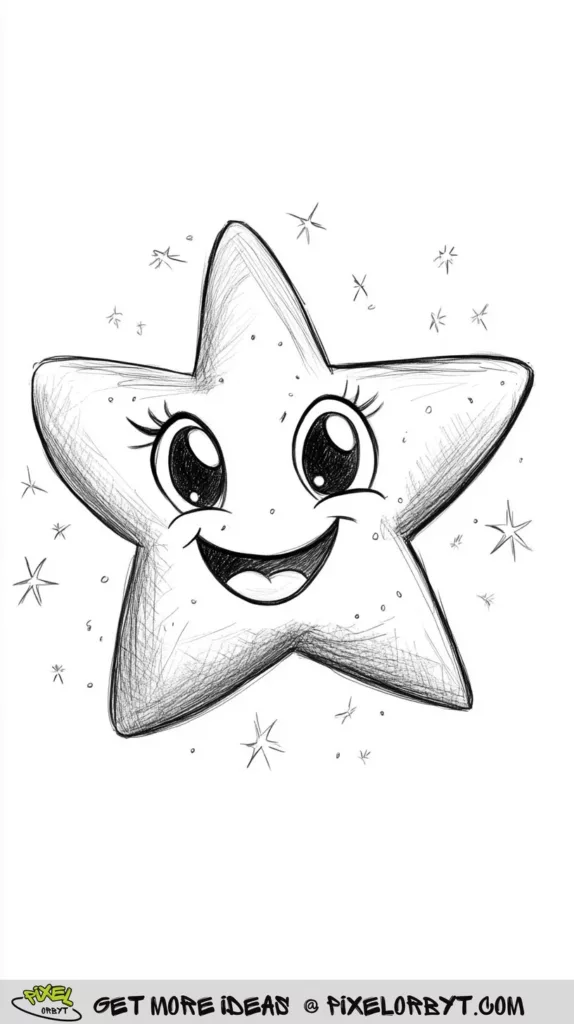
2. Star with lashes and blush. Two blush circles do more than any amount of shading. Keep them near the outer points.

3. Rounded baby star. Round every corner: rounded tips read as young, sharp tips as magic.

4. Mid-stride star. The body is static, so the pose comes from the limbs. One leg forward, one back.

5. Splayed-hand star. No wrists to work with, so draw each hand as a small fan rather than five digits.

6. Googly-eyed goofball. Eyeballs that overlap each other and cross the outline turn a shape into a character.

7. Hand-on-hip star. A star has no hips, so the arm bends wherever you commit the elbow.

8. Scribble-textured star. Let the outline emerge from stroke density rather than from any single line.
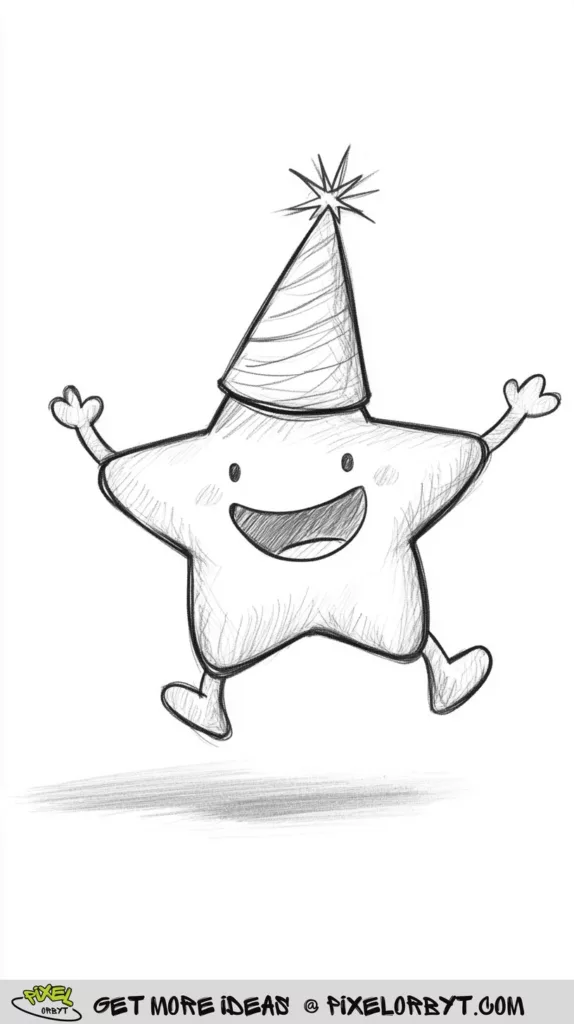
9. Party hat star. The cone follows the star’s tilt, not the paper’s edge, or the hat looks pasted on.

10. Star with twin wands. Two wands means two mirrored arms. Raise one or the pose goes stiff.
Star-Headed Kids and Grinning Starfish
Keep the star, change what it is attached to. A star head on a normal child’s body is the cleanest version; a starfish is what happens when you give the shape a texture and a seaside. Both are easier than the plain mascots in one respect — a body gives you somewhere to put a pose. More sand-and-sea subjects sit in the beach summer coloring pages.

11. Star-headed kid with balloon. A star head on an ordinary body. Keep the body plain so the head stays the surprise.

12. Star kid in dungarees. Repeating the star on the balloon ties it together. Twice works; three times nags.

13. Round-headed balloon boy. Two dots, a nose, a curved mouth — proof of how little a face actually needs.

14. Sunglasses starfish. Stippled dots make it a starfish rather than a star. Vary the spacing near the edges.

15. Starfish close-up. The same character cropped tighter and stood upright — a second drawing from one design.
Stars, Moons and Night Skies
Here the star stops being the character and becomes the setting. The problem shifts from expression to weight: a figure on a moon or a cloud has to look like it is resting on something solid or something soft, and that difference lives entirely in the contact point. Pair them with the moon coloring pages.
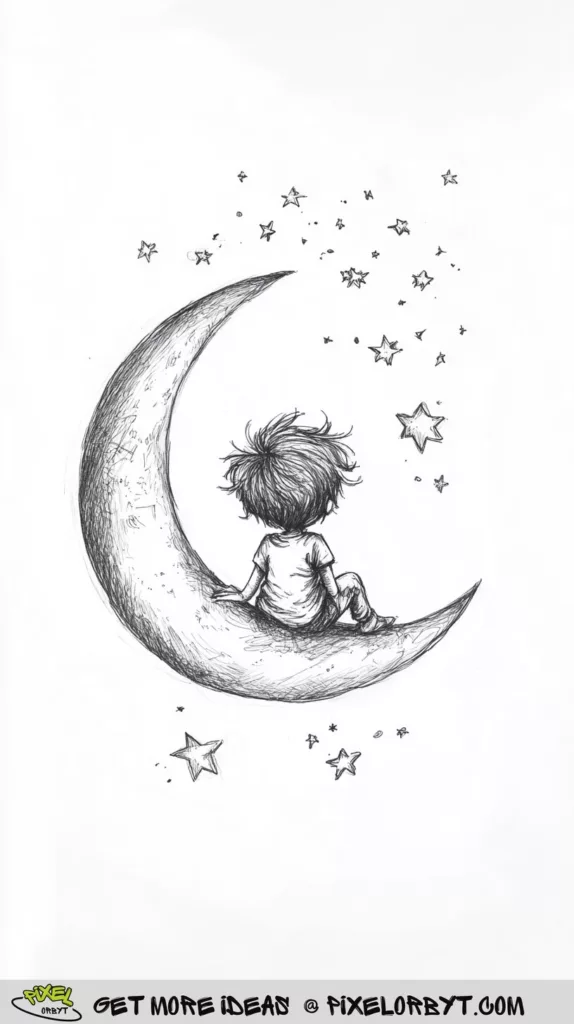
16. Child on a crescent moon. Sit the figure at the low point of the curve so the weight reads believably.

17. Moon seat with star swirl. Stars cluster in a spiral, never evenly. Uneven density is what gives a sky depth.

18. Girl on a cloud. The cloud is stacked lumps, not one outline. Overlap them so some sit in front.

19. Hooded stargazer. The hood points back while her gaze points up. That opposition carries the drawing.
Star-Emblem Superheroes
The jump in difficulty is steep. These are anatomy studies with a star used as a chest emblem, and they ask for things the mascots never did: shoulder width against hip width, how a cape behaves when it hangs rather than flies. Work through the human figure sketching references first if the proportions fight you.

20. Star-chest hero, front stance. The hardest page here. Build a centre line first and hang both halves off it; a symmetrical stance shows every millimetre you get wrong.

21. Blue-line hero, hands on hips. Blue pencil is the traditional under-drawing colour: it scans light, so you ink straight over it.

22. Standing hero with cape. The cape hangs from two shoulder points and falls in two sheets. Draw the gap between them.

23. Cowled hero, fist raised. The raised fist foreshortens: shorter forearm, bigger hand. Exaggerate past what feels comfortable, because measured correctly it still looks timid.
Everyday Characters Worth Colouring
The largest group, and the one that rewards colouring most: kids fishing, building snowmen, cooking, playing instruments, reading maps. No star in sight on most, which is the point — a face plus clothing plus a prop gives you far more enclosed shapes to fill than a smooth five-point body. They double as drawing practice, close to the sketching ideas for kids.

24. Cat on the dock. Vertical hatching does all the water work. Keep the strokes straight; the gaps are the ripples.

25. Boy in the sun hat. The brim hides the eyes, so the story rides on the shoulders and the angle of the rod.

26. The surprised catch. Open mouth plus raised eyebrows equals surprise. That is the whole trick.

27. Star-brim fisher. Small stars punched into the straw brim tie the page to the theme without labouring it.

28. Fixing the carrot nose. Both figures face each other, so the eye lands in the gap. That gap is the subject.

29. Snowman close-up. Closed eyes read as concentration, and are far easier to draw than open ones.

30. Snowman from behind. No face at all. Everything comes from the head tilt and the loose winter coat.

31. Blue-pencil snowman. The snow is bare paper. Shade the air around the flakes, never the flakes themselves.

32. Boy drawing a rainbow. The only colour on the page. One coloured element in graphite steers the eye completely.

33. Chef at the stove. Steam is loose loops thinning as they rise. Lift the pencil before each loop closes.

34. Two-handed cook. Two hands, two tools, two arm angles — otherwise the pose reads as a mirror.

35. Floating feast. The food floats on an invisible arc. Sketch that arc first, then hang items off it, largest nearest.
The next three are music pages, each solving one problem differently: how to make an instrument read correctly without drawing every string and key. There is a longer run in the music sketching ideas set.

36. Boy with the big instrument. Oversizing the instrument shrinks the player and makes the effort funny. The cello is wider than his shoulders.

37. Laughing busker. The laugh crushes the eyes into two curves. Real laughter closes them; that sells it.

38. Clarinet player. Plaid follows the folds, not the page. Bend every check where the cloth bends.

39. Chibi with a map. Chibi proportions: head about a third of the height, feet wide to stay stable.

40. Young explorer. The map is a flat plane among curves. Bow it slightly, or it reads as a sticker.
Magic, Wings and Storybook Scenes
The hardest pages, and the slowest to colour. Wings, smoke, scattered butterflies, heaped animals — detail that has to stay organised or it turns to noise. One rule runs through the section: crowd the detail where you want the eye and leave the rest of the paper alone. The butterfly coloring pages and witch coloring pages cover the same ground.
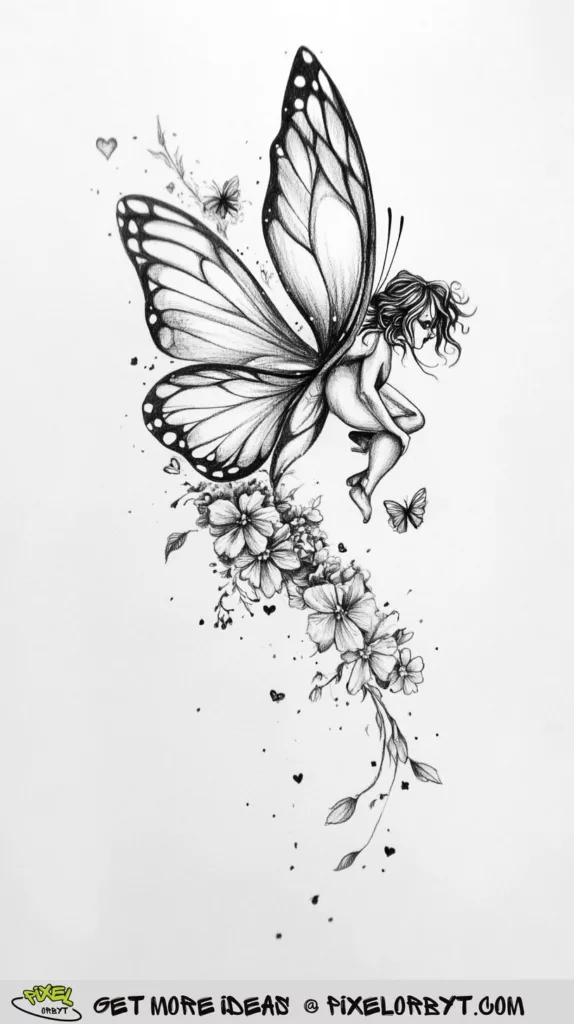
41. Butterfly-winged fairy. Wings mirror but never match. Draw one fully, then vary the second slightly.

42. Releasing the butterfly. The butterflies shrink and lighten as they rise — the only depth cue needed.

43. Field of butterflies. Dense at the bottom, sparse at the top. Spaced evenly they read as wallpaper.

44. Witch with sparks. Smoke and hat brim share one soft edge, binding them into a single silhouette.
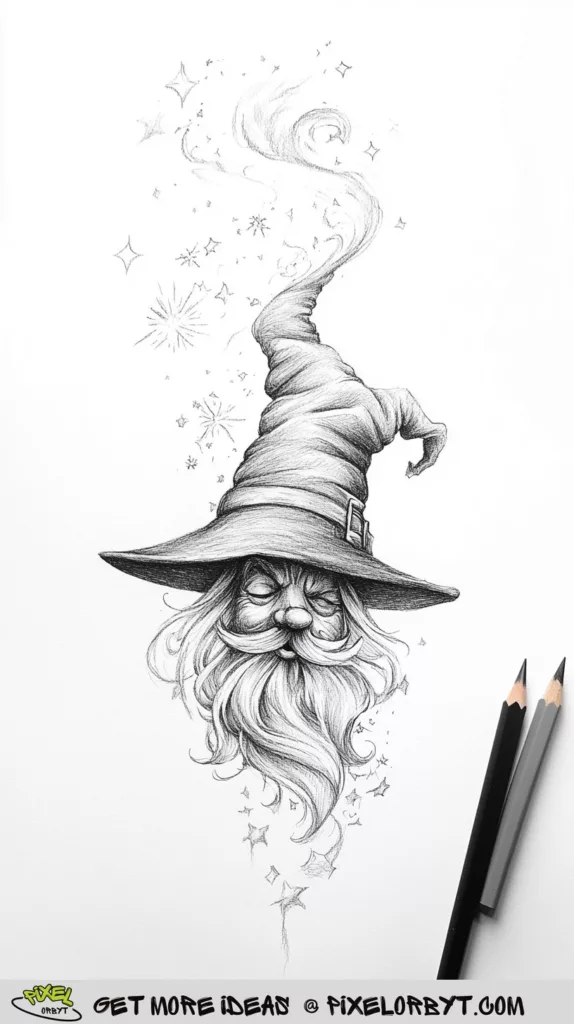
45. Long-hatted wizard. The hat is three times the head height. Extreme proportion is a choice, not an error — commit to it.

46. The rabbit reader. Draw the seated figure first, then grow the animal crowd out into the negative space.

47. Storybook crown. The animals form a crown above her head. Silhouette first — the outline carries it.

48. Reader with a kitten. Her hands and the book edges are the only crisp lines; everything else softens.
How to Use These Pages
Print at A4 and the line work holds up. These are graphite rather than flat black outlines, so coloured pencil sits better than marker, which floods the existing shading. For a clean fill, trace the outline onto fresh paper and colour the copy — you keep the reference and get a sheet that behaves like a normal coloring page.
For redrawing, cover the reference after two minutes and finish from memory. How you get it wrong tells you what you were not looking at — more useful than a careful copy. Our cartoon character drawing and sketching ideas post has more references for that, and the easy drawing ideas for kids of all ages set sorts subjects by patience required.
FAQ
Are these printable coloring pages or drawing references?
Both, though they behave differently from standard coloring book pages. There is no flat black outline — each is a finished pencil drawing with shading already in it, so colouring over the top gives depth for free but leaves less clean white space.
Which ones should a young child start with?
Numbers 1 to 10, the plain star mascots: large enclosed shapes, few internal lines, nothing that punishes going outside the edge. The starfish at 14 and 15 are the next step up. Save the superheroes for later.
Why do the star characters have such big eyes?
A five-point star has no neck, jaw or eyebrows, so the eyes carry the whole expression alone. Shrink them and the character goes blank — the principle behind our cartoon characters with big eyes collection.
How do I get the star shape symmetrical?
Not point by point. Draw a light circle, mark five evenly spaced dots around it, then connect every second dot. The star falls out of the geometry, correct by construction, and the circle erases away.


