

45 Crochet Handbag Ideas: Totes, Bucket Bags & Granny Squares
A crochet handbag is the rare project that is both a skills exercise and something you actually use. A tote is a rectangle, a bucket bag is a cylinder, and a hobo is a shaped oval — once you can read a bag that way, the pattern stops being intimidating.

Below are 45 bags, each with a note on what makes it work and where it usually goes wrong. If a full handbag feels like a big commitment, start with these crochet zipper pouch ideas — same construction and colour work, finished in an evening.
Any bag built from joined motifs is a small quilt with a strap, so the block sizing and sashing in these crochet quilt ideas apply directly to the granny square bags further down.
The cotton left over from a bag lining is enough for a pair of crochet earrings — small motifs, one evening, and the same colour decisions you just made on the bag.
Once a tote or two is off the hook, this list of crochet project ideas grouped by skill shows what to make next with the shaping and colourwork you just practised.
The same granny squares scale straight up into outerwear — these crochet jacket ideas show the motif layouts working at garment size.
The tight cotton stitch that makes a bag hold its shape is the same one that makes a good storage basket, which is where these crochet room decor ideas pick up.
45 Crochet Handbag Ideas to Make
1. Mandala Circle Bag with Fringe

Two flat circles worked in concentric rounds, seamed together and hung from a braided brown strap. The whole thing lives or dies on your increase count: six increases per round in double crochet keeps the disc flat, and skipping one makes it cup. Knot the fringe through the seam stitches last.
2. Plain Red Everyday Tote

No pattern, no colourwork, nothing to hide behind — just single crochet worked in a spiral over an oval base. That makes tension the entire design. Count your base round twice before you start the sides, because an uneven oval shows in every row above it.
3. Pink Daisy Box Bag

A true box shape: flat rectangular base, then sides worked straight up in the back loop so the corners fold sharp. T-shirt yarn gives it enough body to stand unaided. The daisies are made separately and stitched on afterwards, which lets you space them evenly instead of counting mid-round.
4. Rainbow Drawstring Beach Bag

Bright stripes worked in continuous rounds, cinched with a drawstring through an eyelet round near the top. Working in a spiral leaves a visible jog where each colour changes — put that seam at the back and it disappears. Cotton holds the shape when it gets damp; acrylic will sag.
5. Chunky Navy Hobo

Giant roving yarn on a 12mm hook, so the whole bag is maybe forty stitches around and finishes in an afternoon. The trade-off is stretch: chunky fabric droops under weight, so line it or accept the slouch as the look. The cabled handle is worked separately and sewn in.
6. Flower Granny Square Tote

Nine squares per face, each with a raised flower centre, joined with a cream border that pulls the palette together. Block the squares before joining — unblocked granny squares are never quite the same size, and that difference multiplies across a nine-square grid.
7. Crescent Moon Night Bag

The moon is a separate crescent motif appliqued onto a navy body, with small stars scattered around it. Metallic yarn is slippery and splits easily, so use a hook one size down and go slowly on the stars. A dark base makes the gold read from across a room.
8. Earthy Striped Bucket Tote

The colour changes are the obvious feature, but the texture changes are what makes it: bobble rows, post-stitch ridges and plain single crochet stacked in bands. Alternate a textured band with a flat one so the eye gets somewhere to rest.
9. Black-and-White Chevron Tote

A chevron repeat where every increase must sit directly above the increase below it. Lose one and the zigzag drifts sideways a few rows later — count the peaks each row rather than trusting the fabric. Two high-contrast colours make any mistake obvious, which is oddly helpful.
10. Ruffled Two-Tone Bag
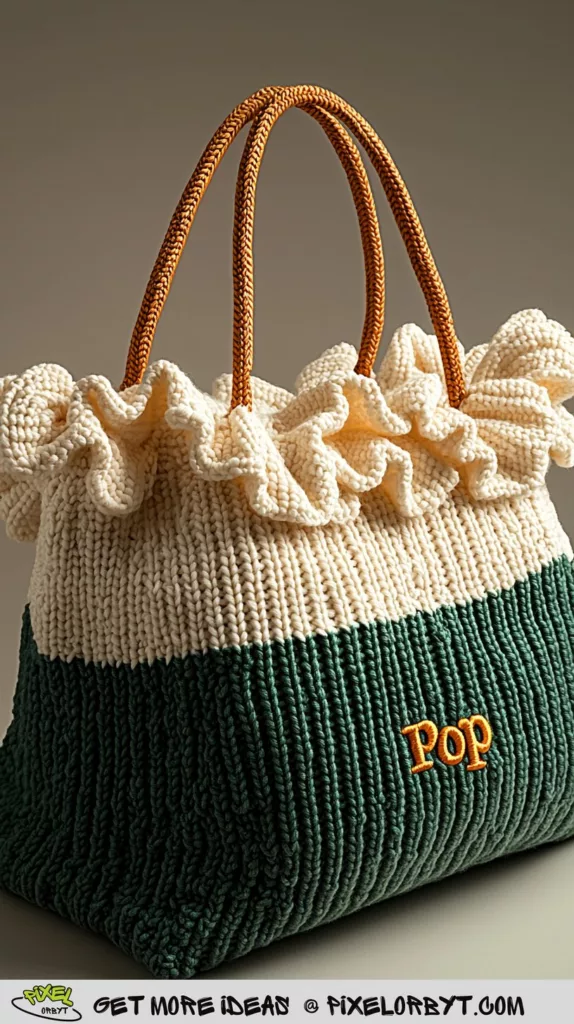
The ruffle comes from working two or three stitches into every stitch of the final round, so it flares instead of lying flat. The green lower half is worked in back-loop single crochet for the vertical rib. Orange cord handles stop it from looking prim.
11. Sage Stripe Ruffle Tote

Narrow two-row stripes mean a lot of colour changes. Carry the unused yarn up the side of the work rather than cutting each time — you save yourself a dozen ends to weave in, and the carried strand hides inside the seam.
12. Panda Colourwork Band

Tapestry crochet: you carry the colour you are not using inside the stitches and pick it up when the chart says so. Keep the carried strand relaxed. Pull it tight and the pandas pucker into little dents that no amount of blocking will fix.
13. Cow-Print Tapestry Tote

Irregular blobs are harder than they look, because there is no repeat to fall back on. Chart it on graph paper first, one square per stitch, and mark the row you are on. The organic edges are more forgiving of a miscount than a geometric motif would be.
14. Green Ruffle Tote with Gradient Handles

Same ruffle construction as the two-tone bag, but the handles are worked in a gradient yarn so the tan fades along their length. Handles take the most abuse of any part of a bag — work them in a tight single crochet over a cord core so they never stretch.
15. Mesh Market Net Bag

Chain spaces instead of solid fabric, so it packs to nothing and expands around whatever you load into it. That stretch is the point and also the risk: reinforce the base with a few solid rounds, or heavy shopping will pull the mesh into a long teardrop.
16. Wayuu-Style Zigzag Bucket

Traditional Wayuu bags are worked in single crochet so tight the fabric barely bends, which is why they hold a perfect cylinder. Expect sore hands and slow progress. Go down two hook sizes from the yarn’s label and let the density do the shaping for you.
17. Daisy Box Bag with Chain Strap

The same box construction as before, upgraded with hardware. Sew D-rings to a reinforced patch on the inside seam, not to a single stitch — a chain strap concentrates all the weight on two points and will tear straight through unsupported fabric.
18. Abstract Colour-Block Tote

Circles and arcs in flat colour blocks, worked intarsia style with a separate yarn bobbin for each shape. Twist the two yarns around each other at every colour change or you will end up with a slit where the colours meet.
19. Pastel Stripe Everyday Tote

Wide bands in dusty pastels, with thin accent lines breaking them up. Stripe rhythm matters more than stripe colour: repeat a wide-wide-narrow sequence and it looks designed, scatter them randomly and it looks like leftover yarn.
20. Puff Flower Stripe Tote
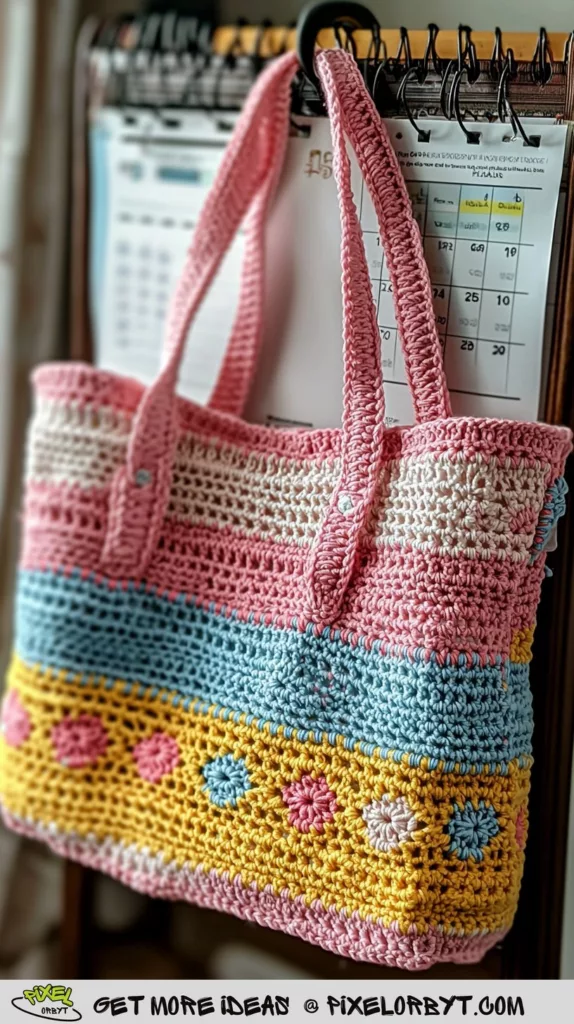
A single row of puff-stitch flowers turns a plain striped bag into something intentional. Puffs eat yarn and pull the row tighter than the rows around it, so add a stitch or two on the flower round to keep the sides from nipping in.
21. Minimalist Cream Tote

Undyed cotton, no pattern, leather straps riveted through the top edge. The restraint is the design, which means every stitch is on display. Punch the strap holes through a doubled-over hem so the leather has something solid to grip.
22. Gold Star Moon Bag

A close cousin of the earlier moon bag, but the stars here are surface embroidery worked over the finished fabric rather than crocheted motifs. Embroidering on top is much easier than planning appliqué placement in advance, and you can reposition until it looks right.
23. Bobble Basketweave Tote

All the interest is in the stitch: raised bobbles in a staggered grid, no colour change anywhere. Textured stitches shrink your finished size noticeably, so crochet a swatch and measure it before trusting the pattern’s dimensions.
24. Vertical Rib Tote

Front post double crochets stacked row on row create those vertical columns, which is the trick for making a wide bag look taller. The ribbing also adds spring — good for a tote you overload, less good if you want rigid sides.
25. Lace Band Two-Tone Bag

An openwork band sits above a solid base, so the bag stays functional where it counts and decorative where it shows. Line the solid section only; a lining behind the lace kills the effect you worked for.
26. Rainbow Granny Square Box Bag

Six panels of squares joined into a rigid box, which only works if every square is genuinely identical. Work them all in the same sitting if you can — tension drifts between sessions, and a granny square made on a tired evening is measurably bigger.
27. Structured Red Handbag

Sharp corners and flat sides mean this one is lined and probably interfaced. Cut the lining a few millimetres smaller than the crochet piece so it pulls the fabric taut from the inside instead of bagging out at the base.
28. Seashell Beach Bag

Real shells stitched onto a striped body, which sounds charming until you carry it. Sew each shell through a drilled hole onto a backing patch, not directly onto a single strand of yarn, or the first knock will take one off.
29. Shell Charm Stripe Tote

A gentler take on the same idea: shells hang as charms from short chains rather than sitting flat on the fabric. Charms move, catch light, and cost the bag nothing in structure. Pair it with a free crochet swimsuit pattern and you have a whole summer set.
30. Boho Colour Block with Tassels
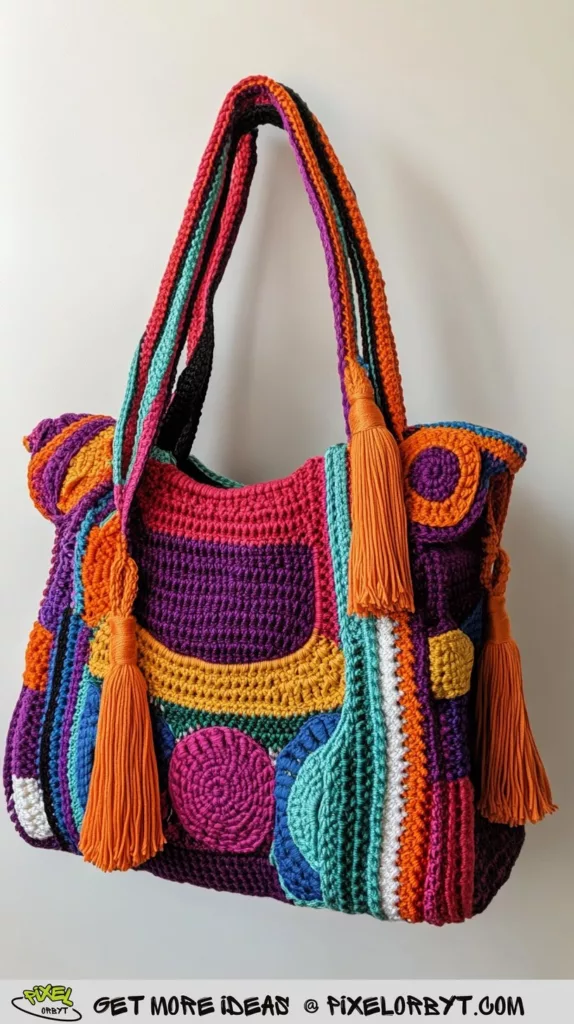
Blocks of saturated colour with fat orange tassels at the corners. The tassels are doing real work here — they add weight at the base, which stops a soft-sided bag from collapsing inward when it is empty.
31. Kids’ Animal Applique Bag

Small amigurumi shapes flattened and sewn onto a striped body. Make the appliqués first, lay them out on the finished panel, and only then decide the spacing. Stuffing them lightly gives depth without making the bag lumpy against a child’s side.
32. Lilac Irish Lace Rose Bag

Irish crochet: motifs made individually, then joined with a mesh filling worked around them. It is the most advanced bag on this page and it needs a lining, since the openwork will happily let a phone slip through. The layered rose is built one petal round at a time.
33. Amigurumi Charm Bag

A whole cast of miniature amigurumi sewn across the front. Each one is a small project, so this bag is really twenty projects on a bag. If you like making the little pieces best, crochet keychains scratch the same itch on a smaller commitment.
34. Navy Crossbody with Charm

Tight single crochet in a dark solid colour, which makes it read as a shop-bought bag until you look closely. The mixed cord-and-chain strap is what modernises it. Adjust the strap so the bag lands at your hip, not your ribs.
35. Geometric Square Crossbody

Concentric squares in clashing brights, worked as flat intarsia panels then seamed. Nested squares are unforgiving of a wandering stitch count because the eye tracks straight lines instantly — mark each corner with a stitch marker as you go.
36. Patchwork Tassel Bag

Solid patches and open mesh panels combined in one body, using up odd balls without looking accidental. The rule that keeps scrap projects coherent: vary the colours as much as you like, but keep every yarn the same weight.
37. Floral Granny Square Bag with Braided Handles

Traditional squares with raised flower centres, bordered in red to frame the grid. The braided handles are three crocheted cords plaited together — stronger than a single cord and far more comfortable across the palm.
38. Neutral Textured Stripe Bag

Muted stripes carried by texture rather than colour: smooth rows against ridged post-stitch rows in near-neighbour shades. This is the most wearable bag here and the one that will still look right in five years.
39. Burgundy Bobble Bag with Gold Clasp

A diamond lattice of bobbles gives a quilted look, and the gold clasp lifts it out of craft-fair territory entirely. Hardware like this needs a firm fabric to sit against; work a size tighter than usual across the clasp panel.
40. Magenta Granny Slouch

Unstructured and deliberately soft — the squares are joined without a rigid base, so it slumps into a comfortable shape when you carry it. Granny squares behave the same way in a boho granny square poncho if you want to try the technique on something larger.
41. Mandala Flap Bag with Long Fringe

The mandala is worked as the flap itself, so the round motif closes the bag rather than decorating it. Long fringe below the flap adds swing. Trim it in one pass with the bag hanging, never flat on a table, or it dries crooked.
42. Deep Red Crescent Hobo

The crescent shape comes from increasing along the lower curve and leaving the top edge straight. No pattern, no embellishment, so your stitch definition is the whole show — a mercerised cotton will hold the crisp edges that a fluffy yarn blurs.
43. Green Beaded Flower Bag

Beaded flower motifs on a deep green ground, with beads worked into the trim as well. Thread every bead onto the yarn before you start the round — there is no way to add them afterwards without cutting. Work a practice motif flat before committing it to the bag.
44. Lilac Flower Panel Bag

Raised flower squares in a single colour, which keeps a busy texture calm. Tonal texture work like this photographs badly and looks wonderful in person, so do not judge your progress from a phone picture.
45. Cream Lace Bag with Tassels

Fine cotton lace motifs with tassels at the base. Lace needs blocking to open up — pin it damp and let it dry fully before you seam anything, because an unblocked lace panel looks like a mistake rather than a design.
Choosing Yarn That Holds Its Shape
Yarn choice decides whether your bag stands up or sags, and it is the single most common reason a finished bag disappoints. Mercerised cotton and t-shirt yarn hold structure. Acrylic stretches under weight and never fully recovers. Wool blends sit in between and full slightly with use, which some bags benefit from.

Dense tapestry work like this diamond-patterned tote needs a smooth, tightly plied yarn — fuzzy fibres blur the pattern edges until the shapes go soft. Drop a hook size or two below the label recommendation for any bag: a fabric you can see daylight through will not hold a shape.

Lace bags are the exception. Fine cotton worked at an open gauge is meant to drape, so give it a lining and let it be pretty rather than structural. Match the yarn to the job:
- Everyday tote: worsted cotton, tight gauge, lined base
- Beach bag: cotton or jute — it dries and keeps its shape damp
- Structured box bag: t-shirt yarn or macrame cord, no lining needed
- Evening or lace bag: fine mercerised cotton, always lined
Embellishments That Survive Being Carried
Anything you add to a bag gets knocked against doorframes and car seats. The test is whether it is attached to fabric or to a single strand of yarn.

Metal flowers on a plum lattice look expensive because the base fabric is dense enough to carry them. Attach heavy trims through a doubled patch of fabric or a scrap of lining on the inside — one stitch will not hold.

Crocheted embellishments are safer than found objects because they flex instead of snapping. This flower-covered bag layers blooms in three sizes; making a pile of crochet flowers first, then arranging them, gives a far better result than working them in as you go.

Novelty shapes are the same idea taken further — here the leaf handles are structural as well as decorative, so they need a firm cord core running through them. Keep one strong element and let the rest be soft.
Construction Details Worth Getting Right
Handles fail first, then the base, then the top edge. Work handles in tight single crochet around a cord or webbing core, and stitch them down over at least four stitches on each side. A handle sewn to two stitches will pull free.

Plan colour placement before you join anything. Lay your squares out, photograph them in black and white, and check the light and dark ones are spread evenly — that greyscale trick catches clumping that colour hides. The same planning applies to any patchwork project.
Line any bag you intend to carry keys in. Cut the lining slightly smaller than the crochet, sew it as a separate bag, and slip-stitch it in at the top edge only, so the two layers can move independently. If you are making a matching set, crochet hat ideas use the same stitches you are already working here.
Frequently Asked Questions
How much yarn does a crochet handbag take?
A medium tote in worsted cotton runs roughly 500 to 700 metres, around three to four 100g balls. T-shirt yarn is heavier and shorter: budget two to three 400g balls for a structured box bag. Buy all your main colour at once and check the dye lot, because a bag shows a mismatch far more than a scarf does.
Do crochet bags need a lining?
Any bag with openwork, lace or mesh needs one. Solid single crochet in cotton at a tight gauge does not, though a lining still stops small items catching in the stitches. If you skip the lining, at least add a firm base — a piece of plastic canvas cut to the base shape costs nothing and stops the sag.
What stitch is best for a crochet bag?
Single crochet worked in a spiral, on a hook one or two sizes below the yarn’s label. It makes a dense fabric with no stretch and no visible row seam. Use half double or double crochet only when you want drape, or when the bag is small enough that stretch will not matter.

Which bag should a beginner start with?
A granny square tote like this one. Each square is a small, finishable unit, mistakes cost you one square rather than a whole panel, and joining teaches you seaming on flat pieces before you attempt shaping. From there, move to a plain single crochet tote to practise even tension, and a bucket bag after that to learn working in the round.
Pick one bag, buy enough yarn for it, and make a swatch before you commit. When you want the next project, free knitted sweater patterns and Christmas knitting ideas are waiting.


