

49 Crochet Jacket Ideas: Granny Square, Floral, Chunky and Lace
A crochet jacket is one of the few garments where the handmade part is the point. The 49 ideas below run from lace layers for a summer dress to chunky wool jackets that replace a coat.


Those two set the range: an airy cream motif jacket on one side, a dense charcoal shawl-collar cardigan on the other. Everything below sits between them, grouped by style.
For the same open-front shape in a lighter, faster weight, these crochet cardigan pattern ideas cover the granny square, colour block and cable versions.
Granny Square and Patchwork Jackets
Motif jackets are built in pieces and assembled last, which suits stop-start crochet time. The catch is planning: photograph the layout on the floor before you seam a single square.

1. Neon yellow only works because a black border rings every square, stopping adjacent colours vibrating against each other.

2. Ending the body at the natural waist is what keeps rainbow squares from reading as a blanket with sleeves. Measure to your waist, not your hip.

3. Magenta, orange and purple at full saturation. Keep every motif identical when colour is this loud — the eye needs one repeating shape.

4. Hot pink joining yarn unifies mismatched scrap squares. The squares can be anything as long as the seaming yarn stays constant.

5. Angular wedges rather than squares, so this is intarsia and short rows. Every colour change is a strand you have to trap.

6. Southwestern diamonds in tapestry crochet — carrying the unused colour across every row is what makes it this dense and windproof.

7. Teal against orange is a complementary pair, so the zigzags read at distance. The plain ribbed placket makes the noisy body wearable.

8. Each square is nearly a hand-span, so the jacket is about thirty pieces instead of two hundred.

9. Cream and tan squares alternated with mesh panels — mixing solid motifs with openwork keeps the weight down.

10. Pastel patchwork in horizontal bands rather than a grid, which is far easier to keep true because you only align one direction.

11. All-cream motifs with ruffled cuffs. With colour off the table, alternate a popcorn motif with a flat one so the surface still moves.
Floral and Appliqué Jackets
Surface flowers are the cheapest upgrade to a plain jacket, and placement is where beginners go wrong. Pin every bloom on and hang the jacket up first — what balances on a table rarely balances on a body.

12. Roses follow the placket line down both front edges — anchoring appliqué to a structural line is the safest layout there is.

13. White-on-white roses climbing one shoulder. Tonal appliqué is forgiving: shadow does the work, so a wonky petal disappears.

14. A vine of pink roses down the centre front. The trailing leaves matter as much as the blooms — without stems, appliqué looks stuck on.

15. An asymmetric spray across one side of the chest — more flattering than a matched pair, and half the flowers.

16. Flowers scattered down the sleeves catch the eye when arms move. Keep them above the elbow so they do not snag.

17. Embroidered bouquets sit low where the cape flares — weighting the hem is what makes a cape hang instead of billowing.

18. Batwing lace sleeves with the flowers clustered at the neck. Practise the blooms as standalone pieces first with these sculptural crochet flowers.
Chunky Oversized Cardigan Jackets
Chunky is the fastest route to a finished jacket and the easiest place to get fit wrong. Bulky yarn adds real bulk at the underarm, so an oversized pattern in a size up will swallow you.

19. Patch pockets sewn on afterwards, so they land where your hands fall rather than where the schematic says.

20. Bobbles with balloon sleeves. Bobble fabric eats yarn at roughly double the plain rate.

21. Deep ribbing that pulls in at the waist and relaxes over the hip, worked as back-loop-only rows.

22. Oatmeal is the workhorse colour here, and barely-dyed wool hides the small tension shifts that show up badly in dark yarn.

23. Enormous sleeves that need a slim layer underneath, or the whole outfit reads as padding. Volume has to be balanced somewhere.

24. Forest green keeps its stitch definition because chunky yarn is thick enough to cast its own shadows.

25. Dusty pink chunky rib cropped at the waistband — the muted tone stops a bulky silhouette tipping into costume.

26. Wide black and cream bands. Stripes this bold only work if they are even, so count rows.

27. The quietest jacket here and the one you would wear weekly — a single lace panel in plain fabric is enough.
Lace and Openwork Jackets
Openwork jackets are layering pieces, not warm ones, and they live or die on blocking. Lace comes off the hook crumpled and wrong: wet it, pin it out, let it dry before judging.

28. Cropped, scalloped, three-quarter sleeves — the scalloped edge means no separate border round is needed.

29. A peach border round a cream lace body — one contrast round on every edge is the cheapest way to look deliberate.

30. Batwing sleeves in large-scale openwork. The wide armhole means no set-in sleeve maths, which is why free patterns love it.

31. Tassel fringe adds weight exactly where you want it, pulling airy fabric straight instead of letting the hem curl.

32. Barely a jacket — closer to a shawl with armholes. For the same drape without any sleeve shaping, see these crochet poncho patterns.

33. Sage green with a cream lace placket — two colours, one of them only on the edges, transforming an otherwise plain cardigan.
Long Dusters and Capes
Length changes the maths. A duster takes two to three times the yarn of a hip-length jacket, so go up a hook size for drape and reinforce the shoulder seam inside.

34. Mustard, green and rust circles set into a cream ground. The motifs are worked separately and dropped into gaps, keeping the coat flat.

35. Floor-length and completely open, no closure at all. The same openwork logic scales up into these crochet dresses for ladies if you want the garment rather than the layer.

36. Large floral motifs set into a long lace body. Make the motifs first and fill between them rather than placing them afterwards.

37. A capelet stopping at the elbow, buttoned once at the throat — a weekend project and a genuinely useful one.
Colour-Block and Striped Jackets
The boldest jackets here are patchwork by another name, and the block-planning behind these crochet quilt layouts applies directly. Decide block sizes first; you cannot fix proportion later without frogging.

38. Pink, mint and cream bands tied together by a pink scalloped edge, repeating one stripe colour in the border.

39. Orange blocks on the sleeves only, with a black placket — restricting colour to one area reads better than striping the whole body.
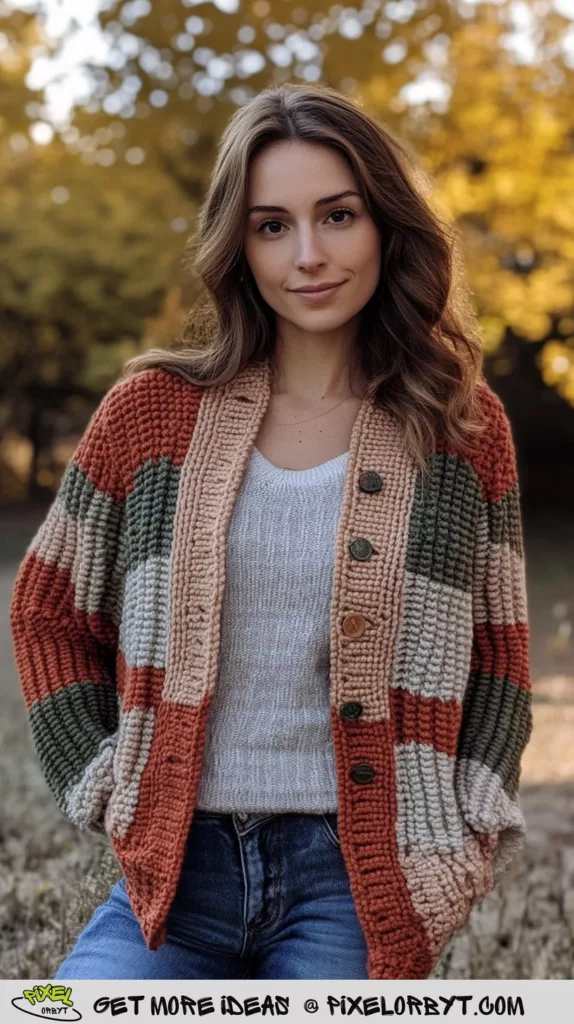
40. Rust, sage and cream in uneven blocks with wooden buttons — uneven sizing looks deliberate, an even split accidental.

41. Black grounding pink, mustard and grey. A dark anchor lets you use shades that would otherwise clash outright.

42. Broad earth-tone stripes with patch pockets, graduated rather than equal in width, which stops the eye sliding straight down.

43. Wide black, cream and tan bands. Metal buttons are the detail that lifts a striped cardigan out of homemade territory.

44. Pastel rainbow stripes in a lace stitch, so the colour reads soft rather than graphic. The shape also works as half of a crochet two-piece set.
Crochet Jackets for Men
Menswear crochet wants a shorter body, a straighter side seam and far less ease. Keep the stitch tight — loose fabric on a boxy shape reads as unfinished.

45. Tan cables with a shawl collar. Crochet cables are front post double crochet: slower than knitting, identical payoff.

46. Dark brown with a stand collar rather than a shawl. Stand collars flop unless firm, so work those rows a hook size down.

47. Openwork in dark brown, so the holes read as texture rather than lace.

48. Long, open, no fastening, in heathered dark yarn. The length is the entire design.

49. Charcoal chunky with a deep shawl collar — make this first if you are crocheting for someone wary of looking crafty.
Choosing Yarn and Hook for a Crochet Jacket
Cotton and bamboo drape and breathe but have no memory — a cotton jacket grows as you wear it, so crochet the body an inch short. Wool springs back, blocks well and holds a shaped shoulder. Acrylic is warm, cheap and washable: the sensible pick for a first jacket you might get wrong.
Buy enough at once: a sleeve from a different dye lot announces itself in daylight. Leftovers turn straight into crochet handbags and totes using the same granny squares.
Personalising Your Jacket
Buttons, edging and pockets change a jacket more than the stitch pattern does. Swap plastic for wood, horn or vintage glass and the whole garment reads differently.
If armhole shaping is putting you off, skip it — a boho granny square poncho is two flat rectangles with no shaping at all, using the same motifs as half the jackets above.
Frequently Asked Questions
How much yarn does a crochet jacket take?
Budget 1,200 to 1,800 metres for a hip-length worsted jacket, and 2,000 to 2,800 for a chunky or duster length. Bobbles, cables and tapestry crochet push that up by roughly a third.
Which stitch is best for a beginner’s first jacket?
Half double crochet in rows. It builds faster than single crochet, stays denser than double crochet, and forgives small tension changes. A plain half double crochet cardigan with a granny square back panel is a realistic first project.
How do I stop my crochet jacket from stretching out of shape?
Use a hook half a size smaller than the ball band suggests, seam the shoulders with slip stitch rather than whip stitch so they cannot give, and store the jacket folded flat rather than hung. Wool recovers after washing; cotton will not, so build the shortfall in from the start.
Can I crochet a jacket without following a pattern?
Yes, if you work in motifs. Make squares, lay them out in the shape of a jacket on the floor, and seam. That is how most granny square jackets are actually made, and it removes nearly all the shaping maths. Freehanding a set-in sleeve is another matter.
Pick the one you would actually wear over the one that photographs best. A plain oatmeal cardigan you reach for weekly beats a patchwork masterpiece that lives in the wardrobe.


