

29 Disney Sketching Ideas (With Pencil References to Draw From)
Disney characters are the drawings most of us started with, and they are far less simple than they look. A Mickey head is a construction test. A Goofy run cycle teaches you more about weight and balance than an hour of stick-figure gestures.
Below are 29 Disney-style sketching ideas, each tied to a reference drawing on this page and to the specific problem it asks you to solve. Work through them in any order.
29 Disney Sketching Ideas to Draw From
1. Donald Duck With His Arms Folded

Fold the arms high and tight, drop the shoulders, turn both feet outward. That combination is what makes the stance read as stubborn rather than relaxed.
2. A Wide-Eyed Child in a Hoodie

Modern Disney faces push the eyes enormous and shrink everything else: eyes set low on the skull, barely a nose, small mouth.
3. A Twirling Princess in a Polka-Dot Bodice

Hair and skirt sweep the same direction, and that is what sells the spin. The dotted bodice is a wrapping exercise – the dots compress toward the edges as the surface curves away.
4. Donald Duck in a Beret, Close Up

A bust crop lets you push much darker than a full body. The collar and beret are the darkest values on the page, framing the pale bill. More of this bold rendering in the cartoon character sketching set.
5. A Fairy Caught Mid-Flight

The body forms one long curve from fingertip to toe. Wings are the trap: thin veined membranes with the background showing through, never filled solid. Flat feet kill the float instantly.
6. A Quiet Profile With a Ponytail

Pure profile is unforgiving – nowhere to hide a misplaced feature. Draw the forehead-to-chin silhouette as one line, then set the eye about one eye-width back from the front of the face.
7. Goofy Mid-Laugh

Goofy’s head is overlapping ovals: long muzzle, domed skull, drooping ears. Laughing stretches the muzzle down and squashes the eyes into half-moons. The colour is accent over graphite, nothing more.
8. Mickey Mouse, Arms Open, Mid-Step

Both ears stay perfect circles seen flat-on however the head turns – that rule is what makes Mickey read as Mickey. Fix the head-to-body ratio at roughly one-to-one before anything else.
9. An Ice Princess Close-Up

Freckles stop a clean princess face from looking like plastic – scatter them unevenly, heavier on one cheek.
10. Mickey With Construction Lines Left In

Leave the scaffolding in on purpose. The centre line and ground line stop him leaning, and keeping them tells you afterwards exactly where your proportions drifted.
11. A Girl Looking Up Over Her Shoulder

The neck twist is the difficulty: shoulders stay square while the head turns and tips back. The gap between shoulder line and jaw is where all the movement comes from.
12. A Sheet of Woodland Expression Studies

Nine heads, one character, nine moods. A grid forces you to change only eyes, brows and mouth while the construction holds steady. Pairs well with the woodland creature studies.
13. Minnie Mouse in Her Polka-Dot Dress

Minnie’s silhouette is a diamond: bow, ears, flared skirt, tiny feet. The heels shift her weight forward and tip the hips.
14. Mickey With a Curling Tail

A calmer pose than the arms-open version, and harder for it. With no gesture to carry the drawing, it all rests on line weight – darker where forms overlap, lighter along top edges.
15. A Bear Cub in a Cap and Jacket

Animals in clothing still need real anatomy underneath: the jacket sits on genuine bear shoulders, the arms cross a barrel chest.
16. Minnie With Both Arms Thrown Wide

An open pose is a hands exercise. Cartoon gloves are four rounded fingers, clear webbing lines, thumb set low. Splay them fully – half-open hands look tentative and drain the pose.
17. A Mickey Head Study

Crop tight and the head is the only problem to solve. Watch the ear attachment – high and toward the back of the skull, not the sides. The muzzle is two cheek circles with the nose on the join.
18. A Ballpoint Concept Figure

Concept artists work in pen because you cannot fuss over it – the line commits and mistakes stay visible. Try a full figure in ballpoint with no pencil underneath. More proportions in the female character sketch collection.
19. Two Kids, One Piggyback Ride

Two figures sharing weight is genuinely hard. His spine curves forward to counterbalance her, and the point where they connect has to look like real pressure.
20. A Puppy Sitting Up

Cartoon puppies are all one formula: enormous head, huge nose, tiny body, oversized paws, small round eyes. Dozens more to drill in the dog sketching gallery.
21. An Upward Gaze With a Long Braid

Looking up shortens the face – nose foreshortens, chin comes forward, the underside of the jaw shows. Most people forget the ear drops as the head tips back.
22. Goofy in Full Stride

Copy this one to understand cartoon action. Nothing is symmetrical: arms swing opposite the legs, the torso twists, the cap tips off-axis. Same principles pose by pose in the action pose breakdowns.
23. A Laughing Girl With Big Curly Hair

Curly hair is drawn as clumps, not curls. Block three or four big masses, shade them, then pick out spiral strands only at the lit edges.
24. A Lanky Street Dog

Long-legged dogs live on the ribcage-to-hip gap: deep chest, high narrow waist, thin legs. The faces cropped at the frame edge imply a wider scene you never have to draw.
25. A Grumpy Man With a Handlebar Moustache

Villains and side characters are built from one exaggerated feature. Here it is the moustache, and the brows, cap brim and jaw all angle down to agree with it. Head structure basics in the portrait drawing guide.
26. A Dog Leaning Over a Ledge

The ledge is never drawn – you infer it from where the chest stops and the paws hang. Let a character touch an object you leave out and the viewer fills it in every time.
27. A Big-Eared Dog Sprawled Forward

The extended paw is a foreshortening exercise: noticeably larger than the far paw and overlapping the chest. Get that size difference wrong and the pose flattens out completely.
28. A Fox in a Ball Gown

Keep the fox skull honest – narrow muzzle, high triangular ears – while the body follows a human dress form. The bow sits at the natural waist, which is higher on a fox than you expect.
29. Mickey on a Skateboard
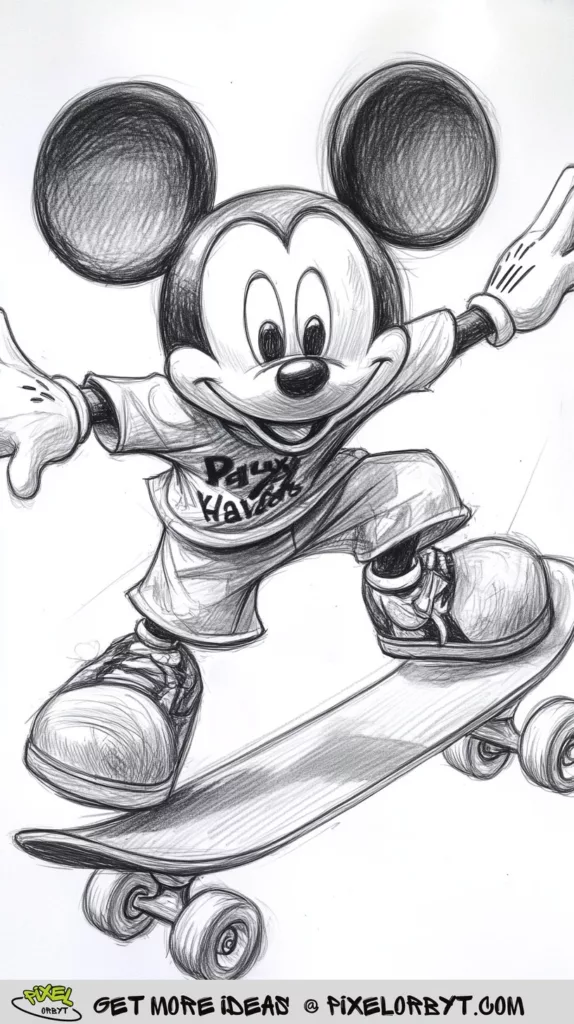
Putting a classic character in a modern setting is the quickest way to make fan art feel like yours. The board sets the angle and the body reacts: knees bent, arms out, torso leaning against the tilt.
Getting More Out of These References
Copying a finished drawing trains your hand but not your eye. Work in this order:
- Gesture it in under 30 seconds – one line for the spine, one for the shoulders, one for the hips.
- Block the big shapes before any detail. Mickey is circles, Goofy is stretched ovals, a princess head is an egg with a jaw.
- Only then commit to line weight, heavier where forms overlap, lighter along top edges.
- Redraw the same character from memory three times. That is where it sticks.
On days when a full character study feels like too much, the Disney coloring pages are a low-pressure way to keep the pencil moving.
Disney Sketching FAQ
Do I need to draw Disney characters exactly on-model?
Not for practice. On-model accuracy matters professionally, but in your own sketchbook the useful part is the construction underneath – ear placement, head-to-body ratio, muzzle build. Get those right and deviations read as style, not error.
Which pencil should I use for these?
An HB for construction and a 2B or 4B for the finished line covers almost everything here. Build the darks in three or four soft passes rather than pressing once – pressing dents the paper and ruins your erasing.
Can I post Disney fan art online?
Sharing personal fan art is normal and widely tolerated, but the characters are trademarked and selling prints or merchandise of them is not. If you want sellable work, use these for construction practice and design original characters in the same style.
What should I draw first as a beginner?
Start with the Mickey head study at number 17 – three circles and a muzzle, with an obvious right answer to check yourself against. Move to Minnie and Donald for full bodies, then the human faces.
Pick five, give each a proper twenty minutes, and you will end the week with a steadier hand. When the character work starts feeling easy, the big-eyed cartoon character studies are the natural next step.


