

27 Dog Coloring Pages: Easy to Detailed (Free Printables)
Dog coloring pages are one of the few printables that genuinely work for the whole household. A four-year-old can fill in a bold cartoon puppy with crayons while an adult sits at the same table layering pencil over a shaggy retriever portrait with a thousand separate fur strands in it. Same subject, wildly different amounts of concentration required.
Below are all 27 pages in this collection, in order, with what makes each one worth printing and how to approach the colouring. They run from thick-lined cartoons to dense adult line art, so it is worth scrolling the whole way down before you send anything to the printer.
1. Golden Retriever and a Curly Little Friend

Two completely different fur textures share one page here: the retriever’s long, straight feathering falls in heavy sweeps down its chest and front legs, while the little bichon next to it is drawn as tight overlapping curls. Colour them the same way and the picture goes flat.
Pull your pencil in long strokes that follow the retriever’s fur direction, then use tiny circular scribbles on the bichon. Leave the flower bed at the bottom for last so you can pick colours that push the two dogs forward.
2. Shaggy Retriever Portrait That Fills the Frame
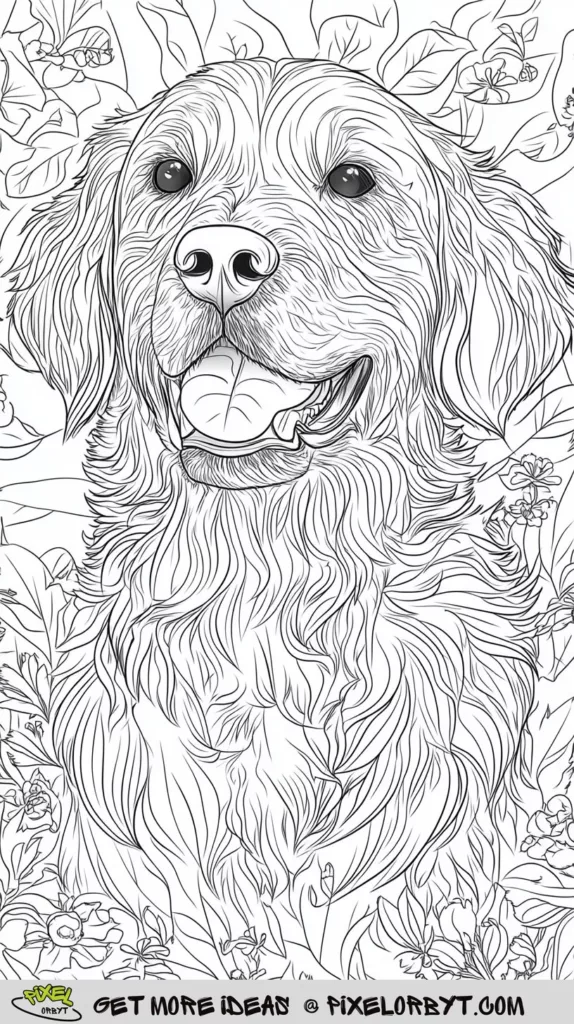
Every strand of this dog’s coat is drawn as a separate line, and the face fills the whole page with flowers packed in behind it. It is the most demanding sheet in the set — there is almost no empty space to rest in.
Work in thin layers rather than pressing hard. Lay a pale sand base over the entire coat first, then come back with a mid-brown only in the shadow channels between the fur clumps. The white you leave under the muzzle and around the eyes is what makes the fur look lit.
3. Great Dane Sitting Square, Clean Outlines Only

No interior detail at all — just a confident outline of a big dog sitting square, chest forward, tail curling out beside one paw. This is the page to hand a five-year-old, or to reach for when you want markers instead of pencils.
Big flat areas take marker beautifully. If you want it to read as a real Great Dane, try a soft grey-blue over the body with a darker grey blocked around the muzzle, which is where the black mask sits on the real breed.
4. Two Puppies Loose in the Living Room

This one is really an interior scene that happens to have puppies in it: a fireplace, an armchair with a cushion, curtains, a potted plant on the mantel, and two pups on the rug with a ball between them.
Colour the room before the dogs. If you do the puppies first you will almost always make the furniture too bright to compete, and they disappear into it. Warm the firelight side of the room and cool the window side — that single decision does most of the work.
5. Puppy Looking Up at Its Mother

Thick cartoon lines, huge eyes, and a puppy tilted right back so it can look up at the adult. The whole story of the drawing is in that upward tilt of the head.
Crayons are fine here — the lines are wide enough to forgive a wobbly hand. Give the parent and the pup the same coat colour but make the puppy a shade or two lighter, the way real puppies usually are before their adult coat comes in.
6. Wire-Haired Terrier Among the Daisies

A scruffy little terrier with its ears set at two different angles and a beard hanging off its chin, sitting behind a screen of daisies that comes up past its chest. Wiry coats are drawn as short broken strokes going every direction, not smooth flowing ones.
Scribble rather than shade. Use two or three close browns and greys layered messily on top of each other, and let some paper show through between the strokes — that gap is what reads as wire hair.
7. German Shepherd Built From Stained-Glass Patterns

This page arrives already coloured, and it is worth studying before you start the others. The artist has cut the shepherd’s ruff into dozens of separate leaf-shaped cells and given each one its own colour, so the chest runs through a full rainbow while the face stays naturalistic.
That is the trick: keep the head believable, then let the coat go wherever you want. If you enjoy this approach, the patterned sections in these zentangle coloring designs work exactly the same way — small shapes, high contrast between neighbours, no blending.
8. Long-Coated Shepherd Sitting in Deep Grass

A long-coated shepherd sitting up straight, mouth open, with a thick ruff spilling around its chest and a few wheat stalks off to one side. The ears are the landmark — set high, wide apart, and slightly outward.
The classic saddle marking works well here: dark, almost black across the back and shoulders, fading to tan on the legs, chest and face. Make that transition gradual rather than drawing a hard border and it instantly looks like a real dog.
9. Whippet Standing Over a Tiny Chihuahua

The whole point of this page is scale. The whippet’s chest sits higher than the chihuahua’s whole body, and its tucked waist and long thin legs make the little dog look even smaller. Getting that size relationship right is the whole battle when you draw a puppy next to a grown dog.
Keep the whippet in a single quiet colour — fawn, dove grey, soft blue — and save your brightest choice for the chihuahua’s collar. One small hot spot of colour anchors the whole composition.
10. Four Puppies Peeking Out of Tall Grass

Only the heads and shoulders of these four make it above the grass line, so most of the page is blades of grass with four grinning faces pushed through it. Each pup has a different patch pattern around the eyes and ears.
Give every puppy a different coat so they read as four individuals, then keep the grass in two greens only — a light one at the top of the blades, a darker one down where they overlap. Too many greens and the faces stop popping.
11. Italian Greyhound Standing on a Wooden Floor

Long neck, deep narrow chest, and legs that look impossibly thin — this is a proper sighthound build, standing on plank flooring with one ear folded down over itself. The plank lines running away behind the dog give you free perspective practice.
Colour the floor with the grain, following the plank direction, and it will look like wood instead of a brown rectangle. Sighthound coats are usually short and shiny, so leave a clean unshaded strip along the top of the back and down the front of each leg.
12. Golden Retriever With a Tennis Ball

A retriever standing over its ball with the tongue out and the tail carried level, feathering hanging off the tail and the backs of the legs. The ball at its feet is the smallest object on the page and the easiest thing to get wrong.
Real tennis balls are yellow-green with white curved seams. Colour it flat yellow and it reads as a lemon. Everything else can be warm golds — build them from a yellow base with light orange in the shadow areas rather than reaching for a single brown.
13. Puppy Watching a Butterfly Go By

A puppy in a collar with a round tag, head tipped up and mouth open, following a butterfly across a cloudy sky. Nice and open — big sky, big grass, not much to fuss over.
The butterfly is the only place on this page where a loud colour belongs. Make it orange or electric blue against a pale sky and keep the puppy in soft tans. If butterflies are your thing, there are far more elaborate wings to fill in over on these butterfly coloring pages.
14. Beagle Puppy Stepping Through the Garden

Enormous dark eyes that are already shaded in, one ear flopped forward and the other pinned back, and a freckled muzzle. The front paw is lifted mid-step, which is why the whole drawing feels like it is coming toward you.
The eyes are done for you, so do not colour over them. Classic beagle colouring is a black saddle over the back, tan on the head and legs, and white on the muzzle, chest and paw tips — three zones, clean edges between them.
15. Two Pugs Standing in a Flower Bed

Two pugs shoulder to shoulder with flowers crowding in over their heads. All the character sits in the wrinkles — the folds above the nose, the loose skin on the brow, the dark mask around the eyes and muzzle.
Pug fawn is a warm sandy colour, and the mask is genuinely almost black. Push that contrast, because a pale mask makes the face look blank. Shade inside each wrinkle rather than along it so the folds look deep instead of drawn on.
16. Greyhound Resting Its Head on Its Paws

A greyhound lying flat with its chin down on its outstretched forelegs, ears still up and eyes open. Much of the shading is already worked into the drawing, so this page is more about tinting than filling.
Work very lightly. Lay a thin wash of colour straight over the existing grey and let the printed shading do the modelling underneath. Press hard and you will lose the muscle definition along the shoulder and thigh that makes the drawing work.
17. Golden Retriever on a Mountain Rock

A retriever sitting on a boulder with a mountain range and a line of pines behind it, mouth open after the climb. The background here is a real landscape, not decoration, so it deserves proper attention.
Distance fades. Make the nearest pines a solid deep green, the mid trees a duller sage, and the far peaks a pale blue-grey with almost no detail. That single rule does more for depth than any amount of shading, and it is the same one used across these landscape coloring pages.
18. Two Puppies in a City Park

The boldest lines in the whole set. Two chunky cartoon puppies on a patch of grass with tree shapes and a flat city skyline behind them — huge open areas and nothing fiddly anywhere.
This is the sheet for the youngest colourists in the house, or for a five-minute break when you do not want to concentrate. Blocking the skyline in a single flat colour and leaving the sky white looks surprisingly sharp.
19. Staffie Running Straight at You

A broad, muscular Staffie coming down a forest path directly toward the viewer, tail up, mouth open. The front legs are foreshortened — squashed short because they are pointing at you — and that is what makes this the trickiest anatomy on the page.
Do not fight the foreshortening; shade it. Darken the inside of the chest between the front legs and keep the shoulders bright, and the dog will push forward out of the background. Short-coated breeds like this show muscle, so shade along the shoulder and thigh masses rather than randomly.
20. Fluffy Puppy in a Little Rowboat

A very fluffy small puppy sitting up in a wooden rowboat with one paw hooked over the side, water lines beneath and round clouds above. The boat’s plank seams and the water ripples give you two different repeating textures to play with.
Keep the puppy pale — cream or soft apricot — so it stands out against a mid-toned boat and darker water. Colouring the water in horizontal bands that get darker toward the bottom of the page gives an easy sense of depth.
21. Winged Labrador Puppy on a Cloud

A perfectly ordinary Labrador puppy sitting on a cloud with butterfly wings coming out of its shoulders and flowers drifting below. The wings are drawn with soft veining rather than hard cells.
Wings like these look best when the colour is strongest at the outer edge and fades toward the body. Colour from the wing tips inward, easing off as you go, and leave the section nearest the shoulders almost untouched.
22. Puppy Picnic Under a Tree

Six puppies around a picnic basket on a checked blanket, under a tree with fallen leaves scattered on the grass. One of them is wearing a heart-shaped tag on its collar.
The blanket check is your friend — two alternating colours in the squares immediately organise a busy page. Give each puppy a different coat and let the tree canopy stay loose and light so it does not crush the scene underneath it.
23. Scruffy Terrier in the Wildflowers

A shaggy terrier sitting chest-deep in wildflowers with its face fur parted straight down the middle over the eyes. The flowers around it are all different — daisies, buds, seed heads — which is unusual and worth using.
Give each flower type its own colour instead of making them all yellow. For the coat, drag your pencil in the direction the fur is drawn, especially where it falls away from the parting on the face.
24. Terrier Looking Up in a Daisy Meadow

The same shaggy build as the previous page but with the chin lifted and the eyes turned skyward, wearing a collar with a heart tag. That raised head changes the whole mood from alert to hopeful.
Daisies are mostly white, so resist filling them in — a pale grey shadow on one side of each petal and a yellow centre is enough. Let the grass carry the colour instead, and the flowers will glow by comparison.
25. Bulldog Sitting in the Doorway

A bulldog sitting square in an open doorway, facing straight out, jowls hanging low and the brow stacked in folds. The door frame boxes the dog neatly, which makes this one of the more graphic compositions here.
Bulldog coats come in fawn, red, brindle and white patches — brindle is the interesting choice, striped in fine dark streaks over a lighter base. Keep the door frame neutral so all the attention stays on that face.
26. Group Selfie With the Family Dog

A retriever’s grinning face fills the foreground of a selfie with three people leaning in behind it and string lights strung overhead. It is the only page in the set with human faces on it.
Skin tones need a light hand: a thin base layer, a touch of pink at the cheeks, and nothing on the highlights. Colour the little bulbs on the string lights warm yellow and leave a white ring around each one so they look lit.
27. Pug on the Beach in a Pearl Collar

A pug sitting on pebbles at the water’s edge wearing a strand of pearls, with the sea and a bank of clouds behind. The pebbles under it are all drawn individually, which is either a treat or a chore depending on your mood.
Vary the pebbles between three or four greys and warm browns rather than doing them all alike. Keeping the sea in cool blue-greens against the pug’s warm fawn coat sets up the contrast the page is built around — the same warm-against-cool idea running through these beach and summer coloring pages.
Printing and Tools That Actually Make a Difference
Standard copy paper is fine for crayons and pencils but buckles the moment a marker touches it. If you are working with alcohol markers, print onto 160gsm cardstock or slide a spare sheet underneath to catch the bleed. For the dense pages — the shaggy retriever portrait, the two pugs, the greyhound — a slightly toothy paper holds several pencil layers without going shiny and refusing to take any more colour.
- Colored pencils: best for the detailed sheets, because you can build a coat up in three or four passes instead of committing on the first stroke.
- Markers: ideal for the bold-line pages like the Great Dane and the city park puppies, where the flat areas are large and the outlines are wide enough to hide a slip.
- Crayons: perfectly good for the cartoon pages, and much less frustrating for small hands than pencils that need pressure to show up.
- A blending stump or a colourless blender pencil: the one item most people skip, and the fastest way to make pencil fur look soft rather than scratchy.
Sharpen more often than feels necessary on the detailed pages. A blunt tip cannot get into the narrow channels between fur clumps, and the moment you start pressing harder to compensate, the strokes get heavy and the fur stops reading as fur.
Choosing Colours That Look Like Real Dogs
Almost no dog is a single colour. A golden retriever runs from pale cream on the feathering to deep red-gold along the back. A German shepherd carries an almost-black saddle that fades to tan at the legs. Even a solid black Labrador shows brown where light hits the muzzle and haunches.
The habit worth building is to pick two pencils per dog instead of one — a base and a shadow — and decide before you start where the light is coming from. Everything on the far side of that light gets the second pencil. It takes no extra time and it is the single biggest difference between a page that looks filled in and a page that looks lit.
If you want to go further, colour one page realistically and the same breed again in whatever colours you like. Working from observation and working from invention train different muscles, which is why plenty of artists keep both a reference-based sketchbook and a set of dog sketching ideas on the go at once.
Colouring These With Children
Hand out the pages by line weight, not by age. The Great Dane outline, the mother-and-puppy cartoon and the city park scene have thick borders and large open shapes — a young child can stay roughly inside them and feel successful. The wire-haired terrier and the mountain retriever will only end in frustration at that age.
Colouring the same page side by side is more fun than it sounds, too. Print two copies, colour them differently, and compare at the end. It quietly teaches that there is no correct answer, which is the hardest lesson to land with kids who are worried about getting things wrong. Plenty of parents keep a stack of animal coloring pages on hand for exactly this reason.
What to Do With the Finished Pages
- Frame the best one. A cheap clip frame turns a coloured page into something a child will actually see hanging up, which matters more than the quality of the colouring.
- Keep them in a ring binder. Punched and dated, a year of pages becomes a visible record of improvement — and improvement is genuinely obvious over that span.
- Cut them into cards. The portrait pages crop neatly to a folded A5 card, and a hand-coloured card for a dog-owning friend lands better than a shop-bought one.
- Use them as gift wrap. Print onto thinner paper, colour loosely, and wrap something small in it. Loose colouring works better here than careful colouring.
- Make bookmarks. Cut a tall strip from the busy backgrounds — the daisy meadow and the wildflower page are perfect — and laminate it.
Colouring as a Way to Settle Down
There is a reason so many people reach for a coloring page at the end of a hard day. Filling in a small area with repetitive strokes occupies just enough of your attention to stop the mental churn, but not so much that it feels like work. Fifteen minutes on the pebbles at the bottom of the pug page does more for a restless evening than most people expect.
Set a small target rather than aiming to finish. One dog, one flower bed, one corner of sky. Coming back to a half-finished page the next evening is part of the appeal, not a failure to complete something. If you want more of that slow repetitive quality, the dense petal work in these flower coloring pages is built for it.
Frequently Asked Questions
What paper should I print dog coloring pages on?
Plain 80gsm copy paper works for pencils and crayons. For markers, use 160gsm cardstock or smooth marker paper so the ink does not bleed through and blur the fine fur lines. If you are layering coloured pencil heavily, a paper with a little texture holds more layers before the surface goes slick.
Which of these pages are best for young children?
The Great Dane outline, the puppy looking up at its mother, and the two puppies in the city park. All three have thick borders, large open shapes and no fine detail, so a child can colour them with crayons and stay roughly inside the lines without getting frustrated.
How do I colour realistic dog fur with pencils?
Work in the direction the fur grows, in short overlapping strokes, and build up in three light layers instead of one heavy one. Lay a pale base over the whole coat, add a mid-tone only in the shadow channels between fur clumps, then leave the highlight areas — top of the head, bridge of the nose, the chest — almost untouched.
Can I use these pages for a class or a group activity?
Yes. Print them at home or at school and use them freely with children, in a classroom, or at a party — that is what they are here for. The set works especially well as a mixed-ability activity, since you can hand out the bold-line sheets and the detailed ones from the same collection.
What should I do if I make a mistake?
Usually nothing. A colour that lands in the wrong place can almost always be absorbed by darkening the area around it or turning it into a shadow. If it really bothers you, reprint the page — it costs a sheet of paper, and the second attempt is nearly always better than the first because you already know where the tricky parts are.
Print a few of these, spread them out on a table, and start with whichever one you keep looking back at. That is usually the one you will finish. And if colouring these leaves you wanting to draw your own, the playful pet sketch ideas in this collection are a natural next step.


