

16 Easy Knitting Ideas for Beginners
Almost everything on this page is a rectangle, a tube, or a rectangle sewn into a tube. Once you can cast on, knit, purl and bind off, the difference between a dishcloth and a phone case is mostly how many stitches you cast on.
The sixteen projects below run from fastest to most patient, and each names the one new thing it teaches — so you can pick the next skill, not the next pretty photo. Never held needles? Start at number five. The 24 knitting ideas for beginners round-up has more small projects when these run out.
Once these feel routine, this wider set of knitting ideas names the single skill behind each project so you can pick your next step deliberately.
When you are ready for a full garment, these modern knitting patterns step up to sweaters and name the actual difficulty in each one.
Once the basics feel comfortable, these machine knitting ideas cover the same projects worked in a fraction of the time.
Before You Cast On
Worsted or aran weight yarn in a light, solid colour, and 5 mm needles. Dark yarn hides your stitches and variegated yarn hides your mistakes — helpful right up until you need to find the one you dropped. Acrylic survives being frogged five times. For a structured first pattern, the beginner knitting projects list has full instructions.
16 Easy Knitting Ideas for Beginners
1. Cable-Knit Phone Case

The cheapest way to learn cables. About twenty stitches, with one crossing every eighth row, is enough to make the whole thing look complicated. Knit it slightly narrower than your phone — the fabric stretches, and a loose case lets the phone slide out of your pocket.

The caramel version uses three narrow cables instead of one wide one — easier to track, since every crossing lands on the same row.

Cream is the hardest colour to keep clean and the easiest to read. Leave a generous camera cut-out and bind off loosely across the top.
2. A Striped Sweater for Your Dog

Small enough that a stripe sequence you would tire of on an adult jumper stays fun. Measure neck to tail and around the deepest part of the chest, then knit a tube with holes for the front legs. Carry unused colours up the side instead of cutting each stripe. Full-size versions live in the free knitted sweater patterns collection.
3. Baby Booties With Button Straps

Shaping on a scale you can finish in an evening: ribbed cuff, stockinette foot, then decreases every other stitch to close the toe. The wooden button does real work — a strap holds a bootie on a kicking baby far better than elastic. Use superwash wool or acrylic; these get washed constantly.
4. Colour-Block Mittens

The thumb gusset is the only hard part; everything before it is a ribbed cuff and everything after is a tube. Working cuff, hand and tip in three colours gives you three natural places to stop. They make good gifts, which is why they reappear in the Christmas knitting ideas round-up.
5. Tasselled Bookmark

Cast on ten stitches, knit every row for about seven inches, bind off, tie on a tassel. That is the whole pattern — and the best first project, because at this size uneven tension reads as texture rather than error.

Once the shape is easy, add a slipped-stitch edge: slip the first stitch of every row purlwise and you get a clean chain up both sides instead of a lumpy one.

The tassel is what people notice. Wrap yarn round a card twenty times, tie the bundle at the top, cut the bottom loop, then bind a separate strand round the neck and trim the ends flat.
6. Owl Softie

A flat rectangle seamed into a tube, gathered at the base, stuffed, gathered again at the top — the corners of that top seam become the ears, with no extra shaping. The face goes on afterwards, and eye placement decides the whole personality.

Same construction, different character: wide round button eyes set close together turn the sleepy owl into a startled one. Weight the base with rice instead of fibrefill and it works as a doorstop.
7. Fringed Triangle Shawl

Cast on three stitches and increase one at each end of every right-side row; the shape makes itself. Gradient yarn does the colour work, so you never join a ball mid-row. Knot the fringe on after blocking, four strands per bundle.
8. Little Heart Keychain

Two small hearts sewn together round a little stuffing, with an i-cord loop for the ring. About five yards of yarn, so it is the ideal use for tail ends. Knit it tightly — loose stitches let the stuffing show through. More small hangers in the free knitted seaside keychain patterns.
9. Openwork Ombré Wrap

This looks like lace and is not: knit two together, yarn over, repeated across the row, gives the whole mesh. The rule that catches everyone is that each yarn over must be paired with a decrease, or the stitch count creeps up and the edges flare.
10. Cable Zip Pouch

Two rectangles seamed on three sides, with a zip hand-sewn into the top. Line it with cotton first — unlined, the zip tape drags on the stitches and the top edge stretches out of shape within a week.
11. Cable Headband and Cowl Set

A strip of ribbing with one fat cable down the centre, seamed into a ring. Knit it two inches shorter than your head measurement so it grips. The cowl is the same pattern on more stitches — the quickest way to make two objects look like a set.
12. Garter Stitch Tote Bag

Garter stitch is dense and barely stretches sideways, which is what a bag carrying weight needs. Knit one long rectangle, fold, seam the sides, then pick up stitches for the straps rather than sewing them on — picked-up straps pull against the whole top edge instead of tearing two holes.
13. Braided Rainbow Bracelet

Three i-cords plaited and joined into a loop. An i-cord is four stitches on double-pointed needles that you never turn: knit the row, slide the stitches back to the other end, pull the yarn across the back, knit again.

Braid loosely enough that the plait lies flat on the wrist. If double-pointed needles feel like too much, finger knitting makes the same cords with no needles at all.
14. Chunky Variegated Cowl

Long enough to loop twice means roughly 60 inches, and chunky yarn on 8 mm needles gets there in two evenings. Give the strip one half-twist before seaming — that Möbius turn is why the loops sit flat instead of bunching at the back of the neck.
15. Mesh Market Bag

Same yarn-over-and-decrease pattern as the wrap at number nine, worked in cotton on large needles so the holes stay open. Cotton has no memory: it stretches under shopping and stays stretched, so knit the bag noticeably smaller than you want it.
16. Chunky Cable Blanket
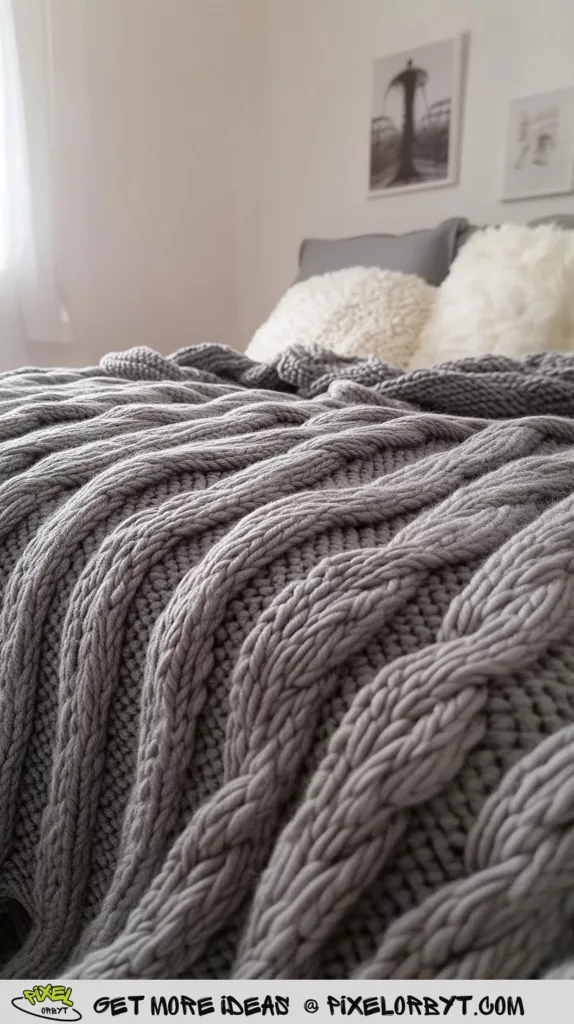
The most patient project here, and still only knits and purls. Super-bulky yarn on 12 mm needles makes a blanket a weekend rather than a winter, and cables at that scale need no chart. Knit it in panels and seam them if the full width gets too heavy. Loom knitting is a kinder option if your wrists complain.
Frequently Asked Questions
How long should my first project actually take?
A bookmark or keychain, an evening. A phone case, headband or booties, two or three. A chunky cowl is a weekend; a blanket is several. If yours drags well past that, the yarn is probably too thin for the needles — going up a weight is not cheating.
Why do my edges curl in?
Stockinette curls. That is the fabric behaving normally, not a mistake. Add three or four stitches of garter or ribbing down each side, plus a few rows top and bottom, and it lies flat — which is why so many beginner patterns start and end with ribbing.
Why is my rectangle wider at the top than the bottom?
You are gaining a stitch at the start of rows, usually by knitting into the gap where the yarn crosses the edge. Count every few rows while you are learning; slipping the first stitch purlwise makes that edge stitch obvious and mostly ends it.
Do I need to learn to purl straight away?
No. Plenty of these work in garter stitch, i-cord or the round, where knit stitches alone carry you. Learn purl when you want ribbing — the headband and mitten cuffs are the natural moment.
Where to Go Next
Pick one project, buy one ball of yarn for it, and finish it before buying anything else — half-done knitting in a bag is the main reason people decide they are not knitters. Once these feel easy, free knitting scarf patterns are the natural next step: same stitches, more room for a repeat longer than eight rows.


