

27 Easy Pig Pencil Sketch Ideas With Drawing Tips
A pig is two circles and a wedge. That is the whole armature — a big oval for the barrel of the body, a smaller circle for the head, and a blunt cylinder for the snout. Everything that makes a pig sketch look right after that is proportion and value, not complicated line work.
The 27 references below run from a two-minute piglet portrait to a fully dressed pig in denim boots. Each names the specific thing it teaches, so you can pick the drawing that matches the skill you are fixing rather than sketching at random.
1. Pig in a Plaid Flannel Shirt

A bust portrait of a pig in an unbuttoned plaid shirt, forearms folded. The head stays fully animal — wide-set eyes, wrinkled snout bridge, cartilage ridges in the ears — while the shoulders read as human posture. Draw the plaid last and bend the check lines where the cloth folds; ruler-straight lines flatten the shirt instantly.
2. Pig Riding a Bicycle, Head-On

The pig is the easy half. From head-on the front wheel is a narrow vertical ellipse, not a circle, and the rear wheel hides almost entirely behind it. Block the bike as a stick armature — one vertical for the fork, a shallow ellipse per wheel, a bar for the handlebars — before any hoof or tooth goes down.
3. Two Piglets Standing in a Puddle

Reflections are not mirror copies: they sit darker, softer at the edges, and broken by ripples, so draw yours at roughly 70% of the contrast of the pigs above. The muddy hoofprints scattered around the puddle do more work than the pigs do — they anchor both animals to the same ground plane.
4. Three Piglets Huddled Together

Three heads stacked in a pile, the pink snouts the only colour in an otherwise graphite drawing. The lesson is occlusion — the front piglet gets a complete unbroken outline and the two behind it get cut off by that edge. Draw front to back; reverse the order and you erase overlaps forever. The same rule governs any litter of young animals.
5. Two Piglets, One Turning to the Other

One piglet faces forward, the other turns its head in, and that single turn creates a diagonal through what would otherwise be a static lineup. Watch the wrinkle rings across the bridge of the turning snout: they compress on the inside of the turn and stretch on the outside, which is what makes the head read as a solid cylinder.
6. Two Piglets Cheek to Cheek

Both faces are frontal, so the only thing separating them is value — the far pig needs a full step more tone or the two heads merge into one mass. Ears are semi-transparent: where light comes through from behind, the inner ear goes lighter than the head with vein cartilage branching darker across it.
7. Piglet Walking Through Grass

The walk reads because one foreleg is lifted and soft at the hoof while the other three stay planted and crisp. Do not draw every blade of grass — flick the pencil upward in loose clumps, dark at the base and fading at the tips, leaving patches of clean paper. Even coverage looks like carpet.
8. Pig Under an Overhanging Branch

The pig sits small and light at the bottom while a dense dark branch fills the top third, so the heaviest tone in the picture is above the subject and pushes your eye down to it. Render the canopy as clumps of tone with white paper punched through rather than individual leaves — the same massing that drives most pencil tree studies.
9. Pig Lying at the Foot of a Tree

Lying poses fail when the body still looks like a standing body tipped over. The belly has to spread and flatten where it meets the ground and the near foreleg tucks under. Contrast the textures hard: broken vertical strokes for bark, long blended tone for the flank. That difference makes graphite read as two materials.
10. Pig Standing Beside a Tree Trunk

A plain head-on pig with a trunk running vertically behind it, doing composition work — the vertical gives the round body something to sit against instead of floating in empty space. Place the trunk slightly off-centre. Directly behind the head it looks like the pig is growing out of it; offset, it reads as depth.
11. Pig Resting in Fallen Leaves

Leaves lying flat on the ground are ellipses seen at a steep angle, narrowing and crowding together as they recede. Keep the ones nearest the pig detailed and let the far ones collapse into pure tone — detailing every leaf equally is the fastest way to make a background compete with your subject.
12. Pig Trotting Toward the Viewer

The hardest angle in the set. Chest and shoulders are close so they read wide; the hindquarters are far away and shrink dramatically, yet the pig must still feel one continuous length. Measure head width against chest width with your pencil at arm’s length — beginners draw the back half too big because they know how long a pig is.
13. Piglet Leaping for a Balloon

The pose works because the centre of gravity sits outside the feet: drop a vertical line from the chest and it should miss the hooves entirely. The balloon is the only colour on the page, which makes it the focal point by default — restraint worth borrowing whenever you add a single colour accent to a pencil sketch.
14. Piglet Holding a Balloon String

Upright on two legs with one trotter pinched around a string and a balloon deliberately oversized for the body — that exaggeration is what makes it charming rather than odd. The string is one confident line drawn in a single pass; sketch it ten times lightly and it turns into a fuzzy rope.
15. Pig Drinking From a Bowl

The dropped ear is the honest detail — when a pig lowers its head the ear swings forward under gravity instead of staying perked. The bowl rim is an ellipse and its far edge must stay visible behind the snout. Hide that far edge and the bowl becomes a flat crescent stuck to the paper.
16. Piglet Cradling a Round Fruit

A close-up with the chin down over crossed trotters and something smooth and round held underneath. The contrast is the point: fine broken hair strokes on the face against an unbroken gradient on the fruit. Leave a clean highlight on the fruit and never touch it — graphite cannot go lighter than paper.
17. Standing Piglet, Three-Quarter View

The most useful practice pose here: turned about thirty degrees off centre so you see body length and face together, which neither a profile nor a front view gives you. The two ears will not match and should not — the near ear is wider and lower on the page, the far ear narrower and higher.
18. Piglet Resting Its Chin on Its Trotters

A symmetrical head-on portrait, chin dropped between the trotters as if leaning over a gate. Symmetry is unforgiving — a millimetre of drift between the eyes shows immediately. Draw a light vertical centre line and a horizontal eye line first, then measure both eyes off the centre rather than off each other.
19. Minimal Piglet Value Study

No background, no props, no scene. Strip everything away and the only thing holding the drawing up is value control, which is exactly why this one is worth doing. Limit yourself to three tones — light body, mid shadow side and ear interiors, dark eyes, nostrils and hooves. Three separated values beat twenty muddy ones.
20. Piglet Sketch With the Pencils in Shot
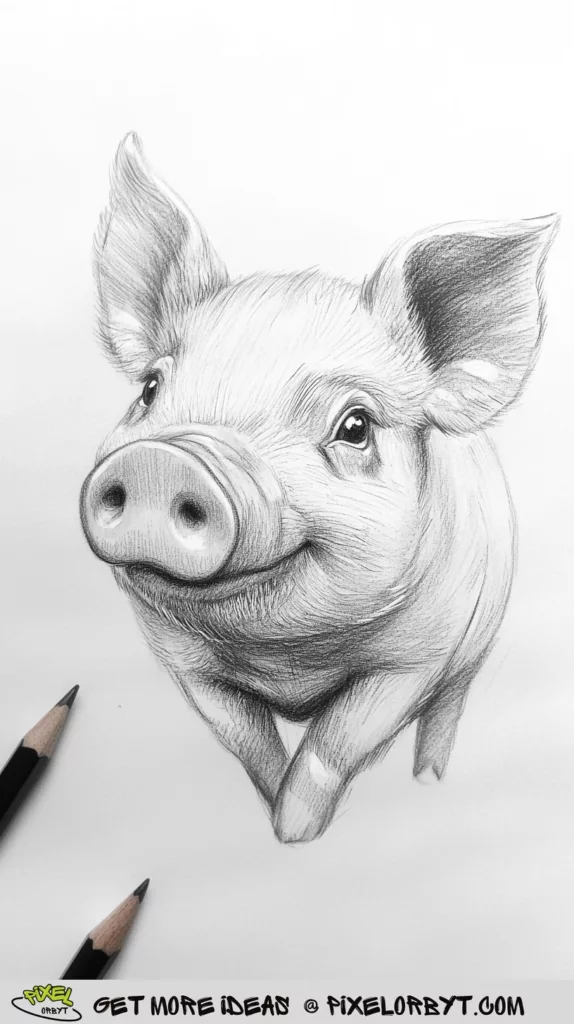
Two soft pencils lying beside the finished piglet, and worth copying as a study of what grades actually do: the darkest accents here are unreachable with an HB no matter how hard you press. Use 2B for body tone, 4B for the shadow side, 6B only for eyes, nostrils and the crease behind the ear.
21. Close-Up Pig Head Study

Cropped tight to the head, which forces you to solve the ear — its cartilage ridges, its curl, and the light passing through the thin part near the tip. Build it in two passes: flat mid-tone over the whole shape, then lift the backlit edge with a kneaded eraser. Subtracting gives a glow shading alone cannot.
22. Pig With Its Hooves on a Pumpkin

The pumpkin’s ribs are the technical challenge. They are not straight lines but curves that follow the sphere and compress toward the outer edges. Draw the pumpkin as a sphere first and wrap light curved guidelines around it like lines of longitude, then put the ribs on those guides.
23. Pig Among Wildflowers
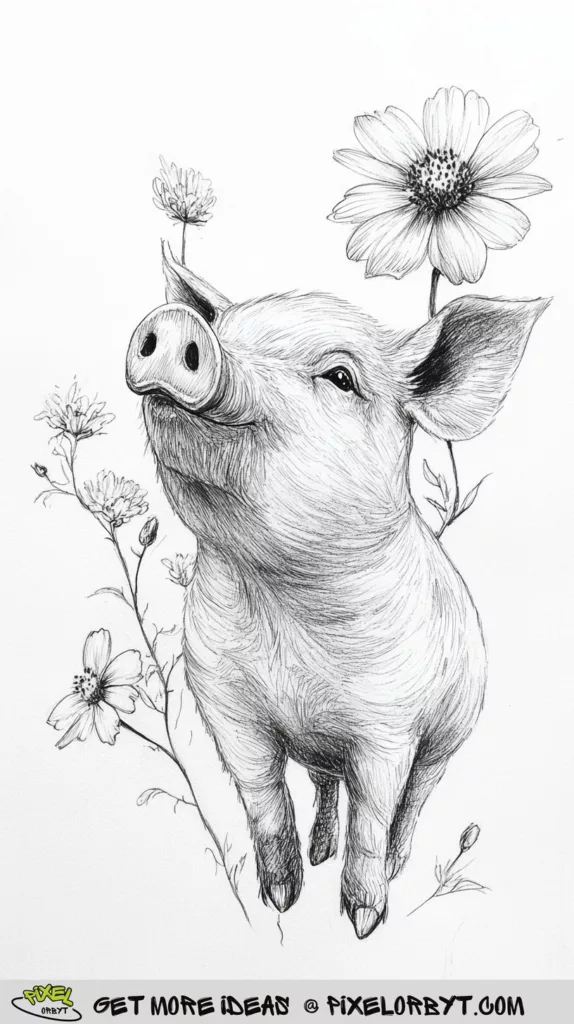
The flowers are pure contour line with almost no shading while the pig is fully rendered, and that deliberate mismatch is what keeps the animal in front. Draw each stem as one continuous flowing line from the ground up, then add the bloom — stems built from short repeated strokes look brittle and dead.
24. Cartoon Piglet Holding a Daisy

The one openly cartoon drawing here: oversized snout, wide grin, tiny legs, a daisy in one trotter. Simplifying well means keeping the two or three features that say pig — the flat disc of the snout with two dark nostrils, and the floppy triangular ears — and rounding off everything else. It is why this style suits easy animal drawings for kids.
25. Pig in a Draped Shirt

The cloth is the subject, not the pig. Folds gather at the elbows and fall in long pipes below, and every one of them radiates from a point where the fabric is pinched or supported. Find those anchor points first — folds scattered at random read as crumpled paper. More on drawing fabric folds and texture.
26. Pig in a Hoodie on a Bicycle

Compared with the head-on bike earlier, this three-quarter angle is far more forgiving because both wheels read as open ellipses instead of narrow slivers. The hood is what sells it: a soft cone collapsed behind the neck, with the drawstring catching on it and hanging asymmetrically. Draw the two cord ends at different lengths.
27. Pig in a Denim Jacket and Boots

The most involved sketch on the page — a full standing figure in denim, a second jacket over one arm, boots planted. The weight sits on one leg, dropping that hip and tilting the shoulders the opposite way. Mark the hip line and shoulder line as two slanted dashes before drawing any clothing.
Building Any Pig From Two Circles
Every drawing above starts the same way: a large oval for the barrel, a smaller circle for the skull set into it, a short cylinder for the snout, four stubby columns for the legs. Get those five shapes into the right relationship and the pig is structurally finished — the rest is surface.
- Body to head ratio. An adult pig’s body oval runs roughly two and a half head-lengths; a piglet’s is closer to two. Use the adult ratio on a piglet and it reads as a small adult, not a baby.
- Leg length. Legs are short — about one head-length from belly to ground. When a pig looks wrong and you cannot say why, measure the legs first.
- Snout attachment. The snout is a cylinder pushed into the skull at a slight downward angle, not a cone stuck on the tip. Draw the far edge of its disc even when barely visible.
- Eye placement. Pig eyes sit high and far apart, close to the base of the ears. Placing them low and central gives you a dog.
If shapes-first feels unfamiliar, run through a few general sketching exercises for beginners before returning to animals — the habit transfers directly.
Shading a Pig Without Losing the Form
Pig skin is smooth with sparse, wiry hair, which means it takes light in broad soft gradients rather than the tufted patches you would draw on a dog. Blend the flanks, but stop blending before you reach the edges — a fully blended outline dissolves the animal.
- Follow the curve. Lay your strokes around the barrel of the body, not up and down it. Cross-contour shading describes the roundness on its own, before any blending happens.
- Wrinkles are shadow, not line. The rings across a snout and the creases behind the ears are grooves. Draw them as short dark tapers that fade at both ends, never as full-length outlines.
- Keep the belly dark. Reflected light from the ground lifts the very bottom edge slightly, but the underside stays the darkest area of the body. Beginners light it too evenly and the pig floats.
- Reserve your whites. The wet tip of the snout and the top of each ear are the brightest points. Leave the paper untouched there from the first stroke.
That value logic carries across species, so keep practising with realistic animal pencil studies once the pigs feel comfortable.
Three Mistakes That Make Pig Sketches Look Off
- Matching ears. Unless the head is dead-on frontal, the two ears differ in width, height and angle. Symmetrical ears on a turned head are the loudest error on this list.
- Legs too long. A pig with correct legs looks almost comically low-slung on paper. Trust the measurement over the instinct.
- Outlining the whole silhouette. A hard continuous line flattens the animal. Let the outline break and lighten wherever the form turns toward the light.
What You Actually Need
- 2B, 4B and 6B pencils — soft grey through to true black. One HB will not cover it.
- A kneaded eraser for lifting highlights out of shaded ears without scrubbing the paper.
- Medium-tooth paper around 160gsm. Smooth paper refuses to hold the darks these drawings need.
- A blending stump. Fingers leave oil that resists further graphite. A stump costs almost nothing.
Pig Sketching FAQ
What is the easiest pig sketch for a complete beginner?
The minimal value study — a piglet head-on with no background. It removes perspective, props and scenery, so the only skill tested is separating three tones cleanly. Most people get a convincing result first try.
Why do my pigs look like dogs?
Almost always eye placement and snout shape. Pig eyes sit high and wide apart near the ear bases, and the snout ends in a flat disc rather than tapering. Move the eyes up, flatten the nose, and the species changes immediately.
How do I draw a curly pig tail so it does not look flat?
Draw it as a spring seen from the side, not a spiral drawn on the page. Vary the line weight — thicker where the tail passes in front of itself, thinner where it goes behind — and the coil gains depth in two strokes.
How long should one of these take?
Plain head studies run fifteen to twenty minutes. Scenes with trees, water or leaves take an hour or more, mostly on the background. Short sitting? Work the portraits and save the full scenes for later.
If you are building skill deliberately, work through these by difficulty rather than page order: the value study, then the three-quarter piglet, then the huddled group, then the scenes with backgrounds, and finally the dressed characters. Each step adds one new problem instead of five at once. Keep the finished ones too — six months of pig sketches stacked together shows progress no single drawing can. For more animals in the meantime, the simple animal pencil drawing ideas collection follows the same shapes-first approach.


