

22 Free Giraffe Coloring Pages: Easy to Intricate (Printable)
Giraffes are one of the easiest animals to color badly and one of the most satisfying to color well. The neck eats up half the page, the spots want to be filled in flat orange, and the legs are so thin that most people press too hard and lose them. The 22 free giraffe coloring pages below are sorted so you can pick by difficulty rather than by cuteness — chunky toddler outlines near the start and end, zentangle-level detail in the middle, and a few pages where the giraffe is wearing a hoodie. Every page prints on standard letter or A4.
1. Giraffe by the Watering Hole

A full-body giraffe standing at the edge of the water, drawn with thick, forgiving outlines. The useful thing here is the background: the bushes and clouds are sketched in thin lines, so if you color them at full pressure they will fight the giraffe for attention. Keep the shrubs pale and the sky barely tinted, and the animal stays the subject. The tail tuft and the short mane running down the neck are the two spots worth going darker on.
One of the friendliest giraffe scenes for small children actually sits inside the baby princess coloring pages, where a princess stands feeding a spotted giraffe under a pair of trees.
2. Big-Eyed Giraffe Portrait

Head and neck fill the frame, with long lashes and leafy plants crowding the bottom corners. Because the neck is one long column of patches, this page rewards varying the patch color slightly — a few shades of tan and ochre rather than one flat brown — so the neck reads as round instead of flat. Leave a pale strip down the left edge of the neck where the light would land.
3. Grazing Giraffe Reaching a Branch

Realistically proportioned, with the neck stretched into a long diagonal to reach the leaves overhead. That diagonal is what makes the page work — the whole body leans, and the back legs are planted further back to balance it. Color the leaf canopy at the top darker than the shrubs at the bottom and you get instant depth. This one sits close to the pencil work in our realistic animal pencil drawing and sketching collection if you want to try shading it rather than coloring it flat.
4. Giraffe in a Hoodie and Cargo Shorts

A giraffe standing on two legs in an oversized hoodie, knee-length cargo shorts and chunky sneakers. The drawstrings, pocket seams and the fold lines under the arms are all drawn in — treat them as fabric folds, not outlines, and shade just inside each crease. Pick one loud color for the hoodie and keep the shorts and shoes neutral, or the outfit turns to noise. Anyone who enjoys this page will find more of the same thinking in our outfit drawing ideas.
5. Chibi Baby Giraffe in the Flowers

Big head, short legs, enormous glossy eyes — chibi proportions that kids gravitate to immediately. Leave the two white highlight dots in each eye uncolored; filling them in is the single mistake that flattens a face like this. The scattered flowers and leaves around the feet are small enough to take a bright accent color without overwhelming the calf, so that is where the loudest pink or yellow belongs.
6. Zentangle Giraffe with Daisies

The first genuinely adult page in the set. The giraffe’s face is broken into leaf shapes, scales and stippled cells, and two oversized daisies crowd the bottom of the frame. Do not try to give every cell its own color. Choose three or four hues, repeat them in a rotation across the pattern, and the whole face holds together. Fine-tip pens beat pencils here. If this is your kind of page, the zentangle animal drawing ideas post covers how these patterns are built in the first place.
7. Bold-Outline Baby Giraffe

The thickest lines in the whole collection, an empty background, and solid black hooves and horn tips already filled for you. This is the page for a three-year-old with a fat crayon: there is nothing small enough to miss and no background to get lost in. The half-dozen spots along the flank are large and widely spaced, which makes it a gentle first lesson in leaving white space between shapes.
8. Giraffe Under a Rainbow

A rainbow arcs behind the giraffe, its bands wide enough to color without a fine point. This page is a free color-order lesson: run the bands red, orange, yellow, green, blue, violet from the outside in and the arc looks right instantly. Keep the clouds white or the palest grey — a colored sky behind a rainbow kills the whole effect.
9. Giraffe Wearing a Scarf

The scarf is wound three times around a very long neck, which is funnier and more useful than it sounds — it breaks the neck into segments and gives you a place to put a strong color. Blank background, so the giraffe carries the page alone. Try striping the scarf and leaving the body in muted tans; the contrast does all the work.
10. Giraffe Peeking Between Two Trees

The head pokes out between two tree trunks while the body stays half-hidden behind them — a simple bit of overlap that teaches depth better than any explanation. Color the trunks a shade darker than the giraffe so they clearly sit in front. The bark texture is drawn as long vertical strokes, so pull your pencil in the same direction rather than scribbling across it.
11. Smiling Giraffe Close-Up
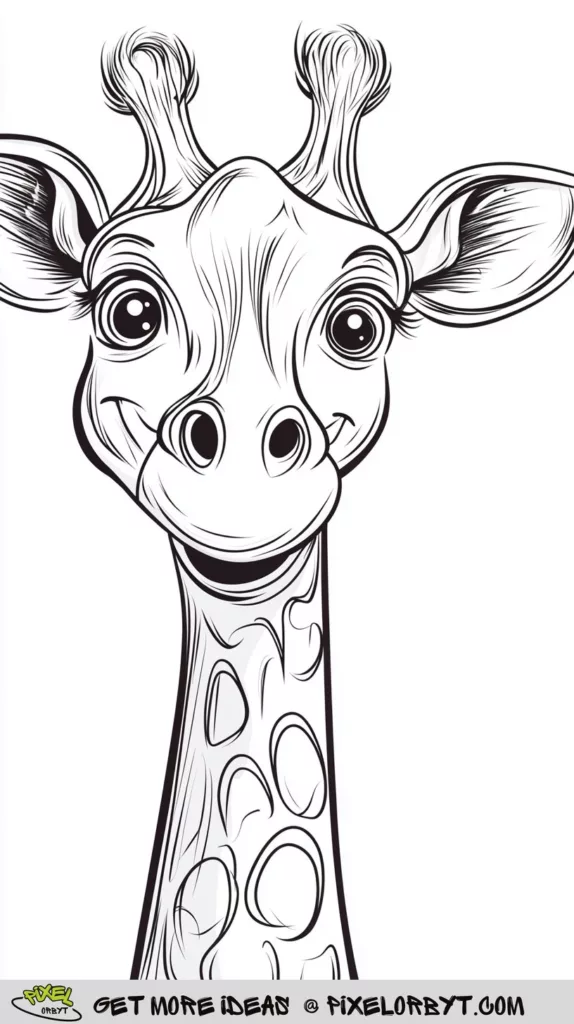
Ears out wide, a broad grin, and no background at all. With nothing else on the page the only decision that matters is the patches: keep them irregular. Real giraffe patches are lopsided polygons with pale channels between them, and even on a cartoon face copying that irregularity makes the neck look like a giraffe rather than a chessboard.
12. Intricate Patterned Giraffe Head

The most demanding page in the set. Every patch on the face carries its own internal pattern, and the leaves and flowers behind are packed edge to edge. Plan on an hour or more, and work outward from the eyes so the face is settled before you commit to the background. A light box or a window helps if you want to test a palette on a photocopy first.
13. Giraffe with a Saddlebag on the Trail

A packed saddlebag is strapped over the giraffe’s back with visible buckles and straps, and it is picking its way along a rocky trail. Leather is the interesting problem here: color the bag mid-brown, then darken only the creases and the underside of each flap, leaving the top surfaces light. That two-step approach turns a flat shape into an object with weight.
14. Giraffe in a Wide-Brimmed Hat

A floppy sun hat with a feather tucked into the band, worn at an angle, and the giraffe caught mid-stride with one front leg lifted. The hat brim curves over the head in a shallow S — shade the underside of that brim and the hat stops looking like a sticker and starts sitting on the skull. The walking pose is what gives the page its bounce.
15. Two Giraffes in the Tall Grass

A calf and a larger giraffe rise out of the grass, the bigger one with its tongue out. This is the page to hand two children at once — one takes each giraffe, and the shared grass at the bottom forces them to agree on a green. Giving the two animals slightly different patch colors, rather than identical ones, is what makes them read as two individuals.
16. Giraffe in the Zoo Enclosure

Wooden rail fence in the foreground, a spreading shade tree above, low hills on the horizon. Three depth planes in one drawing, which makes it a small lesson in atmospheric perspective: fence darkest, giraffe and tree mid-tone, hills palest. Get that order right and the page gains real distance. The same layering runs through our landscape coloring pages.
17. Young Giraffe Stretching for Leaves

A young giraffe tips its head back toward a branch entering from the top right corner, and the tilt of the head is the whole drawing. Plenty of open white space, big spots, thin grass at the base — an easy page that still tells a story. It works well as a first animal page for a child who has outgrown pure shape-tracing.
18. Mother and Calf Among the Branches

The most naturalistic drawing here: an adult and a calf pressed close together, faces rendered with fine hatching around the muzzle and eyes, leafy branches woven across both bodies. The muzzle stippling is already drawn — color over it lightly rather than filling it in solid, or you lose the texture that makes these two faces convincing. The size difference between the adult’s head and the calf’s is the second thing to protect — shade them at the same weight and the calf stops reading as young.
19. Giraffe in a Rope Harness

A grinning giraffe suspended in a strap harness, with ropes running off to trees on both sides. The ropes are long unbroken lines crossing the whole page, and they are the trap — a heavy color turns them into fences. Keep them light and thin so the giraffe still floats. The dense foliage on either side gives you room to play with several greens at once.
20. Two Simple Giraffes Side by Side

Two giraffes reduced to their simplest possible shapes — one tall, one short, a handful of teardrop spots each, and a few blades of grass. Nothing here needs precision, which makes it the best page in the set for a child who gets frustrated by detail. It also doubles as a size-comparison exercise: same animal, two heights, side by side.
21. Lumberjack Giraffe with an Axe

Plaid flannel jacket, laced work boots, an axe resting over one shoulder, pine trees behind. The plaid is the fun part and the reason to slow down: color all the vertical bands first, then all the horizontal ones in a second pass, and let the overlaps go darker where the two cross. That single trick is what makes plaid look woven instead of drawn. The boots have visible laces and a chunky sole, both worth a darker tone than the jacket so the giraffe stays planted on the ground.
22. Tall Giraffe Against the Clouds

A full-length giraffe drawn with fine, decorative linework, standing against billowing clouds with plants around its feet. It closes the set the way it should: the height is the subject, so resist filling the sky. A soft graded blue at the top fading to white near the horizon keeps the eye traveling up the neck, which is exactly where a giraffe page wants it.
Getting Giraffe Patches Right
Most giraffe pages fall apart in the same place — the spots. Flat orange in every patch reads as wallpaper. Three fixes solve almost all of it:
- Vary the tone patch to patch. Two or three browns rotated at random beat one brown repeated forty times.
- Keep the channels pale. The cream gaps between patches are what makes the pattern legible. Do not color into them.
- Darken toward the belly and the far legs. Light comes from above, so the underside of the barrel and the two legs on the far side should sit a step darker than the rest.
- Follow the neck’s curve. Patches wrap around a cylinder, so they should narrow slightly toward the edges of the neck rather than staying the same width across.
- Watch the leg width. Giraffe legs are thin, and pressing hard right up to the outline swallows them. Color to just inside the line and let the white edge stay.
Realistic tans, greys and cream will always look convincing, but nothing stops a pink or teal giraffe. The pattern is doing the identifying work, not the color — which is exactly why giraffes show up so often in animal coloring pages collections.
Choosing the Right Page for the Right Person
Difficulty matters more than subject when you are handing a page to someone. Pages 7 and 20 have the thickest lines and the least detail — those are the toddler and preschool pages. Pages 1, 5, 8, 10, 11, 15 and 17 sit in the comfortable middle: recognizable scenes, plenty of open space, nothing that demands a fine point. Pages 6, 12, 18 and 22 are the adult end of the collection, and they will take an hour or more each.
Time is the other thing worth matching. A bold page is done in ten or fifteen minutes, which is roughly how long a young child stays with one sheet before wanting a new one — so print two or three at once. The detailed pages run the other way: they are meant to be picked up and put down over several sittings, and they suffer if you rush the last quarter. If you only have twenty minutes, start a simple page rather than a third of a complicated one.
The costumed giraffes — the hoodie, the scarf, the hat, the lumberjack — occupy their own category. They pull in children who have decided animal pages are boring, because the character is the draw rather than the animal. Once someone is enjoying those, sketching their own version is a small step, and pages like these sit well alongside easy cute animal drawing ideas.
Printing and Materials
Print at 100% scale rather than “fit to page” — scaling shrinks the thin lines on the detailed pages until they close up. Standard copy paper is fine for crayons and colored pencils, but markers bleed through it. For pages 6, 12, 18 and 22, or anything you plan to use markers on, cardstock around 160gsm is worth the extra cost.
Colored pencils suit the detailed pages because you can build tone in layers and correct as you go. Markers are better for the bold pages, where flat blocks of color are the point. Gel pens are excellent on the zentangle designs. And print two copies of any page worth keeping — the second one lets you try a palette without fear of ruining the first, the same habit that pays off across the nature coloring pages and other detailed sets on the site.
Frequently Asked Questions
Are these giraffe coloring pages free to print?
Yes. All 22 pages are free for personal, classroom and library use. Save the image or print straight from the page at 100% scale. They are not licensed for resale or for redistribution as your own printable pack.
Which pages work for a three or four-year-old?
Pages 7 and 20. Both use thick outlines, large shapes and almost no background, so a chunky crayon can cover them without frustration. Page 11 is the next step up — still simple, but with patches small enough to require a little aim.
What colors are real giraffes?
Patches range from pale sandy tan to deep chestnut brown, separated by cream or off-white channels. Older males darken with age, so the deepest browns belong on the big adults. Legs stay lighter than the body below the knee, and the muzzle is greyish rather than brown.
How do I stop markers bleeding through the paper?
Print on cardstock, or slide a scrap sheet behind the page to catch what soaks through. Work in short strokes rather than holding the tip still — most bleed happens when a marker sits in one spot and floods the fibers.
Start Anywhere
You do not have to work through these in order. Pick the page that matches the mood — ten easy minutes with the bold-outline calf, or an evening with the zentangle head and a set of gel pens. The giraffe is a generous subject either way: the shape is unmistakable, the pattern is forgiving, and there is no wrong color for a spot. Print a couple, sharpen something, and see where they end up. When you are ready for a different animal, our deer coloring pages ask for the same patience with a very different silhouette.


