

18 Harry Potter Sketching Ideas With Pencil References to Copy
Wands, brooms, owls and one very famous pair of round glasses. The Harry Potter world is full of subjects simple enough to finish in an evening and specific enough that people recognise what you drew — which is why they keep turning up in sketchbooks.
Below are 18 ideas, one for each reference on this page, and each says what is actually difficult about that drawing so you know what you are practising before you start. For another familiar character afterwards, these Spider-Man sketching ideas run through twenty-three poses the same way.
18 Harry Potter Sketching Ideas to Draw
1. Harry casting straight down the barrel

The wand points at the viewer, so the forearm compresses to almost nothing and the fist reads huge. Foreshortening fails when you draw the arm you know instead of the arm you see — block in the hand first at full size, then fit the sleeve behind it. The hand drawing references carries this drawing.
2. A broomstick on a bare page
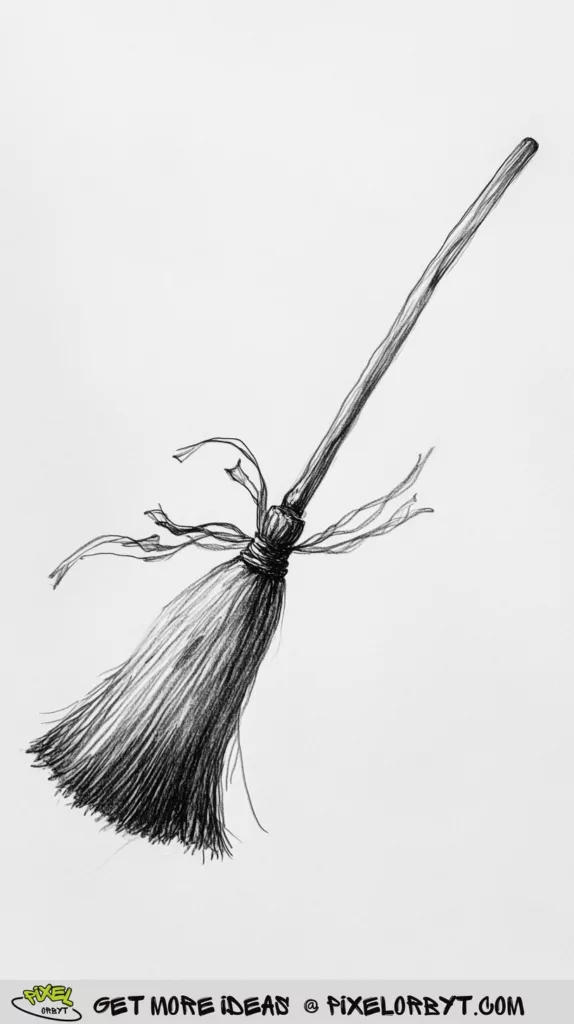
No character, no background — a diagonal handle and a spray of bristles. Draw the twigs in three tones: dark at the bound throat, mid grey through the body, near-white flyaway strands at the tip. That drop stops bristles turning into a flat grey blob.
3. Ron and the chess king

Two hands wrapped around a small object, plus a plaid shirt. The plaid is the lesson: the check bends across the chest and shrinks into the shoulder seam. Evenly spaced squares kill it instantly — the same trap covered in drawing fabric texture.
4. An owl mid-delivery, wings spread

The wings sit at different angles, so the feather rows on the far wing compress while the near ones stay open. Lay in the three feather groups as bands before drawing a single feather — the core problem in bird sketching ideas too.
5. Hogwarts dissolving into ink

Crisp towers up top, everything below the cliff smeared into a black cloud. Keep the architecture tight, then attack the lower half with a smudge stick. The contrast between the two halves is the effect — blur it all and you get mud.
6. A potion bottle with something alive inside

A rounded flask, a cork, a flame curling behind the glass. Glass is drawn by what happens on it and through it: a hard white highlight on the shoulder, a compressed reflection along the base, the flame bent where the curve distorts it.
7. Hermione reading, cross-legged

Almost all line, barely any shading, and it still holds up. The head tips forward and the shoulders round over the book — that curve is the whole gesture. Sit her upright and she stops reading and starts posing.
8. The broom that has started growing again

Same subject as idea 2 with one narrative change: sprigs of new growth pushing out of the binding. Details like that turn an object study into a picture for about five minutes of extra work.
9. The castle with one small figure beneath it

The castle sits in fine grey detail; the figure is a solid black silhouette a couple of centimetres tall. Scale does the storytelling. Get the towers converging first — the eye level is low, standard two-point perspective drawing territory.
10. A chin-raised portrait looking up

Tilting the head back moves the ear up, hides the eyebrows behind the brow ridge, and exposes the underside of the jaw and nose. Beginner portraits fail here by drawing features on a flat grid. Curve the guidelines with the skull.
11. The straight-on portrait

Dead-front views punish asymmetry — one eye a millimetre high and the face looks wrong. Draw both eyes as a pair, checking the gap between them against the eye width, before committing to detail. Same discipline as any of these portrait drawing ideas.
12. Reading in profile, standing

Standing changes everything from idea 7: weight shifts to one leg, that hip lifts, the shoulders counter-tilt. Hip and shoulder lines separate — that separation stops a figure looking like a plank. Pair it with female character sketches.
13. The owl coming straight at you

Head-on flight, the yellow eyes the only colour on the page. The far wing foreshortens hard while the near one stays full width, and the head holds level whatever the wings do. One spot of colour on a grey drawing is a cheap, effective trick.
14. The Marauder’s Map with footprints

Fine-liner work: a castle in elevation sitting on a plan-view map, torn parchment edges, bare footprints walking off the sheet. Draw the torn edge as a ragged outline with a thin cast shadow beneath, so the paper reads as an object rather than a shape.
15. A cracked map with a cliff-top castle

Cross-hatched mountains, a compass rose, footprints fading as they move down the page. Press hard on the first print and barely touch the paper by the last — the fade is what makes the trail read as time passing.
16. Ron looking down at the piece

Much darker than idea 3 — deep graphite in the sweater, the face half in shadow, the chess piece holding the only clean highlight. Build that depth in soft-pencil layers instead of grinding one hard pencil into the paper.
17. A full-body duelling stance

Feet wide, weight low, coat trailing behind the movement, loose smoke scribbles filling the space. Draw the line of action from the back foot up through the wand arm, then hang the body on it — the method used in these action pose breakdowns.
18. An empty bottle as a five-minute warm-up

Construction lines still showing, a blank label waiting for a name. This is the one to do before the hard ones: symmetry off a centre line, an ellipse at the neck and another at the base, five minutes, then thrown away.
Getting Better Results From These References
- Work bigger than feels comfortable — thumbnail-sized faces hide proportion errors until you scan them.
- Start every figure with the gesture line, not the outline.
- Use two pencils minimum: an HB for construction, a 4B or 6B for the darks. One pencil pushed hard gives shiny grey, never black — charcoal drawing techniques go darker still.
- Squint at the reference until the detail drops away and only the big shapes are left.
Frequently Asked Questions
Which of these is easiest to start with?
The empty bottle (idea 18) and the plain broomstick (idea 2). Both are single objects with clean silhouettes, so you can focus on symmetry, ellipses and a simple tonal range without a face judging you from the page.
How do I draw the glasses without making the face look flat?
Draw the head and eyes fully first, then wrap the frames over them. The lenses are two ellipses at slightly different angles because the face is curved, and the arm of the frame disappears behind the temple rather than stopping at the edge of the head.
What pencils suit these drawings?
An HB, a 2B and a 6B cover every reference here. Add a kneaded eraser for lifting highlights out of hair and glass, and a blending stump for smoke and mist only — not for skin.
Can I post fan art of these characters online?
Sharing personal fan art is common practice, but these characters are protected intellectual property, so selling prints or commissions of them is a different matter legally. If you plan to sell, build the portfolio from original characters and keep studies like these as practice.
Pick three rather than working straight down the list — one object, one portrait, one full figure. Copy them closely first, then change the lighting or the angle and draw them again from memory.


