

43 Little Animal Sketches Ideas With Step-by-Step Tips
Small animals are the fastest way to build real drawing mileage. A rabbit is one head, two ears and a fur mass — you can finish it in twenty minutes, see exactly where you went wrong, and start again. A horse will punish you for two hours before telling you the same thing.
The 43 sketches below are grouped by subject, and each one teaches something specific: an ear that has to sit on a skull, fur that changes direction over a ribcage, a reflection that has to stay softer than the thing making it. Under each drawing is the problem it puts in front of you, and how to get past it. Work down the list, or pick the animal you keep avoiding.
For the same animals in printable form, these 40 animal coloring pages run from four-shape toddler sheets to a leopard built almost entirely from solid black rosettes.
When you want a longer session and a bigger subject, these simple animal pencil drawing ideas work through 17 sketches, each one naming the shape to block in first.
Primates take the same fur-and-proportion problems up a level, and these monkey pencil drawing ideas break 27 graphite studies down into the specific skill each one teaches.
For a full set built around a single species, these realistic deer sketches cover 22 fawn and doe studies from empty-background portraits to backlit full-body poses.
Before You Start: Three Habits That Fix Most Animal Sketches
- Block the mass before the fur. Almost every failed animal sketch is good fur drawn over a shape that was already wrong. Get the egg, the wedge and the cylinder down first, and check the silhouette before a single hair goes on.
- Eyes are spheres, not almonds. An eye that reads flat is one you drew as an outline. Shade the ball, leave one clean highlight, then darken the corner where the lid casts a shadow.
- Fur follows the form underneath. Strokes run downhill off the spine and shorten where the surface turns away. If every stroke runs the same direction, the animal looks like a rug.
For a slower warm-up first, the beginner sketching exercises cover line control and pressure work that pays off directly on fur and feather texture.
Rabbits and Bunnies (Ideas 1–6)
Rabbits are the best starting subject here. The head is a rounded wedge, the ears do the expressive work, and the fur is short enough to suggest rather than render.
1. Head-on rabbit portrait with both ears upright

Straight-on symmetry is unforgiving — one ear a few millimetres low and the whole face looks broken. Draw a vertical centre line and measure both ears against it. The ears are not flat paddles: each has a front cup and a rolled outer edge, and the cup catches light while the edge stays dark. That contrast makes the ear stand off the page.
2. The same portrait rendered softer

Draw idea 1 twice, once hard and once soft, and you learn more than from ten different animals. Here the edges break up, the whiskers are single confident flicks, and the cheek fur fades out instead of stopping. Lifting light back out of finished graphite with a kneaded eraser gives a fluffier edge than leaving white paper.
3. Rabbit standing upright with a carrot

The moment a rabbit sits up, its weight shifts onto the haunches and the body becomes a pear. Get that pear right and the pose reads instantly. The carrot does a second job: it is the only colour on the page, so it pulls the eye to the paws. Keep those tidy — toes gripping, not floating beside the carrot.
4. Rabbit sitting, carrot lifted to the mouth

Same subject, different beat: the head tilts down toward the food and one ear swings back, which breaks the symmetry of idea 1 and makes the animal look alive. Watch the overlap where the carrot passes in front of the chest — that little bit of occlusion is what stops the carrot from looking pasted on.
5. Baby rabbit in grass, seen from the side

Babies have bigger heads, shorter ears and rounder skulls — push those proportions or you draw a small adult. The grass is the real exercise: a few dark blades in front of the body, most of them light behind it. Depth is a value problem, not a detail problem. The baby animal sketches collection breaks these proportion shifts down across 18 species.
6. Baby rabbit facing you in a grass patch

This is the simplest drawing on the page and a good one to finish a session on. The body is almost a circle. Nearly all the character comes from where you place the eye — set it slightly wide and low on the skull and the rabbit reads as young; move it up and in and it starts looking like a rodent.
Birds: Parrots, Owls and Songbirds (Ideas 7–13)
Birds are geometry wrapped in feathers: a teardrop body, a ball head, two folded arms. Find those first and the plumage becomes decoration. For wings, tails and beak angles, the bird sketching ideas post covers structure species by species.
7. Parrot on a chain swing, long tail hanging

The swing is the hard part, not the bird. The chains must hang genuinely vertical and parallel, and the perch sits in perspective as a short cylinder, not a rectangle. Draw the chains as repeating figure-eight links, lighter toward the top. The tail is one long taper that anchors the composition — commit to it in a single stroke.
8. The same parrot with a tighter grip and a turned head

Feet are where most bird drawings fall apart. A parrot has two toes forward and two back, and they genuinely wrap around the bar — you should see toe tips curling over the front edge. Draw the perch bar first, then wrap the foot onto it, never the other way round.
9. Parrot on a rope swing, facing forward
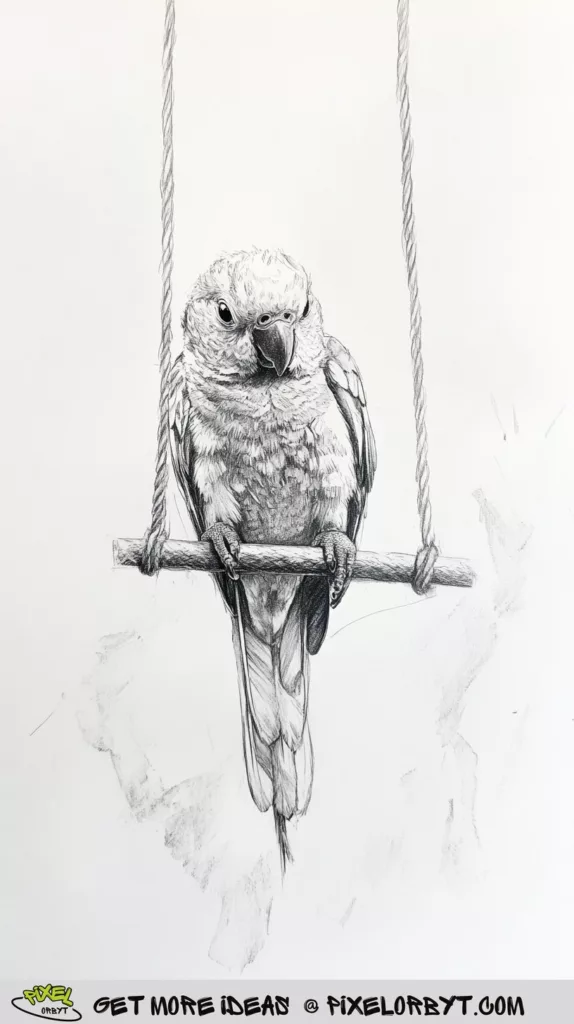
Head-on birds are hard: the beak foreshortens to almost nothing and the chest becomes the widest shape on the page. Layer chest feathers in overlapping rows like roof tiles, each shorter than the one below, lighter down the centre. Rope instead of chain also changes the texture job — twisted diagonal strands rather than hard oval links.
10. Screech owl on a bare branch

The highest-contrast drawing here and the most rewarding to render. Owl plumage is spots and bars, and those markings wrap the body — compressing and curving at the edges of the chest. Draw the pattern following the form, not flat on top of it. The facial disc is a shallow dish, so shade it as one, darkest where it meets the beak.
11. Owl among leaves and twigs
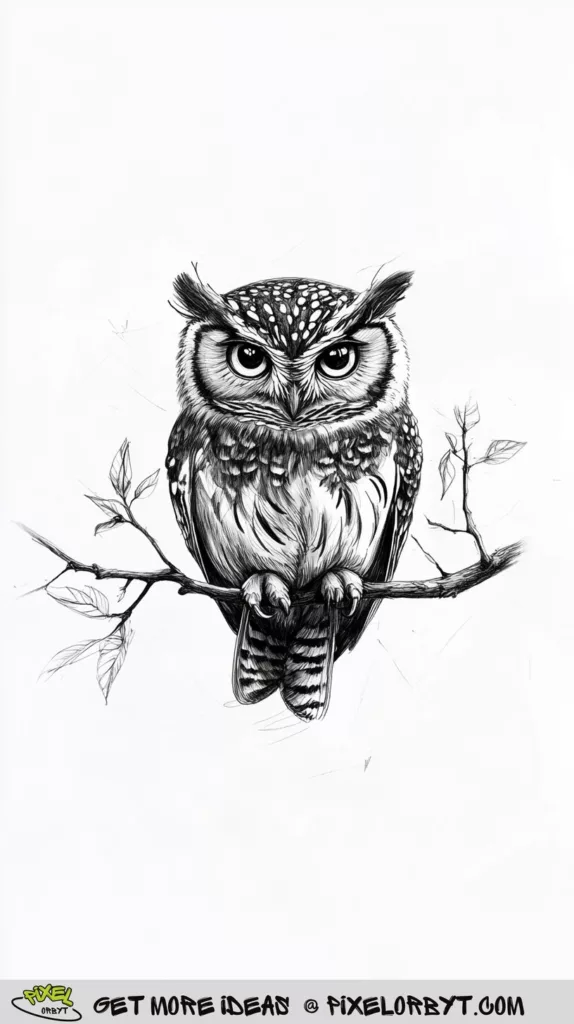
Here the background competes with the subject. The fix is a value gap: keep the leaves in a narrow mid-grey range and reserve your darkest darks and cleanest whites for the owl. If everything on the page is rendered equally hard, nothing reads as the focal point.
12. Loose-line owl sketch

Every set of finished renderings needs one drawing like this. Fifteen minutes, no shading, just shapes and gesture. Working loose shows you which lines actually carry the animal — usually the brow ridge, the wing edge and the toes. The rest was ornament.
13. Small songbird on a diagonal branch

A diagonal perch does something a horizontal one cannot: it puts the bird in an implied wind or a moment of landing. Note that the bird stays vertical while the branch tilts — the toes take up the difference. Get that relationship wrong and the bird looks like it is sliding off.
Water Animals: Fish and Ducklings (Ideas 14–18)
Water is the subject in all five of these. You are not really drawing a fish; you are drawing what glass and water do to a fish.
14. Small fish in a glass teacup

Glass is drawn almost entirely with what you leave out: two thin lines for the rim, one bright unbroken highlight down the side, a darker band where the curve turns away, a soft cast shadow beneath. Then the crucial bit — where the fish sits behind the glass its edges distort and soften. That distortion is the whole illusion.
15. Goldfish in a round bowl
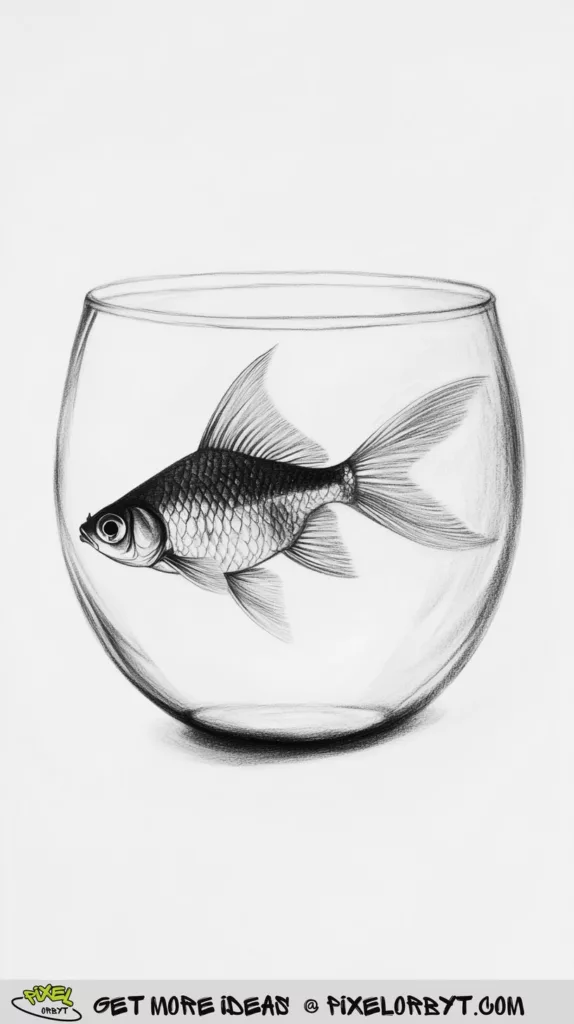
Fins are translucent — your lightest values on the page, with ray lines showing through as fine parallel strokes. The body is the opposite: solid, scales tightening toward the tail. The bowl below the waterline is darker than above it, and that single value change says “water” better than any ripple.
16. Duckling standing in shallow water

Duckling down is not fur and not feathers — it is a fuzzy halo with no hard outline anywhere. Draw the body edge as a broken, feathery line and let short strokes escape past it. The reeds behind should stay ghostly; if they are as dark as the duckling, the bird stops sitting in front of them.
17. Duckling at the water’s edge with reeds

The reflection rule that fixes most water drawings: a reflection is always softer and lower in contrast than the object it mirrors, and it starts exactly where the feet meet the surface, not somewhere below. Smudge it slightly with a stump and pull a few horizontal breaks through it.
18. Duckling with a full mirrored reflection

This one commits fully to the reflection, so it is the best of the three for practising. The ripple breaks are horizontal lines of clean paper cutting through the reflected shape — they interrupt it rather than blur it. Interruption reads as water; uniform blur just reads as a smudge.
Reptiles and Amphibians (Ideas 19–26)
Scales, shells and wet skin are three different surface problems, and this group has all of them. None of these animals have fur to hide behind, so the structure has to be right.
19. Lizard on a rock with its head raised

A lizard’s spine is one S-curve from nose to tail tip, and the tail is usually longer than the body — measure it, because everyone draws it short. The rock is the technical half: hard angular facets, each a flat value, darkest in the crevices. Rock and lizard should not be shaded the same way.
20. Lizard lying flat on a boulder

Basking flattens the animal against the surface, so this is a lesson in contact. The belly presses down, the toes splay wide, and a tight dark shadow appears directly under the body with no gap. Any daylight between animal and rock and it floats.
21. Frog on a lily pad with a lotus flower

Frog anatomy is folded springs: the back legs stack into a tight Z and the knee sits higher than the body. Draw those legs first. Wet skin means small high-contrast highlights on the knuckles, brow ridges and back sitting on a mid-grey body — not an overall shine.
22. Frog on a lily pad, three-quarter view

The lily pad is a flat disc in perspective, which means it is an ellipse, and beginners almost always draw it too round. Squash it. The radiating veins should follow that same ellipse, tightening as they approach the far edge — that convergence is what lays the pad flat on the water.
23. Turtle walking with its legs out

A shell is a dome and the scutes are tiles wrapping over it, so they narrow and compress toward the edges. Draw the dome, sketch the curved grid onto it, then detail. Draw the tiles flat and no amount of shading rescues it.
24. Tortoise pulling its head into its shell

The best drawing in this group, because it is about what is hidden. The head retreats into a dark opening, so the value inside has to be your deepest black — the face reads because it emerges from that. The neck skin bunches into concentric folds as it withdraws; draw those folds and the retreat becomes a movement rather than a pose.
25. Turtle in profile, mid-stride

From the side you finally see the marginal scutes — the flared rim around the bottom of the shell — and the way the plastron runs flat underneath. That rim is what separates a turtle drawing from a rock with legs.
26. Hatchling turtle, small on the page

Deliberately leave this one small with a lot of empty paper around it. Scale is communicated by negative space, not by detail. It also forces you to make every mark count, since at this size a heavy line is a third of a leg.
Woodland Animals (Ideas 27–33)
Thick fur, big tails, cautious body language. If this group is your favourite, the full woodland creature sketches set carries the theme further.
27. Chipmunk peering out of a knot hole

The framing does the storytelling here. Everything outside the hole is rough bark texture; everything inside is near-black; the animal sits on the boundary with its paws hooked over the edge. Keep the bark cracks radiating away from the opening — they lead the eye inward like arrows.
28. Squirrel holding an acorn, facing you

The tail is bigger than the squirrel and that is the point — sketch it as a broad backlit curve first, then sit the body in front of it. Fur direction changes at the shoulder: down the chest, then sweeping out along the tail to the tips. The small hands cupping the acorn need to be tidy; sloppy paws sink an otherwise good squirrel.
29. Squirrel with a pinecone, three-quarter view

Turning the body slightly is a real difficulty jump: now one shoulder is closer to you and the chest foreshortens. Check it with a quick centre line down the body. The pinecone is a bonus texture study — overlapping scales arranged in a spiral, which is the same wrapping logic as the turtle shell in idea 23.
30. Spotted fawn standing on long legs

Fawn legs are proportionally longer than an adult deer’s and unnervingly thin — draw them thinner than feels right. The spots give it away: irregular, clustered along the spine, shrinking and distorting as the body curves away. Evenly spaced spots kill the form instantly. For adult proportions and antlers, the realistic deer pencil drawings walk through the skeleton.
31. Fawn grazing in tall grass

Head down changes everything: the neck stretches into a long curve, the shoulder blade rises above the spine line, and the ears rotate forward. Grass crosses in front of the lower legs, which saves you from drawing hooves and simultaneously plants the animal in the scene. That is an efficient trade.
32. Fox face emerging from the grasses

A fox skull is a narrow wedge — far narrower than a dog’s — and the ears are triangular with deep fur-lined cups. The grass in front of the face is a partial mask, and letting a few blades cross the muzzle is what makes the animal feel hidden rather than posed. Push the darkest values into the ear cups and around the nose.
33. Fox head in a wreath of leaves

This shifts register from wildlife study to illustration: the fox is rendered realistically while the foliage stays flat and decorative, and the contrast is the design. Keep the wreath’s line weight even and lighter than the face so it frames without competing — good practice if you like the zentangle animal drawing approach.
Farm and Field Animals (Ideas 34–37)
Bigger bodies, more weight, and two genuine action poses — the hardest drawings on this page.
34. Baby goat walking toward you

Walking straight at the viewer means severe foreshortening: front legs short and stacked, chest wide, hindquarters nearly gone. Resist lengthening the legs into something that “looks right” — measure against head height and trust it. Ears sticking straight out sideways are what makes this a kid rather than an adult.
35. Baby goat mid-leap

A leap is a single curved line of action from nose to tail, and everything hangs off it. Draw that line first as one stroke. The tucked front legs fold tight to the chest, the hind legs trail, and no hoof touches the ground — that gap under the body is what sells the airtime. Grass blurred beneath adds speed for almost no effort.
36. Baby elephant spraying water straight up

Elephant skin is the exercise: deep wrinkles following the form, bunching at every joint and stretching flat across the ribs. Vary their depth or the animal turns into a walnut. The spray is scattered dots getting sparser and lighter as they rise, and the trunk is a tapering cylinder ringed with wrinkles all the way down.
37. Baby elephant with an arcing spray, side view

The side view lets you get the proportions honest: a calf’s head is huge relative to its body, the legs are stumpy columns, and the back has a distinct dip behind the shoulders. The spray arcs rather than rising straight, which is a small physics detail that makes the drawing believable. Keep the droplets finest at the far end of the arc.
Pets: Dogs, Mice and Kittens (Ideas 38–43)
Familiar subjects cut both ways — everyone knows what a cat looks like, so mistakes show instantly. If pets are your main interest, the playful pet sketch ideas and the more detailed dog sketching ideas go breed by breed.
38. Dog standing square with its tongue out

A full standing body is the real test on this page. Four legs must land on the same ground plane — sketch that line before the dog, or one leg ends up floating. On a short coat the shoulder blade, ribs and hip point show through the skin, so shade those landmarks and the anatomy does the work for you.
39. Kitten standing on its back legs, batting at a string

Balance is the problem: the kitten is stretched vertical with its weight over the back feet, so the spine curves and the tail counterweights it. Draw the string as one continuous light line and let the paw interrupt it — that interruption is what makes contact read. The yarn ball on the floor gives you scale and a second, softer texture.
40. Striped kitten leaping at a ball of yarn

Tabby stripes are the lesson. They run perpendicular to the spine, bend around the ribcage, and compress on the far side of the body. Draw the body, map the stripe bands lightly over it, then darken — laying stripes on flat is the most common way this one goes wrong. The trailing thread tells you which way the ball is swinging.
41. Mouse holding a wedge of cheese

Mouse ears are enormous, thin and translucent — push them larger than instinct says and keep them lighter than the head so they read as membrane. The cheese is a hard-edged geometric solid against a soft furry animal, and that contrast is why the composition works. Its holes are ellipses, not circles, with a shaded inner wall.
42. Mouse standing with cheese, tail curled

The tail is the composition. Long, thin, tapering to a hair, and curving out to balance the body — a straight stiff tail makes the animal look dead. Draw it in one confident sweep and go back to taper it, rather than feeling your way along in short strokes.
43. Mouse biting into the cheese

The action version: the head tilts in, the shoulders round forward, and the cheese now overlaps the muzzle. That overlap is the whole difference between “holding” and “eating”. Finish on this one — it is small, contained, and it rewards a clean bite line more than an hour of extra shading.
Frequently Asked Questions
Which of these should a complete beginner draw first?
Idea 6, the front-on baby rabbit in grass — the body is close to a circle, the ears are short, and there is almost no perspective to solve. Then idea 12, the loose owl, so you learn to see shapes before rendering them. Save the standing dog (38) and the walking goat (34) for later; both need full-body proportion and a believable ground plane.
How do I stop animal fur from looking like scribbles?
Two changes fix it almost every time. Shade the underlying form in smooth mid-greys before drawing a single hair, so the fur has something to sit on. Then draw fur in short overlapping clumps that follow the body’s curve rather than as evenly spaced individual hairs — real fur groups itself. Lift a few highlights back out with a kneaded eraser.
What pencils do these sketches need?
An HB for construction lines, a 2B for the bulk of the fur and mid-tones, and a 6B or 8B for the small pockets of true black — the shell opening in idea 24, the ear cups in idea 32, the eyes everywhere. A kneaded eraser matters more than an extra pencil grade. A blending stump is useful for reflections and skin, but keep it away from fur.
Should I copy these exactly or change them?
Copy them exactly the first time — that is how you find out what you cannot yet do. On the second pass change one variable: flip the pose, drop the background, move the light source. That second version is where the learning lands. Several here are already offered in pairs for exactly that reason: ideas 1 and 2, 34 and 35, 41 and 43.
Where to Take This Next
The quickest way to improve here is not to draw all 43 once. Pick five, draw each three times over a week, and watch the third attempt arrive in half the time with twice the confidence. Once small animals feel comfortable, step the rendering up with realistic animal pencil drawing techniques, or keep sessions short and playful with easy cute animal drawing ideas. Either way the sketchbook fills up, and that is the part that matters.


