

15 Living Room Wall Art Ideas for Every Style
Wall art is the fastest way to change how a living room feels, and the easiest thing to get wrong. Too small and it floats. Too busy against a busy wall and it cancels itself out. Get scale and colour right and even a cheap print looks deliberate.
Below are 15 ideas, each shown in a finished room so you can see how the piece works against the furniture beneath it, with a note on why it holds together — the colour it borrows, the shape it repeats, the mistake it sidesteps.
Painting the piece yourself is usually cheaper than buying one, and the muted misty-mountain canvas in these canvas painting ideas is the kind of quiet, low-contrast work that lives well above a sofa.
If you want something with more surface interest than a poster, a signed edition by one of these contemporary printmakers costs less than most framed reproductions and carries visible ink texture that reads across a room.
1. An Oversized Colour-Block Collage Above the Sofa

This print repeats the sofa’s orange, then adds three colours the room does not already own — teal, magenta, deep navy. That is the trick with a busy abstract: borrow one colour from your largest piece of furniture and let everything else be new. The shapes are not flat either — several carry dots, hatching or scratched texture, which stops a collage this loud reading as clip art. The wide mat and chunky white frame hold it back from the pale wall. The same layered-shape approach shows up in plenty of amazing canvas painting ideas, and you can rehearse the composition on paper first with a few abstract sketching ideas before committing to canvas.
2. A Bauhaus-Style Geometric Print for a Concrete Wall

Half-circles, hard rectangles, one arc. It works on grey concrete because the shapes read from across the room and the palette stops at five flat colours. Note how the burnt-orange armchair sits directly under the orange block — that vertical alignment is what makes the corner feel composed rather than accidental. Geometric work is the easiest style to hand-paint: mask every edge with painter’s tape, burnish it down with a fingernail, and pull it while the acrylic is still tacky. Once it cures, the tape lifts the edge with it.
3. A Full-Width Geometric Grid Over a Statement Sofa

A red velvet sofa is already a statement, so the art above it has to be big enough to hold its own. This canvas spans about two-thirds of the sofa width — that is the ratio to aim for. The grid mixes squares with two circles, and the green circle sitting off-centre is the release valve; without it the composition would be too tidy. The crimson block at top left is a different red from the sofa, close but not matched — two reds a shade apart look intentional, two that almost match look like a failed attempt. Sketch grid layouts small first; it saves a lot of paint.
4. A Minimalist Abstract Landscape in Flat Bands

Four flat bands of colour and nothing else. Read it as hills at dusk and it is a landscape; read it as shapes and it stays abstract. That ambiguity suits a living room — it never demands attention but always rewards a second look. The curve of each band is the whole drawing, so it has to be confident: one sweep, not a line corrected three times. The thin black frame gives a low-contrast image a crisp edge against white. It pairs naturally with more literal landscape painting ideas if you want a set that shifts from abstract to representational.
5. Barely-There Neutral Shapes for a Quiet Room

A soft rectangle, a terracotta circle, a smaller grey circle, and a lot of empty paper. Minimal art has nowhere to hide — placement carries the whole image, and the negative space has to read as intentional rather than unfinished. The shapes sit high and left of centre, which is why the emptiness looks like a decision. What sells it is the terracotta, picked up exactly by the cushion below. Hang a piece this quiet lower than you think so it stays tied to the sofa.
6. A Single Continuous Line-Art Face

One unbroken line describes a brow, a closed eye, a nose and full lips, then runs back up to close the jaw. The difficulty is not the drawing — it is committing to the line and not lifting the pen when a proportion goes wrong. Draw it four times and keep the version where the mouth and jaw landed naturally. Keep the weight even throughout — a stroke that thickens halfway betrays a pause. A paint marker holds that consistency better than a brush, which is why line work turns up so often in Posca pen art ideas as well as in most aesthetic drawing ideas.
7. A Bold Folk-Style Floral Painting

Flat poppies with black centres, stems that lean rather than stand straight, and a cream ground left deliberately dirty. Folk florals forgive imperfect drawing — the charm lives in the wonky stems, so resist straightening them. The blooms cluster tighter at the bottom than the top, and that is what gives the bunch its upward lift. The rust cushions echo the flower heads without matching them, and that near-miss is more interesting than an exact match. To build up to a painting this size, start with easy flower drawings for beginners and scale the shapes up.
8. Matisse-Style Cut-Out Botanicals
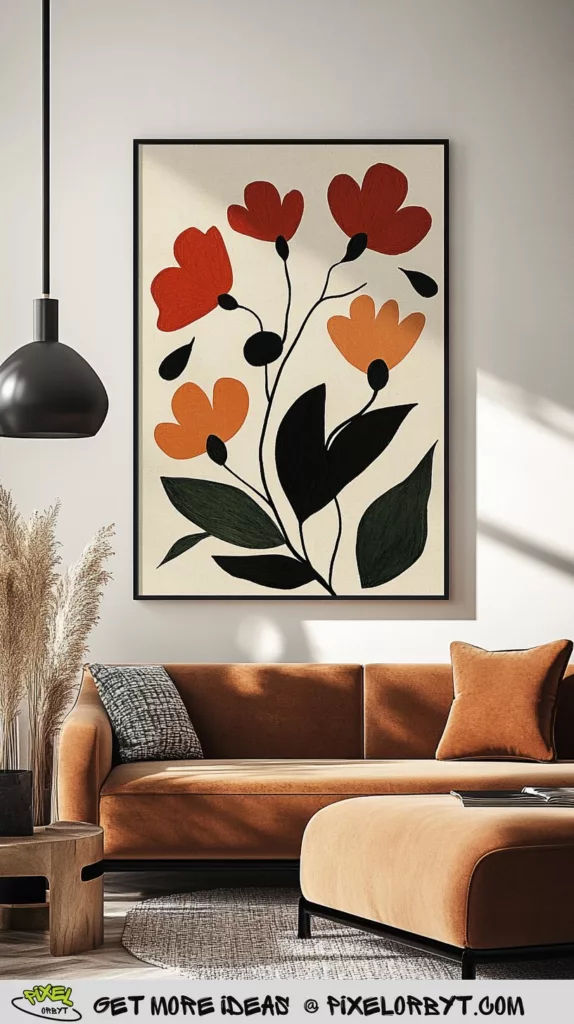
Four blooms on thin stems, a few oversized black leaves, plenty of cream. The black leaves make it work — they anchor the soft orange and red so the image does not float away, and they are larger than the flowers, a reversal that makes the design feel designed. Cut-out style means thinking in silhouettes rather than outlines, so build it with scissors and coloured paper before you touch paint. Note the hard shadow raking the wall: big flat shapes handle direct afternoon sun far better than detailed work does.
9. A Cosmic Canvas for a Dark, Dramatic Wall

Dark walls swallow most artwork. The answer is not a brighter frame but a piece with its own internal light — here a spray of magenta, gold and turquoise behaving like a nebula against near-black. The bright core sits off-centre and fades outward, giving the canvas a focal point instead of an even scatter of dots. It is frameless and edge-wrapped, the right call on a dark wall, since a frame cuts a hard line exactly where you want the image to dissolve. Pouring, splattering and a flicked toothbrush get you most of the way without drawing anything.
10. Marbled Blue and Gold Flow Painting

Layered ribbons of cobalt, teal and gold move diagonally rather than sitting still. Matching art this closely to a royal blue sofa is risky, but it works because the painting shifts value constantly — near-black in the troughs, bright gold at the crest — so wall and furniture never flatten into one blue mass. The gold sits in the top third rather than spread evenly, which keeps it reading as light on water instead of glitter. Fluid effects are far easier in wet media, which is where watercolour painting ideas for beginners pays off.
11. A Deep Crimson Textured Abstract

Crimson over black, scraped back so the underlayer shows, with ghostly flower stamps pressed into the surface. Texture does the heavy lifting — up close you see scrape marks and printed blooms, from the doorway a single glowing red field. The stamped flowers cluster low and thin out towards the top, so the eye has somewhere to travel. Let each layer dry before scraping or the colours turn to mud, and pull an old bank card across the surface rather than a palette knife — the flat edge skips instead of digging in.
12. A Black-and-White City Skyline Photograph

Everything so far has been about colour. This is restraint: a long horizon, a low skyline pushed to the right, a wide mat and a heavy black frame on raw plaster. Monochrome photography is the safest choice when walls and furniture already carry texture, since it adds a subject without adding a colour to manage. The mat is unusually wide, and that generosity is what makes an ordinary photograph look like a print. Shoot your own city at dusk and you already own the picture.
13. A Photographic Floral Still Life
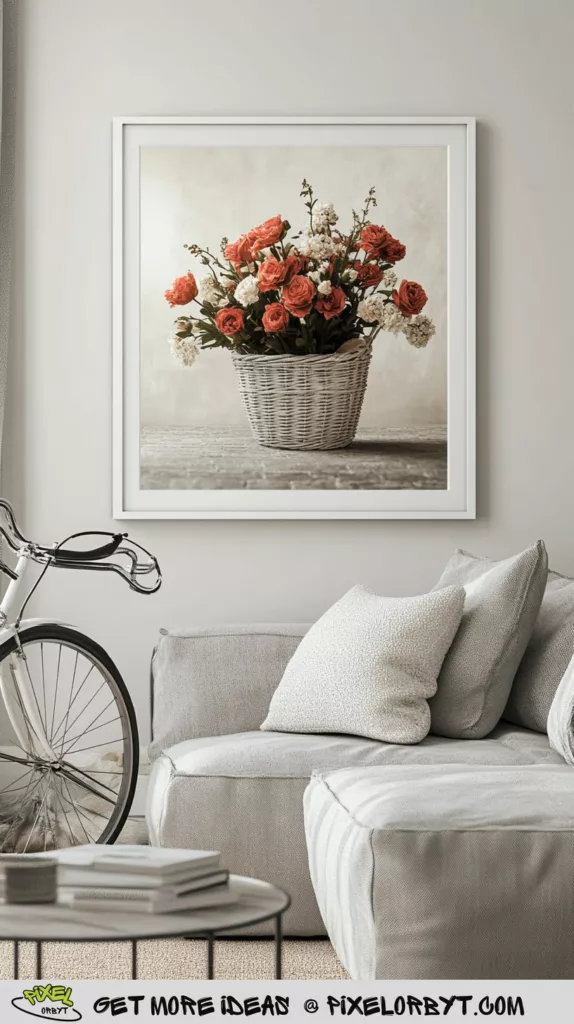
Coral roses and cream stock spilling from a woven basket, shot against a washed-out background so nothing competes with the flowers. Still life sits between painting and snapshot: the arrangement of a painting, the detail of a lens. Light comes from one side and falls off gently, so the basket weave reads without the image going harsh. The white frame and generous mat keep it light in an already pale room. Build the same arrangement in front of you and it becomes a ready-made subject for nature sketch ideas.
14. A Vintage Bicycle Painting for a Soft Neutral Room

A cream bicycle with two wicker baskets of blossom, painted loosely so the spokes are suggested rather than counted. Loose brushwork is the point — tighten it and the piece becomes an illustration and loses its warmth. The wheels are the only shapes that must be right — drawn as true ellipses rather than circles, they are what stops the bike looking flat. The real flowers on the table repeat the artwork’s palette, a cheap and reversible way to tie any picture into a room, and it sits well beside handmade touches like crochet room decor.
15. A Botanical Triptych in Matching Black Frames

Three drawings hung as one piece. The rules for a triptych are strict: identical frames, identical mats, an even gap of two to three inches so the eye reads them as a single band. Vary the plant but keep the line weight identical — a rose, a sprig of blossom and a leafy stem, all drawn with the same fine pen and sitting at the same height inside their mats. This is the easiest gallery wall to pull off, because you are not balancing different sizes. To extend it, hang small square canvases underneath at the same spacing; a few of these mini canvas painting ideas will grow the arrangement without upsetting the grid.
How to Size and Hang Wall Art Correctly
Most wall art problems are measurement problems, not taste problems. Before you buy, work through these:
- Width: the artwork, or the whole arrangement, should span two-thirds to three-quarters of the furniture below it. Narrower and it looks stranded.
- Height: centre the piece 57 to 60 inches from the floor, leaving 6 to 10 inches between the sofa back and the frame so the two read as one group.
- Gaps: keep gallery-wall spacing consistent at 2 to 3 inches. Uneven gaps are the most common reason a wall looks messy.
- Colour: borrow one colour from the room, introduce at least one that is new. Matching everything flattens the space.
- Light: direct sun fades pigment. Bold flat shapes survive a sunny wall; fine pencil work and photographs do not.
- Test first: cut newspaper to the finished size and tape it up for a day before you drill. Scale reads differently on a wall than in a listing photo.
Frequently Asked Questions
What size wall art should go above a three-seater sofa?
A standard three-seater is around 84 inches wide, so aim for a single piece 56 to 63 inches across, or a group spanning that range. One large canvas is easier to get right than three medium ones, since a group has to be spaced and levelled as well as sized.
Can I mix abstract and figurative art on the same wall?
Yes, provided one element is shared across every piece — usually frame colour or mat width. A cut-out botanical and a monochrome photograph sit together happily in matching black frames. Mixing subject, frame and palette all at once is what makes a wall look unplanned.
What should I hang on a dark-painted wall?
Choose art with light inside the image rather than around it: a galaxy canvas, a metallic pour, anything with bright pigment on a dark ground. Frameless edge-wrapped canvases beat framed prints here, since a frame draws a hard boundary where you want the image to blend out.
How high should art hang if the ceilings are low?
Keep the 57-to-60-inch centre line, but choose a piece taller than it is wide and hang it closer to the sofa back, around 6 inches. A vertical shape draws the eye up and makes an eight-foot ceiling feel higher; a wide horizontal piece in the same spot does the opposite.
Is it cheaper to paint my own living room wall art?
Usually, and large abstract work is the most forgiving place to start — flat shapes, limited palette, no drawing accuracy needed. A stretched canvas, three tubes of acrylic and a roll of painter’s tape will get you a convincing geometric piece, and the canvas painting ideas for beginners here are all built from shapes rather than detail.
Pick the two or three ideas above that already share a colour with something you own, measure the wall, then choose the art. That order is what separates a living room that looks styled from one that looks decorated by accident.


