

27 Moon Coloring Pages: Cartoon Faces to Lunar Landscapes
Twenty-seven moon coloring pages, all free to print, and they are nowhere near as similar as the subject suggests. A few are chunky cartoon faces with lines thick enough for a three-year-old and a fat crayon. Others are stippled lunar surfaces with sixty craters on them that will eat an hour of your evening in the best way.

Sorting them first saves you a wasted print. Scroll for what you actually want: cartoon moon faces (pages 9, 10, 18 and 26), realistic lunar surfaces (3, 16 and 19), scenes with a person or an animal in them (1, 2, 7, 8, 20 and 21), stained glass and pattern work (4, 11, 12 and 15), night landscapes (6, 17, 22, 23, 24, 25 and 27), and two Halloween bat pages (13 and 14).
For a crescent moon with something underneath it, a few of the unicorn coloring pages set their star fields and moons behind a full figure.
Several of the moon-and-cloud scenes in our cartoon star character color pages pair a crescent with a small seated figure, if you want the two motifs together.
27 Moon Coloring Pages to Print and Color
1. Boy on a Hilltop Beneath a Full Moon

A small boy stands on a grassy ridge with his arms at his sides, looking up at a cratered moon that sits high and far away. Two thirds of this page is empty sky, and that emptiness is the whole point of the drawing.
Resist filling it in flat. Grade the sky darker at the top and let it fade as it comes down to the horizon line, and the boy stays small the way the artist intended.
2. Close-Up of a Boy Watching the Moon Rise

Same idea, opposite framing. The boy is drawn in profile on a sloped hillside, chin tipped back and hair spiking up, and the moon has dropped low and huge into the top right corner with its craters sketched in thin loops.
Keep the moon lighter in value than the sky behind it. If the sky and the moon end up the same weight, the moon stops glowing and turns into a circle.
3. Detailed Moon Surface with a Shadowed Edge

This is a straight close-up of the moon with no scenery at all. The left half is bright and pitted with dozens of overlapping craters; the right falls away into dense hatching. That dividing line is the terminator, the edge where lunar day becomes night.
The mistake here is treating the two halves as separate zones. Work it as one continuous gradient across the whole sphere, which is exactly the kind of pressure control covered in our colored pencil technique tips.
4. Patterned Crescent Moon with Swirling Clouds

A crescent packed with looping filigree, scattered outlined stars, and ribbons of curling cloud rolling along the bottom edge. Nothing on this page is realistic and it is better for it.
Treat the swirls inside the crescent like a small mandala: choose two or three colors and repeat them in a set order rather than picking a new shade for every loop. Repetition is what makes decorative work look designed instead of busy.
5. Floral Moon Face Inside a Flower Wreath

A serene moon face with closed eyes, long lashes and a soft smile, ringed by a thick wreath of daisies, blossoms and leaves. The petals carry far more line detail than the face does.
Follow that hierarchy with color. Keep the face pale and barely tinted, then push all your saturation into the wreath. If you enjoy this one, the same botanical density runs through our flower coloring pages.
6. Lunar Valley with Jagged Peaks

A rocky alien valley of jagged spires and scattered boulders, with a small cratered moon hanging in the upper left of a star-flecked sky. There is no atmosphere in this scene, so shadows can go hard and black.
Darken the ground as it comes toward the viewer and keep the far peaks pale. That single move gives you depth for free, and it works on every one of our landscape coloring pages too.
7. Boy and Cat on a Rooftop
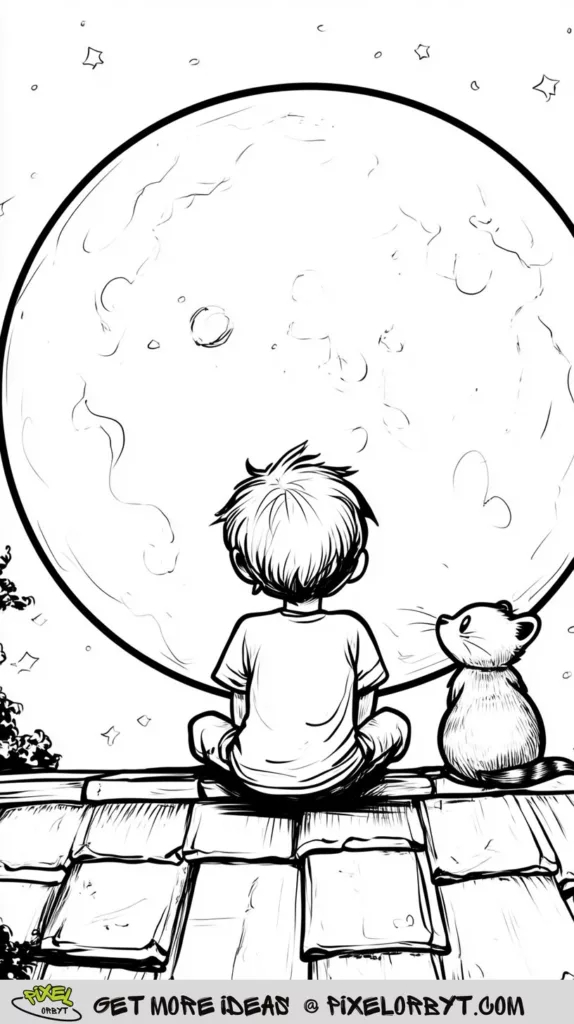
Seen from behind, a boy sits cross-legged on roof tiles with a whiskered cat perched beside him, both facing an enormous moon that fills the upper half of the page. The sky is left open and white.
The roof tiles are the only repeating texture here, so vary them. Shift three or four closely related tones tile by tile instead of laying down one flat color, and the roof reads as clay rather than cardboard.
8. Boy and Raccoon Under a Black Star Sky

The same rooftop pair, but the sky is printed solid black with white stars punched through it and the moon glows as a bright white disc. A raccoon with a ringed tail has taken the cat’s place.
Almost no coloring decisions are left in the sky, which is the appeal. All your attention goes to the tiles, the raccoon’s banded tail and the boy’s shirt, and the contrast is handed to you already built.
9. Cartoon Moon with a Closed Smile

A round moon face with big oval eyes, blushed cheeks and a handful of soft crater shapes, drawn with lines thick enough to survive an enthusiastic crayon. This is the page for the youngest colorist in the house.
There are maybe eight shapes to fill on the whole sheet, so it finishes in a few minutes rather than dragging past a small child’s patience.
10. Grinning Cartoon Moon with Sparkles

The same family as the last one but wider awake: an open grin, bigger eyes with highlight dots, and small four-point sparkles floating around the edge of the face.
One tip that upgrades both of these pages instantly. Color the craters one shade deeper than the moon body rather than leaving them white, and the face gains a bit of roundness without any blending skill at all.
11. Stained Glass Crescent in a Black Sky

A crescent built from mosaic shards sits against a solid black panel scattered with white stars, with a field of larger tiles below and a heavy rectangular border framing the whole thing.
Stained glass only works if neighbouring shards differ in value. Two similar mid-tones side by side erase the leading between them and the mosaic goes flat. Our zentangle coloring page covers the same discipline in more detail.
12. Stained Glass Crescent Cradling a Star Disc

Here the crescent wraps around a full circle packed with small five-point stars, and the whole panel sits inside a mosaic frame studded with more stars. It is the most intricate of the two glass designs.
Limit yourself to four colors and rotate them through the shards in a fixed order. A restricted palette is what separates a stained glass window from a bag of confetti.
13. Full Moon, Cloud Bank and Three Bats

A clean full moon partly veiled by soft clouds, a fat bank of cloud rolling underneath, and three solid black bats flapping across the top of the sky. Big shapes, few lines, quick to finish.
This is the page to reach for in October. It sits comfortably alongside our witch coloring pages if you are building a Halloween printing session for a classroom.
14. Bats Crossing the Face of the Moon

Six bats drawn in outline rather than silhouette fly straight across the moon’s disc, with a billowing cloud bank piled up at the lower right. Because the bats are open shapes, you have a real choice to make.
Fill them solid black for a classic spooky read, or color them in browns and leave the wing membranes lighter so they look like actual animals. Both work; committing to one is what matters.
15. Textured Crescent Around a Black Night Field

A stippled, grainy crescent curves around a solid black field dotted with white stars and a few large sparkles. The moon itself carries all the texture; the sky carries all the darkness.
Only the crescent takes color, so slow down on it. Build the shading with dots rather than strokes and the granular surface of the print stays visible instead of being buried under pigment.
16. Realistic Full Moon Filling the Page

The moon fills the entire frame, drawn with fine circular hatching and dozens of crater rings of every size. There is no background, no sky and nowhere to hide.
Pick a light source before you start and stick to it. Every crater rim gets a bright edge on the same side and a shadow directly opposite. Inconsistent crater lighting is the single thing that makes a moon drawing look wrong.
17. Moon Over a Rocky Canyon

Tall rock spires rise on both sides of a boulder-filled canyon floor, and a finely cratered moon sits in a sky flecked with hundreds of tiny stars. This one takes a while and rewards it.
Aerial perspective is the trick: distant rock goes lighter and cooler, nearby rock goes darker and warmer. The star field can stay untouched white.
18. Smiling Cartoon Moon with Clouds

A simple happy moon with a wide smile, a few crater dents and two small clouds tucked against its edges. Somewhere between the toddler pages and the detailed ones in difficulty.
The clouds are the only place to practise anything here, so try a soft gradient on them: heavier color along the bottom curve, almost nothing along the top.
19. Detailed Moon Face with Lashes and Freckles

A hybrid page, and one of the nicest on the list. The face has long lashes, freckles across the nose and a half smile, but the surface around it is stippled and pocked with realistic craters.
Two people can share this one. A younger colorist works the eyes and mouth in bold color while an older one grinds through the stippled surface, and the styles do not fight each other.
20. Girl in a Winter Coat Watching the Moon Through Pines

A girl in a hooded coat and boots stands on a snowy path with tall firs crowding in from both sides, looking up at a moon framed in the gap between them. The trees are drawn with dense feathered needles.
This scene is nearly monochrome by nature. Give her coat one warm accent color and keep everything else in cool greys and blues, and the eye goes straight to her.
21. Butterflies in Front of a Giant Moon

A large moth-winged butterfly with patterned, tapering wings sits dead centre over a giant moon disc, with three smaller butterflies and a scatter of outlined stars around it.
The wings have symmetrical markings, so mirror your colors left to right rather than improvising each side. Our butterfly coloring pages has more of these wing patterns if you want the practice.
22. Full Moon Above a Boulder in the Water

A cratered moon hangs in a pale sky above a big fractured boulder rising out of rippling water, with a couple of wisp clouds and small stars nearby. Quiet, and much simpler than it first looks.
The water lines are the real subject. Leave narrow white gaps in the ripples directly beneath the moon so a reflection appears without you drawing one.
23. Moonlit Lake Under a Dense Star Field

The sky is a solid black stipple that thins as it drops toward the horizon, with a bright cratered moon above rolling hills and a pine treeline, and a wide lake ruled with long reflection lines below.
The gradient is already printed for you, so match it in the water: darker at the far shore, lighter as the ripples come forward. It is the same layered approach we use across our nature coloring pages.
24. Mountains and a Still Lake Under Stars

A mountain range sits across a glassy lake, a small cratered moon floats in the upper left, and pine branches hang into the top two corners. The sky is dusted with hundreds of tiny stars and circles.
The lake is a mirror, so whatever value you give a peak, give its reflection the same hue one step lighter. Reflections that are darker than the object above them always look wrong.
25. Tall Ship Under a Giant Moon

The most demanding page here. A three-masted sailing ship lies close to a rocky shore, backed by an enormous moon rendered with heavy surface detail, against a black star-filled sky with a small eclipsed disc in the top corner.
Start with the sails. Get them as the lightest value on the page, then work everything else darker around them, and the ship will separate from that huge moon instead of dissolving into it.
26. Chubby Moon Character Sitting on Clouds

A round, fuzzy moon creature with stubby arms and legs and a huge open grin sits on a bank of clouds, with sketched rays radiating out behind it. The fur texture is drawn as fine hatching all over its body.
Colour lightly here. Press too hard and you lose the hatching that makes it look fuzzy, which is the entire charm of the character.
27. Moon Through the Forest Canopy
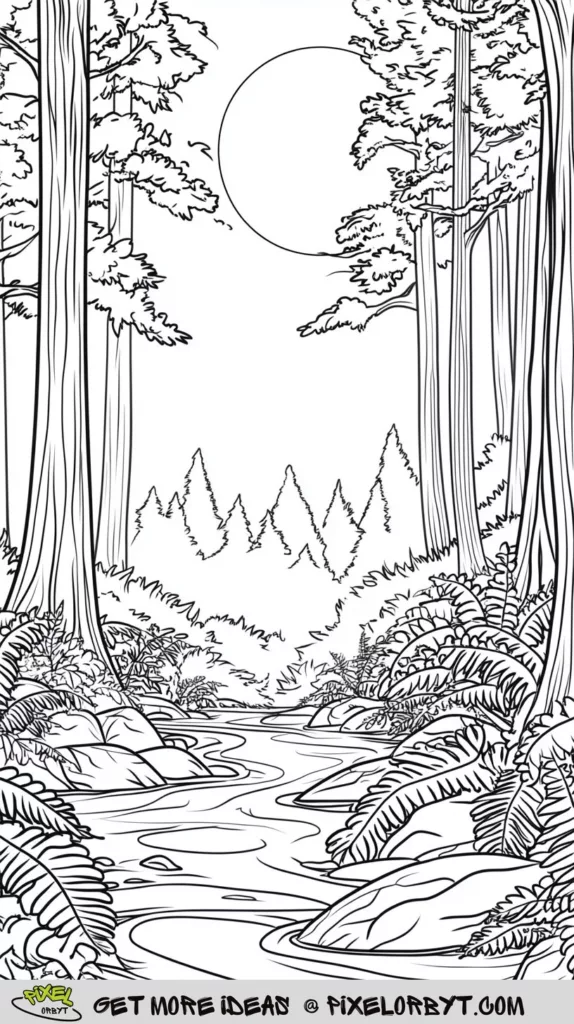
Tall smooth trunks frame a stream running out of the foreground, ferns crowd the banks, small conifers sit in the middle distance, and a pale moon disc shows through a break in the branches at the upper left.
Keep the moon almost untouched. It is the brightest thing in a busy green scene, and leaving the paper bare is a legitimate coloring decision.
How to Color a Moon So It Still Looks Like a Moon
The moon is a sphere lit from one side, and almost every flat-looking moon drawing comes from forgetting that. Four habits fix it.
- Pick a light source and never move it. Every crater rim gets a highlight on the same side and a shadow on the opposite side. Do this consistently on page 16 and the surface pops into three dimensions.
- Let the edges go darker. A sphere turns away from you at its rim, so the outer edge should be a touch deeper than the centre. Even a faint darkening around the circumference reads as roundness.
- Skip grey. The moon is not grey, it is pale cream, faint blue, dull ochre. Layering two or three of those beats a single grey pencil every time.
- Leave paper bare. The brightest spot on any moon should be untouched white paper, not white pencil over color. This is why page 27 works.
For the night skies, the temptation is to reach for black. Deep indigo or violet almost always looks better, and it lets the moon stay the lightest thing on the page rather than competing with a wall of ink.
Printing Tips
- Print on 120 gsm paper or heavier if you are using markers. Standard 80 gsm copy paper will let alcohol markers bleed straight through onto the table.
- Set your printer to Actual Size rather than Fit to Page. Fit to Page shaves a few millimetres off the border, which matters on the stained glass designs where the frame runs to the edge.
- For the black-sky pages (8, 11 and 15), check your printer is not in draft mode. Draft prints those solid fields as stripes.
- Print two copies of any page you plan to color with a child. Racing each other on the same design is more fun than watching, and it saves the negotiation over who gets it.
Frequently Asked Questions
Which of these moon coloring pages suit a three or four year old?
Pages 9, 10, 18 and 26. All four are large simple shapes with thick outlines that tolerate crayon going outside the lines, and each finishes in five or ten minutes. Skip the stippled and stained glass designs at that age; the shard sizes are smaller than a crayon tip.
How do I stop markers from making the detailed pages look muddy?
Work light to dark and let each layer dry properly before adding the next. On a heavily hatched page like 3 or 16, the printed lines already supply most of the darkness, so a single mid-tone pass over them is usually enough. Colored pencils are the safer choice for anything with dense crater detail.
Can I color the moon a color other than white or grey?
Yes, and the fantasy pages invite it. A pink or teal moon looks entirely at home on the patterned crescent (page 4), the floral face (page 5) or either of the stained glass panels. Save the realistic creams and blues for pages 3, 16 and 24 where the drawing is aiming at accuracy.
Are these printable moon coloring pages free to use in a classroom?
Print as many copies as you need for your own class or family. They work well as a follow-on to a lesson on lunar phases, since pages 3 and 15 show the terminator line that creates the phases in the first place.
Start with whichever one you scrolled back up to look at twice. That instinct is usually right, and the other twenty-six will still be here tomorrow.


