

10 Simple Drawing Tutorials for Kids (Step by Step)
Every tutorial below starts from something a child can already make: a letter, a number, two circles, four X marks. That first mark fixes the drawing’s size and position, so nobody faces a blank sheet or guesses at proportions. Disclaimer: Pixel Orbyt does not own the images shared in this post. They were shared on the Facebook page, Sharing Ideas.
Keep guide marks light so they rub out cleanly, and save the coloured pencils until the outline is done.
For a longer list to work through afterwards, these easy drawing ideas for kids of all ages are grouped by age band from toddler to teen.
1. How to Draw a Dove


No oval to start. Four X marks in a loose square fix where the head, chest and both wingtips land — that is what stops one wing coming out longer than the other.
- Step 1: Mark four light Xs in a square, a hand’s width apart.
- Step 2: Draw the head and chest curve between the top two Xs.
- Step 3: Run the back and tail toward the lower right X.
- Step 4: Sweep each wing out until its tip reaches an X.
- Step 5: Scallop the outer wing and tail edges for feathers.
- Step 6: Erase the Xs, add the eye and a triangular beak.
Press the blue pencil hard only under the wings and along the belly, leaving the middle white; that contrast is what reads as a dove. More wing shapes in our bird sketching ideas.
2. How to Draw SpongeBob


Face first, body around it. Draw the square first and kids squeeze the eyes in too high; starting with the eyes fixes the scale.
- Step 1: Two big overlapping circles, dark pupils, short lashes.
- Step 2: Rounded nose below them, wide smile, two square teeth.
- Step 3: Draw a square around the face with a wobbly, bitten edge.
- Step 4: Scatter oval holes, some touching the edge so they break the outline.
- Step 5: Add collar, tie, belt line and square pants.
- Step 6: Finish with noodle arms, straight legs and heavy black shoes.
The wavy outline is the part kids rush; it only reads as a sponge if the edge stays uneven all the way round. More faces in our cartoon character drawing ideas.
3. How to Draw a Unicorn


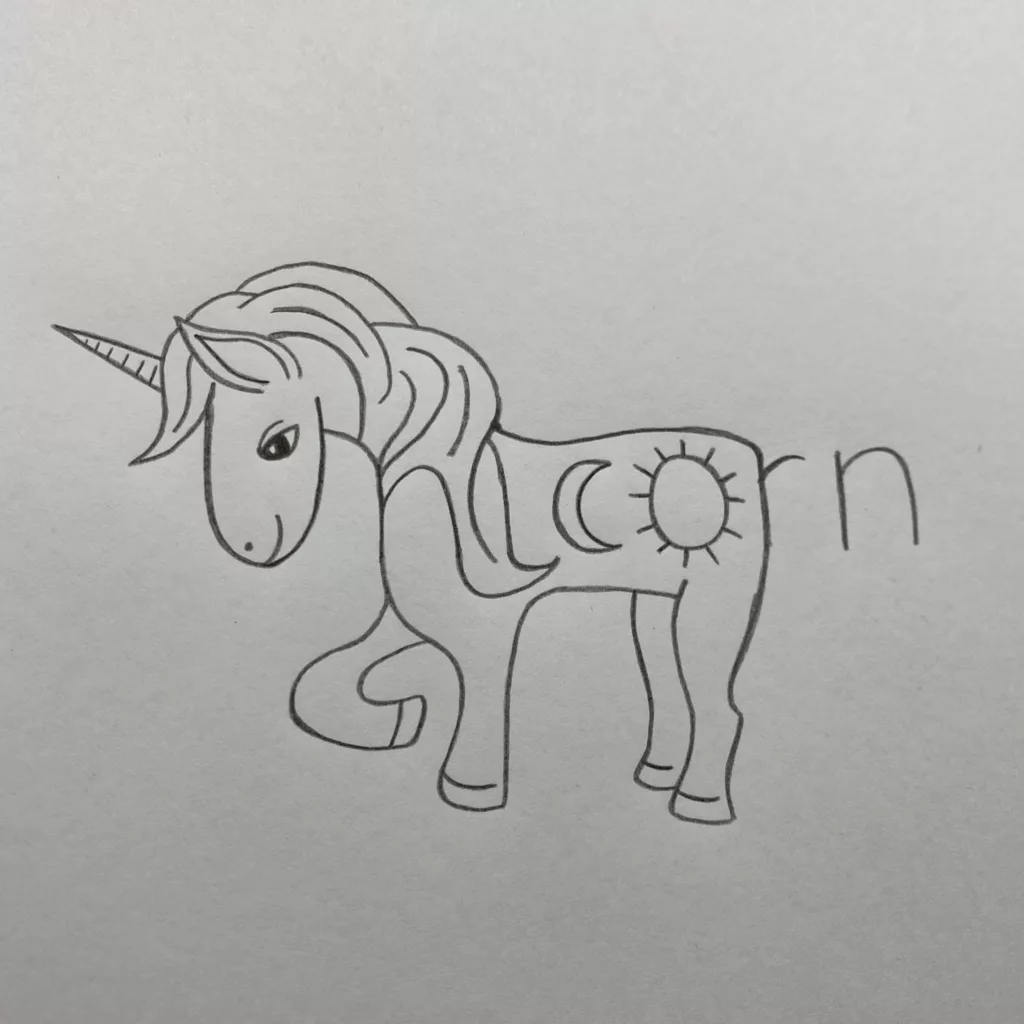

Write the word, then turn it into the animal: the U becomes the head, the first n the chest and front leg, the middle letters the back, the last n the tail. A child who says they cannot draw will still write a word.
- Step 1: Write Unicorn in large, well-spaced block letters.
- Step 2: Round the U into a head and muzzle; add horn and forelock.
- Step 3: Pull the first n down into the chest and a bent front leg.
- Step 4: Add the eye, nostril and a mane in long wavy strands.
- Step 5: Use the middle letters as the back, the last as hind legs.
- Step 6: Turn the final n into a tail and erase leftover letter strokes.
Draw the horn as a cone with a line wrapping round it, not a triangle — the spiral sells it. Printable unicorn coloring pages make a good follow-up.
4. How to Draw a Flower
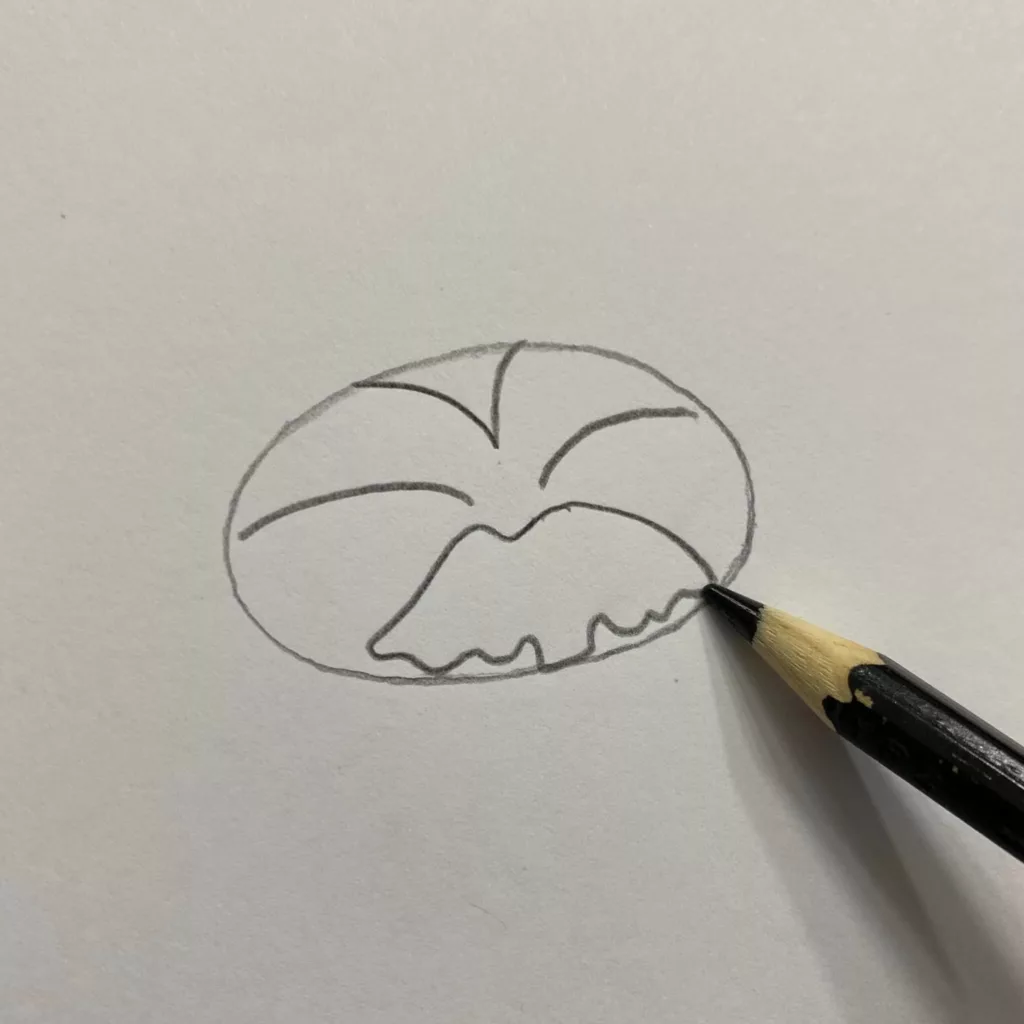


This is a hibiscus, and the ruffle is what separates it from a daisy. Splitting a faint circle into five wedges spaces the petals before any are outlined — no more four fat petals and one squeezed in at the end.
- Step 1: Draw a faint circle and split it into five wedges.
- Step 2: Outline each petal along its wedge with a frilled outer edge.
- Step 3: Draw a long stamen from the centre, fringed with dots.
- Step 4: Tilt it onto a stem and add a closed bud beside it.
- Step 5: Add a serrated leaf, then rub out the guide circle.
- Step 6: Colour the petals red, pressing harder near the centre.
Thin dark lines radiating outward along the folds turn a flat red shape into a petal. More blooms at this pace in our easy flower drawings for beginners.
5. How to Draw a Fish


Eyes first again. Because the circles overlap, one in front of the other, the fish turns toward you instead of lying flat on the page.
- Step 1: Draw two overlapping circles, one slightly larger.
- Step 2: Fill a big pupil in each, leaving a white highlight dot.
- Step 3: Loop a wide oval body around and behind the eyes.
- Step 4: Add a tiny open mouth low down and a rounded side fin.
- Step 5: Draw the tail as two soft lobes, plus a top fin.
- Step 6: Add eyebrows above the eyes for expression.
Front half yellow, back half orange so the body looks round, and leave the eye highlights uncoloured — those dots do most of the work.
6. How to Draw a Rabbit


The rabbit starts as the number 22 — left 2 into the haunches, right 2 into the front leg and chest. Same thinking as our easy drawing tutorial for kids, which builds ten animals from numbers.
- Step 1: Write two large 2s side by side with a gap.
- Step 2: Draw a big oval head on top of the right hand 2.
- Step 3: Add two long ears leaning apart, not parallel.
- Step 4: Close the left 2 into a round rump with a curve over the top.
- Step 5: Join head to body; add a front paw and a back foot.
- Step 6: Add the eye, a small nose and a smile.
Trace the outline in pale blue rather than grey; it keeps the edge soft. More long ears in these bunny coloring pages.
7. How to Draw a Butterfly


Drawn from the side, so the symmetry problem that wrecks most kids’ butterflies never comes up at all.
- Step 1: Small circle head, segmented body angled down to the right.
- Step 2: Add two antennae curling into tight spirals.
- Step 3: Draw a few short legs under the head.
- Step 4: Sweep the upper wing back from the shoulder in one scalloped curve.
- Step 5: Add a shorter, rounder lower wing overlapping the body.
- Step 6: Divide each wing into long sections radiating from the body.
Every division line must point back to where the wing meets the body, or it looks like a leaf. Yellow inside, blue band outside, pink dots. For more detail, these butterfly sketching ideas.
8. How to Draw a Little Lion


One closed shape with a haircut. The mane is a second jagged outline sitting outside the head, which is why the face still reads instead of vanishing into the fur.
- Step 1: Draw a rounded head, wider than it is tall.
- Step 2: Break the top edge with three or four pointed tufts.
- Step 3: Ring the head with a jagged mane, spikes short and uneven.
- Step 4: Add two small rounded ears at the sides.
- Step 5: Eyes as two upward curves, black nose, w-shaped mouth.
- Step 6: Add a short sitting body with paws and toe lines.
Closed curved eyes are easier than open ones and read friendlier. More simplified animals in our easy cute animal drawing ideas.
9. How to Draw a Kitten


Head wide and low, body a rounded hump behind it. Keeping the head near the ground is what makes it a kitten crouching rather than a cat standing.
- Step 1: Draw a wide, flattened head with two pointed ears, one notched.
- Step 2: Large black eyes with a white sliver each, tiny nose and mouth.
- Step 3: Three long whiskers sweeping down each side.
- Step 4: Tuck one front paw beside the face.
- Step 5: Curve a rounded body up behind the head, ending in a back foot.
- Step 6: Lift the tail straight up and band it with stripes.
The upright striped tail balances the low head; without it the drawing sits too low on the page. More to copy in our cat drawing ideas.
10. How to Draw a Hippopotamus


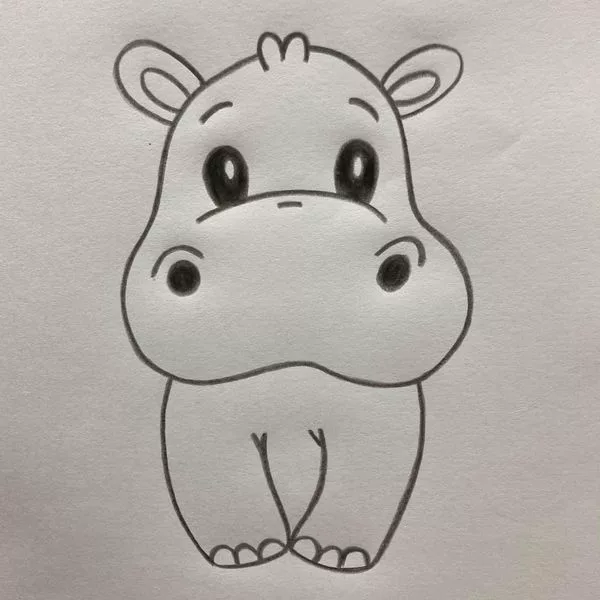

One unbroken pear-shaped outline, narrow on top and heavy at the base, holds the head and muzzle together. Everything after it is detail, which makes this the simplest tutorial here.
- Step 1: Draw one continuous pear shape, narrow on top, wide at the base.
- Step 2: Add two small tufts on top and an oval ear each side.
- Step 3: Curve a line across the lower third to split muzzle from face.
- Step 4: Add two large black eyes above that line, close together.
- Step 5: Put two nostrils and a soft smile on the muzzle.
- Step 6: Add a small sitting body, stubby legs, three toes per foot.
Eyes above the muzzle line and set close together is what makes it a baby hippo. Pale blue-grey, pink ears, yellow toes.
Getting the Most Out of These Tutorials
- Say it before they start: guide marks go on lightly, or the Xs and letters will not erase.
- Finish the outline before colouring. Colouring halfway through is how drawings get abandoned.
- Do the same one twice. The second attempt is visibly better, which is what brings a child back.
- Let uneven lines stay. SpongeBob’s wobbly edge and the lion’s jagged mane are meant to be irregular.
For more structure afterwards, the easy step-by-step art projects break each subject into four clear panels.
Frequently Asked Questions
What age are these tutorials suitable for?
Around five and up. The hippo, fish and lion are the most forgiving, built from one or two rounded shapes. The hibiscus and unicorn need steadier control and suit eight and above, though a younger child manages if an adult draws the guide circle.
Why start from letters, numbers and X marks?
Because a letter is something a child already draws confidently, and it lands on the page at the right size. The 22 sets the rabbit’s proportions before any decisions get made; the four Xs stop the dove’s wings coming out uneven. It removes the two hardest parts, placement and scale.
What supplies do we need?
An HB pencil, a decent eraser and plain paper cover every outline here. Coloured pencils beat felt tips because you can build shading gradually, which is how the dove and hibiscus get their depth.
My child gets frustrated halfway through. What helps?
Split it in two: guide marks and outline in one sitting, colour the next day. It also helps to draw alongside them on your own sheet rather than correcting theirs — children copy what they watch far more readily than what they are told.
Ten tutorials, ten starting points, none of them a blank page. If they want more, the simple step-by-step drawing tutorials by Lavi Arts use the same shape-first approach on roses and landscapes, and our sketching ideas for kids cover shorter one-session subjects. All drawings here were shared on the Sharing Ideas Facebook page.


