

21 Things to Draw on iPad (With a Reference for Each)
An iPad removes almost every excuse — no sharpening, no drying time, no wasted paper. The only thing left to decide is what to actually draw, and that is where most people stall.
Here are 21 specific subjects, each shown finished, each with a note on the one thing that makes it difficult.
21 Things to Draw on iPad
1. A Winter Forest, Half Line and Half Colour

The trick is restraint: the coral trees are painted and everything behind them stays raw outline. Deciding where to stop colouring is a composition choice, not laziness. Pick one focal band, finish it, leave the rest as line.
2. A Football Club Crest

Crests are pure curve control. The gold rings have to be genuinely concentric or the eye catches it instantly, and the crown sits on a shallower arc than most people draw. Use the symmetry guide instead of freehanding both halves.
3. A Misty Pine Forest

Everything soft here comes from low-opacity wet brushes stacked up, not from blurring. The front pines keep hard edges; the ones behind lose them completely, and that falloff is what reads as distance. More depth work in these landscape sketching ideas.
4. A Page of Bird Studies

Five birds on one canvas beats one bird done five times. Vary the action — perched, calling, wings open — so you study the skeleton instead of copying a silhouette. With corvids, the wedge of the tail tells you the angle of the whole body. More shapes in this set of bird sketching references.
5. A Familiar Logo, Drawn Loose

A logo you know by heart is the cleanest test of line confidence. Draw it in twenty overlapping strokes rather than one perfect outline — the scribble finds the shape and the eye averages it into a smooth curve.
6. A Street in One-Point Perspective

Set the vanishing point first, on its own layer, and lock it. Every ledge and roofline runs back to that one dot; the moment one drifts, the whole street tilts. The centre glows because the hatching thickens outward. For a harder version, try two-point perspective city drawing.
7. A Portrait Broken Up With Colour Blocks

You only get away with slapping yellow and white over a face if the drawing underneath is solid. Keep the blocks on a layer above, flat and fully opaque, so they read as paint rather than shading.
8. A Teddy Bear From Five Shapes

Two circles, two smaller circles, one oval — that is the whole bear. The fastest way to learn that ears sit behind the head, not on top of it.
9. A Straight-On Portrait

Front-facing is the hardest angle: both halves show, so any asymmetry is obvious. Flip the canvas horizontally every few minutes — your eye has a bias it cannot see until the image is mirrored. These portrait drawing ideas go further into likeness.
10. Someone Asleep

A sleeping face changes shape: the mouth softens, the cheek flattens against whatever it rests on, the eyelid sits lower than a normal closed eye. Draw the pressure, not just the pose.
11. Hair, Rendered Properly

Not strand by strand — in ribbons. Block the masses first, decide where the light lands, then pull single strands only along the lit edges. Ten well-placed strands beat a thousand even ones.
12. A High-Contrast Face Against Dark Hair

The hair merges into the background so the face carries all the light. Losing an edge on purpose makes a drawing look finished far faster than rendering everything evenly. Decide which edges disappear before you shade.
13. One Eye, Full Canvas

One eye at full canvas forces you to deal with what everyone skips: the thickness of the lash line, the wet reflection on the lower lid, the crease that shifts with age.
14. A Snowy Village in Colour
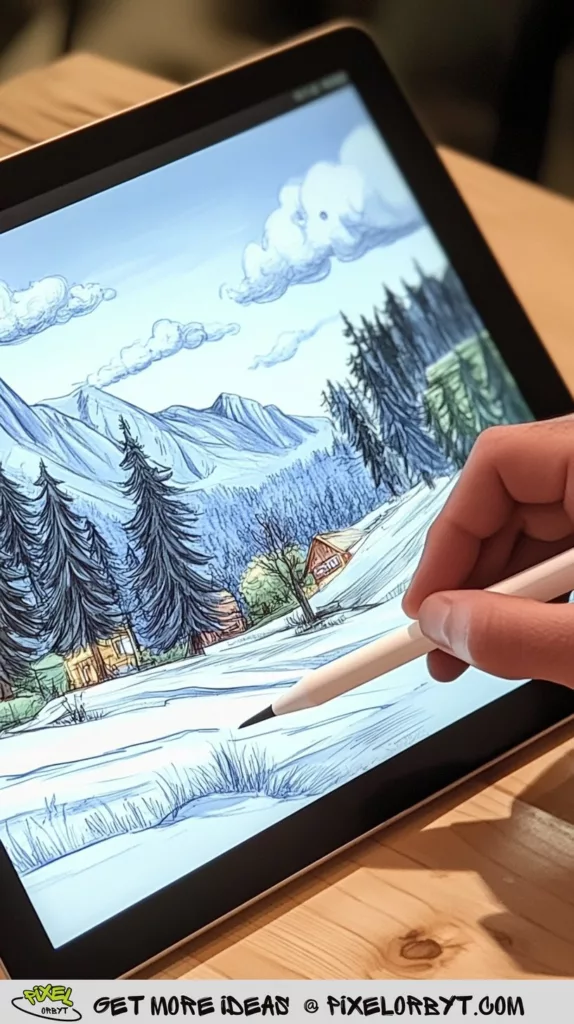
Snow is not white. Shadowed snow is blue-violet, sunlit snow is warm cream, and the two sitting side by side are what make it read as snow. The tiny yellow windows are the only warm note, which is why your eye lands there first.
15. A Single Piece of Fruit

One apple, hatched, in fifteen minutes. The lesson is the form turn — the point where the surface curves away and the hatch lines must bend with it. Straight hatching across the whole apple reads as a flat circle.
16. A Sticker Sheet

Twenty tiny icons on one canvas — cats, hearts, mittens. Each has to read at thumbnail size, which is a real design constraint and a fast lesson in simplification. Export them as PNGs and you have a sticker pack. Start with these doodle sketching ideas.
17. A Sports Car in Clean Line Art
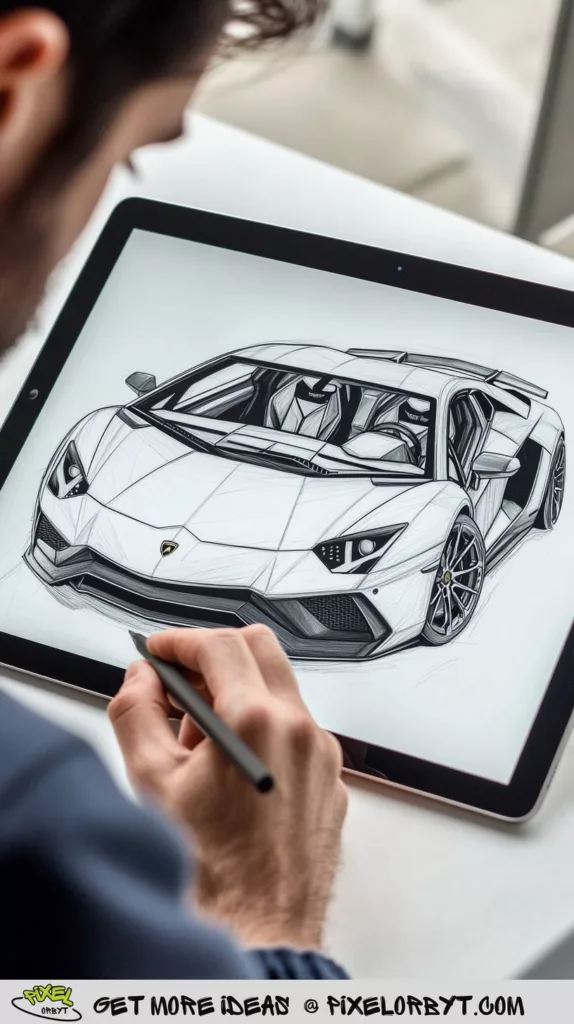
Cars punish sloppy ellipses. The wheels are circles at an angle sharing one axis — get the first right and the second is dictated by it. Draw the wheel wells before the body panels; everything hangs off them.
18. The Floor Plan of a Room You Know
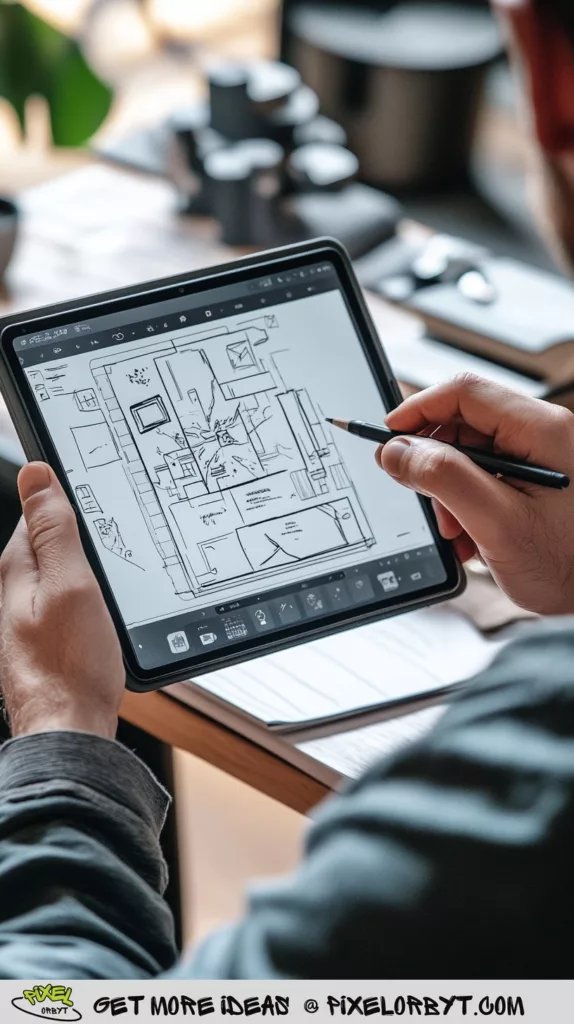
Draw your own place from memory, then measure it and see how wrong you were — everyone overestimates hallways and underestimates room widths. It trains scale the way freehand sketching never does. Pairs well with these architecture sketching ideas.
19. A Hand Supporting a Face

The hardest pose here. The hand deforms the face: the cheek compresses where the knuckles press in, the mouth pulls to one side. Leave the jaw perfectly smooth and the hand looks like it is floating rather than holding weight.
20. A Wedding Couple

Two figures sharing one silhouette. The problem is not the faces, it is the overlaps — where his shoulder meets her veil, where the bouquet cuts the dress. Solve those junctions before you commit colour. More two-figure setups in these couple sketch ideas.
21. A Pet Portrait in Paint

Fur is direction. Every stroke on this collie follows the way the coat grows — short and radial at the muzzle, long and swept back down the neck. Get direction right and even rough strokes read as fur. The warm background exists to push the black and white forward. Try more dog sketching ideas once this one clicks.
Setting Up So the Drawing Goes Faster
None of these need an expensive rig, but a few habits save real time:
- Three layers, always – rough sketch on top at 20% opacity, line art in the middle, flat colour underneath.
- Learn Alpha Lock first – it locks a layer’s transparent pixels so you can shade inside a shape without spilling over the edges. It replaces half of what masking is for.
- Multiply for shadows, Overlay for glow – those two blend modes cover most of what you need.
- Flatten as you go – a 60-layer file stutters on any iPad. Merge what is finished.
Frequently Asked Questions
Do I need an Apple Pencil, or will a cheap stylus work?
Most third-party styluses have no pressure sensitivity or tilt — no thick-to-thin taper, no shading with the side of the tip. For the hatched and pencil subjects above, that is the whole drawing. For line art and flat-colour doodles, a budget stylus is fine.
Which app should I start with?
Procreate for illustration and brushes, Adobe Fresco for live watercolour and oil, Autodesk SketchBook if you want somewhere free and uncluttered to sketch. Affinity Designer only for logos and anything that must scale — the crest in idea 2 is a vector job.
Why do my digital drawings look flat compared to my paper ones?
Usually stroke uniformity. On paper your pressure varies constantly without you thinking; on screen people hold one pressure and let the brush do the work. Turn stabilisation down, vary your speed, and stop undoing every imperfect stroke — the wobble is what makes it look drawn.
How long should one of these take?
The teddy bear and sticker sheet are 15-minute warmups. Bird studies and the apple run 30 to 45 minutes. The portraits and the pet painting take two to four hours rendered properly. Do a short one first — your line quality will show it.
Pick the number that makes you slightly nervous and start there. The subject you are avoiding is usually the one that moves your drawing forward fastest.


